The C-index is this: how close would we have to be to an identical twin Earth to detect them with our SETI searches, given our current detection technology and our (their) emissions? Many argue that we would identify zero twin Earths this way because to detect them, they'd have to be within 3 LY or so - closer than the closest star.
But this post is asking a different question: if modern archaebacteria were seeded onto Hadean prebiotic Earth (say, an iron-sulfur species like the ones that our best guesses show were the last universal common ancestor of all life on Earth) - would they run rampant and colonize the whole world, or would they collapse, relying on some pre-existing network of metabolites produced by other cells? This is relevant to the question of passive colonization of simple organisms from Earth to nearby stars over arbitrary time scales. Archaebacteria in particular are a concern for NASA in terms of contaminating other planets.
This idea has been floated multiple times, including by astronomer and writer Fred Hoyle. Here is how the process of passive colonization could work. Asteroid impacts are sometimes powerful enough to eject surface material at greater than escape velocity. This is how we have over 100 fragments of Mars on Earth right now. If this happens, some bacteria may survive the initial shock, heat, then freezing and dehydration (some bacteria can survive these conditions; and in any event it doesn't have to be many.) Some of these meteorites will escape Earth orbit. If in vacuum and cold they're stable for arbitrarily long periods, they'll just accumulate in the solar system as septic Earth-meteorites over time. Some percentage of these fragments will interact with a solar system body (e.g. Jupiter) and be accelerated to solar escape velocity (like Oamuamua was in its native system.) Some percentage of those will enter another solar system (this is likely to happen once every 15 billion years, based on calculations inspired by Oamuamua.) Some percentage of these fragments will pass through a solar system with "primitive" planets with a liquid water-CO2 atmosphere like the early Earth. Some percentage of fragments will actually strike those planets, and some percentage of bacteria will make it to the surface intact.
Of course there are many unknowns and I only cited one number. We need to know the bacterial "burden" blasted out of orbit per unit time - none of those in our lifetimes, probably not even Tunguska; the percent chance of survival; the stability over time once frozen (being in solid phase is certainly not absolute protection against radiation). The frequency of planets is roughly known, but not the frequency of terrestrial CO2-water worlds, although reasonable bounds could be placed. As to surviving re-entry, this tends to raise the most eyebrows - but it's worth repeating that roundworms on the Columbia did in fact survive uncontrolled re-entry and were found alive on the ground weeks later. Inside a large iron-silicate rock they may be even better protected.
The most uncertain part of this list of attrition factors is the last one we've now come to, the chance of the bacteria fluorishing on the new planet (lack of metal ions for enzymes, or presence of cyanide, low volcanic activity if we're relying on the iron-sulfur archaebacteria; etc.) But we can start actually filling in the values for passive ("dumb") colonization - the equation to show how fast Fred Hoyle's "lifecloud" and Arrhenius's panspermia would actually occur. Note that this is a different concept from the organic von Neumann probes that could also unintentionally seed life as a side effect, although mechanics would be the same, and we would still be looking on watery low-gravity bodies for evidence of them, like comets and asteroids.
Initially I was tempted to make a stab at setting bounds on 50% chance of colonizing another star, but many of the probabilities would be just guesses. It's clear that this is quite a list of attrition factors, reducing the chance nearly to zero for any one cell or asteroid strike on Earth to seed a future alien ecosystem. But over geologic time there have been quite a few of these strikes, and assuming vacuum-frozen surviving bacteria are stable for a long time (a relative straight-forward thing to test), then the solar system has been slowly filling up with septic asteroids - some of which no doubt have been ejected. So for the near-term, this is unlikely to produce lots of passively seeded worlds, but over arbitrary time, the universe would be accumulating archaebacteria from every place that life evolved. If we think of the Sun as a second-generation main sequence star, then planets of third generation stars are more likely to have been seeded by second-generation ecosystems - and may have more metals available in the ashes of the second generation stars from which they're built.
Other quantitative predictions: a one-third chance of life on Europa.
Showing posts with label comet. Show all posts
Showing posts with label comet. Show all posts
Sunday, February 10, 2019

Sunday, September 23, 2018
Ice Volcanoes on Ceres May Provide Replicators Means of Spreading
Extraterrestrial replicators (be they naturally-evolved, or von Neumann probes or the mutant descendants thereof) are at least as likely to be based on organic chemistry as on clanking iron-age technology, as is often imagined. Material returned from comet Wild-2 showed that it was actually an extraterrestrial comet, and had amino acids on it. Other investigations have shown the presence of nucleobases (the components of DNA and RNA.)
Even Arrhenius-style "panspermia" spread by passive diffusion on astronomical timescales is not implausible, as our Oort Cloud has mixed with close-passing stars' clouds on the order of once every 0.1 MA (and we should assume this happens to other stars as well.) However, for passively spreading replicators, higher-gravity bodies like planets or large moons are dead ends because they have no means of escaping the gravity well.

Water geysers on Enceladus, from space.com
This is why comets and wet carbonaceous asteroids are the best places to look, and why the Hayabusa-2 probe on Ryugu is so important. Same for the Dawn probe. Europa and even Enceladus may be a tough sell as passively escapable gravity wells, but now we see evidence of active water volcanoes on Ceres through its life span.
Even Arrhenius-style "panspermia" spread by passive diffusion on astronomical timescales is not implausible, as our Oort Cloud has mixed with close-passing stars' clouds on the order of once every 0.1 MA (and we should assume this happens to other stars as well.) However, for passively spreading replicators, higher-gravity bodies like planets or large moons are dead ends because they have no means of escaping the gravity well.
Water geysers on Enceladus, from space.com
This is why comets and wet carbonaceous asteroids are the best places to look, and why the Hayabusa-2 probe on Ryugu is so important. Same for the Dawn probe. Europa and even Enceladus may be a tough sell as passively escapable gravity wells, but now we see evidence of active water volcanoes on Ceres through its life span.
Saturday, June 23, 2018
Another Interstellar Asteroid - This One a Permanent Resident of the Solar System
Asteroid BZ interested astronomers right away, because it is retrograde, in a 1:-1 resonance with Jupiter - suggesting that it was captured from outside the solar system just as ours formed, and is therefore older than the rest of the solar system.
But more interesting than that, it took several unlikely events for it to be captured and continue in a stable resonance over time (see last paragraph in the Orbit section.) This very strongly suggests that there are interstellar objects passing through the solar system all the time. For such an object to be captured so quickly, so early in the history of the solar system means that there must be enough of them to get trapped by freak aligments. Another way of looking at it is that fast = likely.
This is consistent with a similar argument made about Oamuamua, an interstellar asteroid that is currently passing rapidly through the solar system. Within a year of the first telescope that could detect such an object being activated, it found such an object. Good luck? Or constant interstellar material passing through? (It didn't take long to find BZ either, once we started looking.) The relevant point is that while the vast distance between stars is often cited as a form of quarantine for macroscale beings like us, it is certainly not such a quarantine, even on brief geological time scales, between pools of organic molecules. More here about periodic close passes between stars and interstellar mixing here and here, and (most speculatively) that if von Neumann probes exist, they are likely to interact with comets and asteroids with organics, rather than planets.
But more interesting than that, it took several unlikely events for it to be captured and continue in a stable resonance over time (see last paragraph in the Orbit section.) This very strongly suggests that there are interstellar objects passing through the solar system all the time. For such an object to be captured so quickly, so early in the history of the solar system means that there must be enough of them to get trapped by freak aligments. Another way of looking at it is that fast = likely.
This is consistent with a similar argument made about Oamuamua, an interstellar asteroid that is currently passing rapidly through the solar system. Within a year of the first telescope that could detect such an object being activated, it found such an object. Good luck? Or constant interstellar material passing through? (It didn't take long to find BZ either, once we started looking.) The relevant point is that while the vast distance between stars is often cited as a form of quarantine for macroscale beings like us, it is certainly not such a quarantine, even on brief geological time scales, between pools of organic molecules. More here about periodic close passes between stars and interstellar mixing here and here, and (most speculatively) that if von Neumann probes exist, they are likely to interact with comets and asteroids with organics, rather than planets.
Sunday, October 29, 2017
First Interstellar Asteroid? It's Interstellar, But Not the First We've Seen
Information here and here. Based on the velocity and path, this asteroid originated from outside the solar system. This is a great additional finding, but not actually news! Comet Wild-2 was the subject of the Stardust sample return mission, and analysis showed more than a few interesting things: that it contained the amino acid glycine, and that the nitrogen isotope ratio showed that the object likedly originated from a different solar system.
A point of interest here is that since the solar system's origin, there must have been multiple close passes by other stars - close enough that our respect Oort clouds would mix at the margins, and material would be exchanged between star systems. We have now verified this logical inference visually, and through direct chemical evidence.
Previous post about alien evolution, Life's Origins at Four Billion Years Ago; Implications For Our Future
A point of interest here is that since the solar system's origin, there must have been multiple close passes by other stars - close enough that our respect Oort clouds would mix at the margins, and material would be exchanged between star systems. We have now verified this logical inference visually, and through direct chemical evidence.
Previous post about alien evolution, Life's Origins at Four Billion Years Ago; Implications For Our Future
Sunday, December 29, 2013
Prebiotic Source of Nucleobases Found in Comets and Molecular Clouds
Formamide. It's been found in warm star-forming regions in about the same abundances as on some comets. Here's the possible synthetic pathway.

Star-forming region LH 95. Image credit NASA.
Star-forming region LH 95. Image credit NASA.
Sunday, November 3, 2013
Comet ISON Is More Weird Than Disappointing
No, you can't really see it as brightly as everyone thought (not yet - but wait until perihelion) but it has some very unusual characteristics. Isn't it obvious? We're all doomed! Where's Derek Wildstar when you need him?
Monday, April 15, 2013
A Moore's Law Argument for Panspermia
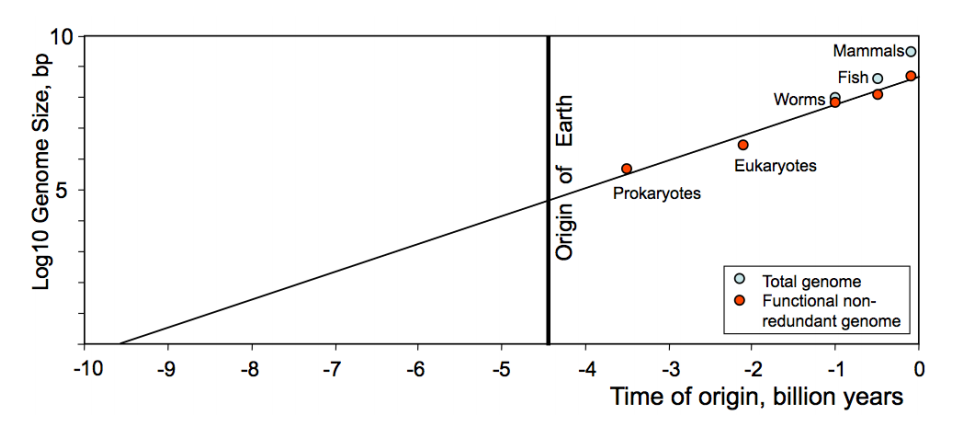
From Sharov and Gordon's paper Life Before Earth at arXiv. The implication is clear from the figure - that life has followed a logarithmic complexity trajectory, which is cooler to refer to in terms of Moore's law, but that at 4.5 GA ago (the formation of Earth from the stellar accretion disc) the complexity is not 0. Their figure crosses that line at a complexity of about 10^4.5, meaning a 30,000 bp genome. For reference, the smallest chemical replicators in nature are viroids (RNA that reproduces in plants), mostly around 2,000 bases, although hepatitis D is a virus essentially parasitic on other viruses with a similar genome size. The smallest replicators with independent metabolism are the Mycoplasma (a medically important genus discovered by Leonard Hayflick), generally under a million bp. Your genome is about 3 billion base pairs.
The first question we should ask here is what we even mean when we say "genome size", and why we care (which the authors do somewhat address). There is a difference between absolute number of base pairs in each cell, non-repetitive DNA (information), and functional complexity. If you want to talk about plain old absolute number of base pairs by mass in the cell, then plants win that one hands down, because they sometimes have many many copies of each chromosome - 20 or more. Modern corn has 6. Fine then; you want to talk about non-repetitive DNA, i.e. the Kolmogorov complexity of genomes? If you want to make a compressed file of a genome, some organisms have long stretches of repeats that can be compressed by saying "[repeat] x a million"; I don't think that complexity is what we're talking about either. (For the record, humans have more non-coding repeat DNA than coding DNA. Coding is about 3% of our genome, and just the most common type of repeat, the Alu element, is 5%.) Even taking that into consideration, yes, vertebrates have bigger non-repeating genomes than most other organisms, but among the vertebrates, non-repeating genome size and behavioral complexity do not correlate. Unless you're willing to concede that fish are smarter than you, because they have bigger non-repeating genomes. (I'm not willing to concede that.)
I think what we're really talking about here is functional complexity - the phenotype that the DNA produces in extension - and the best approximation of this is the number of genes. The authors of this paper refer to functional non-redundant genome, and even then - are you ready? - by this measure, protozoans win. Yes, amoebas and giardia. The kicker is that Trichomonas, which causes an STD, holds the record for the most genes of any organism yet sequenced. (I debated including a picture of its effects but I decided against it. You're welcome.) So it's time to retire your vertebrate chauvinism, or at least find another justification for it, because you're not that complex. For more on this, see the C-value paradox.*

All hail Trichomonas, our genomic superior. This is the one that infects humans; another one in the same genus infected T. rex.
That said, functional non-redundant genome size may still not be a totally awful indicator of genome complexity over geological epochs, but there are still further issues worth pointing out: they assume a constant trend and argue for it based on several other provincial (terrestrial) examples of complexity. We can't really assume that an algorithmic approach to processor speed and scientific publication rates give us the correct start date, and therefore so does the origin of all life, especially when the chemical substrate must have been different early on (see the RNA World hypothesis). They also get a little greedy reducing things to big picture neat-o ideas; for example, the Singularity makes an appearance. I think it's worth pointing out that we're still working out the troublesome details of the origin of replicator chemistry under early-Earth conditions and there are some fairly good answers now, but if replicators predate the Earth that begs the question of under what conditions did they appear. I've made the argument repeatedly that replicators could spread on comets and asteroids but it's much less likely that they originated there. Too cold, too dry, boiling point of solvents too high under low pressure atmosphere.
Of course it's an interesting paper (link here) but that doesn't mean it's correct. If it is correct, it means the evolution of life elsewhere is even more certain than it was before, which makes the Great Filter all the more daunting.
*My own take on the the C-value puzzle is that it's actually not that puzzling, unless of course you assume behavioral complexity must mean genomic complexity. For one thing, those protozoans have very complex life cycles, and have managed to preserve a lot of the behavior of eukaryotes that their single-celled prokaryotic comrades never had; the vast majority of our own cells are coddled in a vast bureaucracy that protects them from the outside world, and even if they screw up and die or reproduce out of control, there are a trillion more of them and an immune system to kill them just in case. There is also very little pressure on multicellular eukaryotes not to let their genomes accumulate a lot of junk, much of which is likely to be non-coding repeat elements. The amount of extra energy it takes your cells to reproduce their Alu elements today is far, far less than the amount of energy it takes you to scratch your head, and you aren't starving because of that either.
Tuesday, April 9, 2013
Meteors Probably Supplied Activated Phosphorus to Early Earth

ATP.
Paper here. This has interesting implications for the von Neumann probe panspermia hypothesis - that is, that there are chemical von Neumann probes (or merely dumb replicators) hitching interstellar rides on small bodies with hyperbolic orbits, and we're a side effect. Consider also that comets delivered most of our water.
Since such a mechanism to build depots for future biochemistry doesn't seem a terribly unlikely occurrence in solar system formation in general, this raises the likelihood of life, but also makes the Fermi paradox (and Great Filter arguments) more exigent.
Wednesday, May 25, 2011
Investigating a Comet Lifecycle
Comets are appearing more and more chemically interesting. They contain amino acids, they contain clays and compounds that are associated with liquid-water chemistry. Delivery of nitrogen to the early Earth by comets seems increasingly plausible. Most speculatively, for reasons I argued previously, we should expect to find evidence of von Neumann probes on chemically rich and active carbonaceous chondrite asteroids and comets.
However, in our brief encounters with the comets (always near perihelion), we may not be getting a complete picture of the chemistry that takes place on or around the comet. A small permanent probe or probes may be useful. Because of the volatility and small size of a comet, a single probe is quite likely to be lost after a short period.
Consequently the small ("thumbnail") satellites which were recently designed by Cornell and are now being investigated may be a good option. A comet with a short period could be targeted, so we could get results sooner and the probes wouldn't have to last as long. Multiple small probes could actually be designed to be blown back off at some point and collect data from the tail may givve us a clearer view into the full lifecycle of a comet as it warms during its descent to the sun.
However, in our brief encounters with the comets (always near perihelion), we may not be getting a complete picture of the chemistry that takes place on or around the comet. A small permanent probe or probes may be useful. Because of the volatility and small size of a comet, a single probe is quite likely to be lost after a short period.
Consequently the small ("thumbnail") satellites which were recently designed by Cornell and are now being investigated may be a good option. A comet with a short period could be targeted, so we could get results sooner and the probes wouldn't have to last as long. Multiple small probes could actually be designed to be blown back off at some point and collect data from the tail may givve us a clearer view into the full lifecycle of a comet as it warms during its descent to the sun.
Subscribe to:
Posts (Atom)


