Showing posts with label astronomy. Show all posts

Saturday, September 12, 2020

All Attempts to Broadcast Our Presence to Nearby Stars Should Be Forbidden

Here you can find a list of when there might be a response to known prior contact attempts within a century, assuming immediate light-speed response, and whether there are known terrestrial planets around the stars. This is incredibly dangerous and reveals the presence of intelligence on Earth to anything that might be listening, and should be immediately stopped (see Stephen Hawking's take on this here.) Granted, astronomers' definition of habitable - "terrestrial planet orbiting in liquid water temperature zone" - leaves a lot to be desired.

Until now. Measurements of terrestrial planets can now show if there is an atmosphere and it contains hydrogen, oxygen, and N2, making at least some water quite likely (Konatham et al 2020.)

We can update the list of stars where we've already broadcast contact attempts, with these new stricter criteria. There are two planets with atmospheres and likely water that we have deliberately broadcast to: Teegarden's Star, a red dwarf (with two planets with likely water), with a response possible by 2036; and GJ273b (Luyten's Star), with a super Earth with likely water, responding at earliest 2043.

Two facts to modify our enthusiasm:
  • Both are red dwarfs, which have a habit of flaring. However, Luyten's Star is quiet by these standards.
  • Also, aliens looking at our solar system using the same definition would keep both Mars and Venus on this stricter habitable list. Both do have atmospheres and some water.
Proxima Centauri is the closest star but in this more-strict list of habitable planets, but we haven't deliberately targeted it. It's worth pointing out that even if there were a twin Earth there, we still wouldn't be able to hear them (the C-index - a rule of thumb, assuming that strength of a civilization's emissions and ability to detect increase in concert.)

(Encouraging to amateurs: Teegarden's Star was discovered by a group of non-professional astronomers poring over data online, without access to telescopes.)

Konatham S, Martin-Torres J, Zorzano M. Atmospheric composition of exoplanets based on the thermal escape of gases and implications for habitability. Published:09 September 2020https://doi.org/10.1098/rspa.2020.0148

Tuesday, February 4, 2020

The Singularity Will Be An Extinction Event, and an Endogenous One

There have been exogenous extinctions, ie not from an ecosystem's "internal contradictions." Examples are massive magma flows like the Central Atlantic Magmatic Province at the Triassic-Jurassic boundary, or the asteroid strike like the K/T Boundary. These were at least partly caused by out-of-context events that life on Earth did not influence. Then there are endogenous extinctions, which were caused entirely by the actions of the system itself, with no external disturbance. The best example is the Great Oxygenation Event, where the cyanobacteria inadvertently poisoned themselves, and paved the way for a whole new kind of metabolism. About every 26 million years, a superpredator develops and kills everythinghumans are filling this role currently – and even if there's not an extinction, there's a local minimum in biodiversity and ecological robustness.

Since we're the aerobic beneficiaries of the Great Oxygenation, we like to narrativize this in the form of a teleologic happy ending. That is: the story becomes, yes the cyanobacteria poisoned themselves, but it was to make way for the glory of oxygen-breathing life. That oxygen they fatally polluted themselves with turned out to be an improvement, a new fitness landscape. Any endogenous extinction clears the way for evolutionary progress!

This is false. Of course the Great Oxygenation Event turned out to be survivable, because we're here looking back on it. But choose any other model example of a closed ecosystem where the endogenous activity of the local organisms is rapidly changing their environment, and you are unlikely to find that the majority of them are success stories. Things poison themselves, and end up with no descendants that can survive. (There is no argument to exclude humans from this phenomenon. Both deforesting Easter Island and the ongoing Great Carbonization Event are good examples.)


Two implications follow:

1. The reason for the Great Silence (ie the Fermi paradox) could be that there are many watery worlds out there which evolve local cyanobacteria, but they have their own endogenous shocks, and these do not result in a survivable planet, or at least in a richer potential fitness landscape. As in Conway's Game of Life, if they're lucky they either settle into a simple oscillating system (bloom, mass extinction, bloom, same kind of mass extinction, ad infinitum) or the ecosystem collapses completely and ends.

Speculation regarding this: we're fairly confident the first metabolism on Earth was sea vent iron sulfur organisms, using sulfur in what is now oxygen's chemical role. The Great Oxygenation may have only happened when it did, a full 1.5 billion years after the first life and at least 800 million years after photosynthesis appeared, because an asteroid delivered molybdenum, allowing nitrogen fixation and more efficient anaerobic metabolism. Whatever the reason, had this happened prior to photosynthesis, we may have ended up with an Earth poisoned with sulfur or at least with a massive amount of oxidized sulfur.

In an interesting parallel observation: we're also confident that Venus was once a wetter, cooler world that had a runaway greenhouse effect. One of the mysteries of Venus is the origin of all the sulfur in its thick atmosphere; to a first approximation all sulfur on Earth's surface is assumed to be from volcanoes, but why so much more on Venus? Another mystery is the identity of the small UV absorbers (about the size of bacteria) that form the dark bands in its atmosphere; one idea is that they're cells descended from ancestors that evolved at the surface and now can only survive in the more benign lower temperatures and pressures of the high clouds. If indeed these are the survivors of a Great Sulfuration Event, while the event did not result in total extinction, it limited the Venusian ecosystem to oscillate on a barren fitness landscape, just from the bad luck of having richer crust contents or earlier impacts with potential-enzyme-cofactor-bearing asteroids that allowed more efficient iron-sulfur metabolism.

(Recent evidence however suggests a massive volcanic event 700 MA ago that resurfaced the planet after massive flows; this which may be enough to explain all the sulfur. A gradual boil off of water remains quite likely, for two reasons – the D/H ratio on Venus is about 150 times higher than Earth, where comets have at most a 3 times higher ratio than Earth, suggesting loss to space of hydrogen from water and preferential retention of the heavier nucleus; and that such a massive volcanic event could have been caused by the loss of water, and the cessation of plate tectonics which allow a cataclysmic buildup of heat. It's interesting that the Siberian trap flows and CAMP happened during a period on Earth when the continents were crammed together and perhaps less efficient at letting out volcanic heat, though these events were still nowhere near what happened on Venus.)

2. If a technological Singularity occurs, it would be an endogenous extinction. In this case we are the cyanobacteria, and our extrasomatic adaptations are the contradiction internal to the system, and the AIs are our oxygen-breathing descendants. Like them, we produced the conditions that destroyed us and paved the way for the next phase of life. It's true that cyanobacteria and anaerobic organisms persist but do not dominate the world as they did in the Archaean. Even if cellular life survives the Singularity, being relegated to the role of cyanobacteria is unappealing for most.

But then there is another possibility, in which the AIs drive themselves extinct too. Think of this as the super-pessimistic case. Singularity optimists think we can benefit from or at least co-exist with superintelligence (becoming the equivalent of cyanobacteria is actually optimistic in this scheme.) Singularity pessimists think the event will kill all biology. Here, I suggest the super-pessimist position, which is that the Singularity may kill us, then also itself, in the final, most spectacular ecocide of Earth's history. Why? One theory is that any self-improving superintelligences will necessarily disassemble matter, including whole planets, into atoms that can be used for computation. But there is no principle stating that intelligence must always exceed power; that is, that impact of behavior must grow more slowly than ability to predict impact of behavior. Certainly it didn't happen with cyanobacteria, and given the sluggishness of our response to global warming it might not be happening with humans. Even if the AIs are in fact superintelligences, they are still not omniscient. As they're disassembling everything, they may get to the end of a predictive computation and realize that part of the code has gone cancerous and is replicating out of control (and consuming matter in the process) and can't be called back, or they're going to run out of power before they get to the next planet or star system, or overheat, or whatever problem an AI might run into.

Therefore, if the Singularity does happen, it would be just one type of endogenous extinction. If in a hundred million years, aliens or their self-replicating probes visit the solar system (if such things ever occur in the history of the universe) they might find its dusty, partly-disassembled remains, and file the data under "ecosystems that ended with behavioral/artifactual singularities" and then move on. Interestingly, we have already found old planetary systems that are far dustier than we would expect, with no explanation for the inner dust ring and a some constant replenishment process. Even this assumes that the self-replicating alien probes can get there before becoming cancerous dead-ends themselves.

Friday, April 12, 2019

Warm Spot on Europa Produces Plume


Image credit space.com


Current explanations for this warm plume (in fact, authors refer to it as a hotspot) are thermal inertia (basically, having higher specific heat than surrounding areas and so retaining heat longer than surrounding areas) or more excitingly, subsurface geologic activity - which would have implications for the evolution of life. Blog post here, paper here.

Trumbo SK, Brown ME, Butler BJ. ALMA Thermal Observations of a Proposed Plume Source Region on Europa. The Astronomical Journal, Volume 154, Number 4.

Sunday, March 31, 2019

Putting Numbers on Panspermia: Material From Earth Impacting Outer System Moons, and Escaping Solar System

In a simulation, Worth Sigurdsson and House (2013) (WSH) retrodict that Europa, Callisto, Titan, and Enceladus have received 1,900, 370, 510 and 340 metric tons of material from Earth, with 3.4 billion metric tons from Earth ejected from the solar system entirely. Enceladus may be less interesting if it really did only form in the cretaceous, but the others have all been there since the start of the solar system. WSH state explicitly that they didn't try to estimate the viability of life surviving the journey, but it cannot be repeated enough that we now have evidence that living things - metazoans, in fact - can survive uncontrolled re-entry with minimal protection, as some worms that were on board the Columbia were found alive on the ground weeks later. We're now able to start putting bounds at least on local panspermia (within our own solar system), though it would be interesting to estimate the chances for gravitational capture by surrounding stars. This is exciting not only to flesh out the realism of panspermia as traditionally considered, but also the idea of very small, molecule- or cell-sized organic von Neumann probes passively spreading between lower-gravity bodies.

A very basic calculation using water surface area and the time it took for life to appear on Earth, shows that all other things being equal, there is a 1-in-3 chance of indigenous life on Europa. An experiment in reproducing impact conditions and local conditions on these moons, along with adding most-likely-transferred Earth fauna, seems that it would be fairly easy to do - a sort of Miller-Urey experiment for local panspermia.

R.J. Worth, Steinn Sigurdsson, and Christopher H. House. Seeding Life on the Moons of the Outer Planets via Lithopanspermia. Astrobiology, Dec 2013.

Sunday, February 10, 2019

Could Modern Bacteria Seed Early Earth? Could Bacteria in Earth Ejecta Do the Same for Extrasolar Planets?

The C-index is this: how close would we have to be to an identical twin Earth to detect them with our SETI searches, given our current detection technology and our (their) emissions? Many argue that we would identify zero twin Earths this way because to detect them, they'd have to be within 3 LY or so - closer than the closest star.

But this post is asking a different question: if modern archaebacteria were seeded onto Hadean prebiotic Earth (say, an iron-sulfur species like the ones that our best guesses show were the last universal common ancestor of all life on Earth) - would they run rampant and colonize the whole world, or would they collapse, relying on some pre-existing network of metabolites produced by other cells? This is relevant to the question of passive colonization of simple organisms from Earth to nearby stars over arbitrary time scales. Archaebacteria in particular are a concern for NASA in terms of contaminating other planets.

This idea has been floated multiple times, including by astronomer and writer Fred Hoyle. Here is how the process of passive colonization could work. Asteroid impacts are sometimes powerful enough to eject surface material at greater than escape velocity. This is how we have over 100 fragments of Mars on Earth right now. If this happens, some bacteria may survive the initial shock, heat, then freezing and dehydration (some bacteria can survive these conditions; and in any event it doesn't have to be many.) Some of these meteorites will escape Earth orbit. If in vacuum and cold they're stable for arbitrarily long periods, they'll just accumulate in the solar system as septic Earth-meteorites over time. Some percentage of these fragments will interact with a solar system body (e.g. Jupiter) and be accelerated to solar escape velocity (like Oamuamua was in its native system.) Some percentage of those will enter another solar system (this is likely to happen once every 15 billion years, based on calculations inspired by Oamuamua.) Some percentage of these fragments will pass through a solar system with "primitive" planets with a liquid water-CO2 atmosphere like the early Earth. Some percentage of fragments will actually strike those planets, and some percentage of bacteria will make it to the surface intact.

Of course there are many unknowns and I only cited one number. We need to know the bacterial "burden" blasted out of orbit per unit time - none of those in our lifetimes, probably not even Tunguska; the percent chance of survival; the stability over time once frozen (being in solid phase is certainly not absolute protection against radiation). The frequency of planets is roughly known, but not the frequency of terrestrial CO2-water worlds, although reasonable bounds could be placed. As to surviving re-entry, this tends to raise the most eyebrows - but it's worth repeating that roundworms on the Columbia did in fact survive uncontrolled re-entry and were found alive on the ground weeks later. Inside a large iron-silicate rock they may be even better protected.

The most uncertain part of this list of attrition factors is the last one we've now come to, the chance of the bacteria fluorishing on the new planet (lack of metal ions for enzymes, or presence of cyanide, low volcanic activity if we're relying on the iron-sulfur archaebacteria; etc.) But we can start actually filling in the values for passive ("dumb") colonization - the equation to show how fast Fred Hoyle's "lifecloud" and Arrhenius's panspermia would actually occur. Note that this is a different concept from the organic von Neumann probes that could also unintentionally seed life as a side effect, although mechanics would be the same, and we would still be looking on watery low-gravity bodies for evidence of them, like comets and asteroids.

Initially I was tempted to make a stab at setting bounds on 50% chance of colonizing another star, but many of the probabilities would be just guesses. It's clear that this is quite a list of attrition factors, reducing the chance nearly to zero for any one cell or asteroid strike on Earth to seed a future alien ecosystem. But over geologic time there have been quite a few of these strikes, and assuming vacuum-frozen surviving bacteria are stable for a long time (a relative straight-forward thing to test), then the solar system has been slowly filling up with septic asteroids - some of which no doubt have been ejected. So for the near-term, this is unlikely to produce lots of passively seeded worlds, but over arbitrary time, the universe would be accumulating archaebacteria from every place that life evolved. If we think of the Sun as a second-generation main sequence star, then planets of third generation stars are more likely to have been seeded by second-generation ecosystems - and may have more metals available in the ashes of the second generation stars from which they're built.

Other quantitative predictions: a one-third chance of life on Europa.

Saturday, December 22, 2018

Deoxyribose From Abiotic Space Conditions

Another biomolecule, the pentose sugar that serves as the backbone of DNA, quickly produced in un-directed synthesis under conditions that obtain on ice in space. Given the speed with which the first life formed on Earth (0.1 GA after the planet cooled to a solid form) as well as increasing evidence like this about how easy it is to make nucleic acid building blocks under prebiotic conditions, it's also very likely that life forms everywhere with water and carbon - even in ice. (See here for most recent panspermia/evolution post.)

Saturday, November 10, 2018

Interstellar and Intergalactic Panspermia

Active colonization time estimates for the galaxy are invariably much shorter than the lifespan of the galaxy. Passive diffusion would take longer of course but empirically observed Oort cloud mixing intervals even this far from the core for the sun are on the order of 10^5 years. Lingam and Loeb (2018) calculate the delivery of amino acids between star systems but not timescales; still, they estimate an upper bound for the size of interstellar objects for our system (a 10 kilometer-radius asteroid) and Alpha Centauri (an Earth sized planet.) This is a second source pointing to the fact that we may be an interstellar backwater, uniquely un-exposed to evidence of replicators* relative to the stars around us.

Where intergalactic material transfer is concerned, of course given the distances involved we should expect the process to be slower, both in terms of at an absolute rate and moreso in terms of colonizing systems, since the ratio of number of incoming objects:number of systems to receive material will be quite low. That said, a) there are extragalactic stars in the Milky Way right now, and b) we're actually talking about an exponential rather than linear rate if there are replicators* of any sort being introduced. This excludes infrequent but massive events like intergalactic collisions, like those which the Milky Way has undergone repeatedly in the past.

*I deliberately use the term replicators as a catch-all to include "space-viroids" (most likely), von Neumann probes, "cancerous" (mutants selected for fecundity over original function) or otherwise, or deliberate colonizations by agents with some kind of intention (least likely.)

Thursday, August 30, 2018

No Radio Signals from Oumuamua

To help rule out Oumuamua as an interstellar probe, it was investigated and found to have no detectable transmissions within 1-10 GHz down to powers of at least 300 milliwatts. Yes, this could be like an uncontacted tribe on Earth in 2018 saying that the drone that surfaced in their bay wasn't sent by people because it didn't give off smoke signals - but you have to start with clear assumptions of SOME kind and test them. That such a ship-like object is passing through the solar system is exciting, but since we found it very soon after we were first capable of finding it suggests that such objects pass through our solar system all the time.

Saturday, August 11, 2018

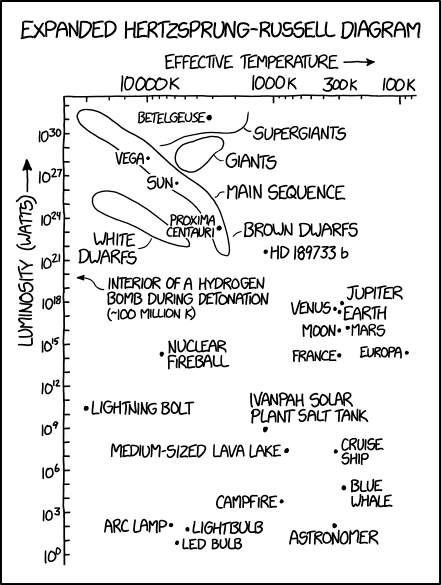
XKCD - Expanded Hertzprung-Russell Diagram

Reminds me of the interesting factoid: on a power-per-mass basis, our sun produces less Wattage than reptile metabolism. (Reptiles! Doesn't even approach mammals, an order of magnitude greater!) But that surface area-to-volume ratio is important, and as the XKCD author pointed out previously, if you had a whole planet made of mammals, it would put out a fair amount of energy in an unexpected scale-dependent phenomenon, although metabolism would not continue - turns out where powering stars is concerned, fusion beats glycolysis or respiration.

Sunday, July 29, 2018

Implications for Panspermia: Metazoans Can Survive Freezing Under Natural Conditions

Nematodes were frozen in Siberian permafrost 42,000 years ago, and were thawed in a lab, showing behaviors like feeding. This has implications for panspermia. In another unintentional experiments, other roundworms on the space shuttle survived uncontrolled re-entry and were found on the ground weeks after the accident. Stars regularly make close passes on time scales on the order of 100,000 years. 70,000 years ago, there was a star less than a light year away (Scholz's Star.) Large meteor strikes regularly (on geological timescales) send material into space. Are there thaw-able Earth nematodes (and many other things) now in order around Scholz's Star? There are definitely extraterrestrial objects in this solar system, but only in one case have we checked for biochemistry - and we at least found amino acids.

Tuesday, July 24, 2018

Look for RNA-World Rock Strata on the Moon

Schulze-Makuch and Crawford show in Astrobiology that that the Moon may have briefly been habitable - either (two options) about 4.5 billion years ago, or 3.5 billion years ago, for a few tens of millions of years, with an atmosphere and some liquid water (Gizmodo digest here.) Since the moon was formed after an impact with the early Earth, we should assume they had many of the same starting materials. The moon had less surface area and less time, and split from the Earth prior to even the earliest suggested prebiotic activity around 4 billion years ago, so it would have had to develop its own life - it could not have been "seeded."


The Moon with life (although terraformed.) From Techeblog.

Recent work by Tashiro et al suggest that a 4 billion year old rock stratum on Earth shows evidence of biological activity and may even be the fossil result of an RNA-World stage in the evolution of life on Earth. If it existed on Earth, it also could have existed on the Moon. It's not as though that rock stratum is exposed everywhere on Earth (the Tashiro people used samples from northern Labrador, Canada.) But it's interesting to think that the same stratum could have existed on the Moon if prebiotic chemistry took a similar course - and that those strata may be much easier to find and more widespread given the inactivity of the Moon relative to Earth.

Thursday, June 28, 2018

Interstellar Object Oamuamua is Releasing Vapor

A Nature paper by Micheli et al demonstrates that outgassing is one plausible explanation for the subtle changes being measured in Oamuamua's trajectory. It also happens to visually look like a comet, though with much more silicate than organic material on the surface. There's less and less distinction between asteroids and comets - that is, a "primitive" (wet, not-yet-burned-off) body like Ceres is more comet-like than a drier body like Vesta. More here on the (now established) phenomenon of interstellar mixing and what it means, more speculatively, for von Neumann probes and/or the panspermia hypothesis.

Note: I refuse to use the apostrophe for Oamuamua because it misses up alphabetical order, and also, is dumb. Sue me, Hawaiians.

Sunday, October 29, 2017

First Interstellar Asteroid? It's Interstellar, But Not the First We've Seen

Information here and here. Based on the velocity and path, this asteroid originated from outside the solar system. This is a great additional finding, but not actually news! Comet Wild-2 was the subject of the Stardust sample return mission, and analysis showed more than a few interesting things: that it contained the amino acid glycine, and that the nitrogen isotope ratio showed that the object likedly originated from a different solar system.

A point of interest here is that since the solar system's origin, there must have been multiple close passes by other stars - close enough that our respect Oort clouds would mix at the margins, and material would be exchanged between star systems. We have now verified this logical inference visually, and through direct chemical evidence.

Previous post about alien evolution, Life's Origins at Four Billion Years Ago; Implications For Our Future

Friday, September 29, 2017

Life's Origins at Four Billion Years Ago; Implications for Our Future

A group from the University of Tokyo (Tashiro et al, 2017) argues in a Nature paper that carbon isotope ratios in rocks in northern Labrador, Canada means that those rocks harbored life almost four billion years ago. This pushes back the early bound on origin of life almost two hundred million years, almost to the Hadean eon. To be sure this finding has not been universally accepted, but it's worth thinking about what it would mean. In particular, and perhaps not coincidentally, this is also right about when the Earth's surface transitioned from molten to solid. [Added later: it turns out the Moon may have been briefly "habitable", i.e. had an atmosphere and liquid water. Look for the same signature in rocks there?]

A recent paper reconstructing the last universal common ancestor (LUCA's) genome from a massive tree of millions of genes showed that it was pretty clearly a sulfur-vent organism. This is good news if you're looking for life on Europa or Enceladus, because that means that life on Earth didn't need the sun (and neither would any life that could evolve along vents under Europa's icy crust.) If you assume that the chance of life evolving by 3.5 billion years ago on Earth was 50%, and that the chance of life evolving is based on surface area, and all other things are equal (admittedly speculative when we don't even have all the information for our N=1) then there is a one in three chance of life on Europa. (If that probability correlates instead with the volume of water, then it was overwhelmingly more likely for life to evolve on Europa!)

[Added several days later: someone has finally run the numbers. A model of RNA polymer formation by Pearce et al suggests that the first RNA world molecules were most likely to have formed in small surface pools rather than sulfur vents - but even earlier, 4.17 billion years ago. If a wet-dry cycle is needed, this suggests ocean worlds like Europa are less likely than once-wet places with exposed land like Mars. The lesson of this paper is that you need puddles, not bone-dry deserts or world-spanning oceans. In this model, a world with puddles and organics seems all but certain to develop into an RNA world. A paper by Cardenas et al from the Geological Society of America Bulletin strongly suggests that 3.5 billion years ago, Mars was exactly the kind of place to have puddles. The logical argument is that life, or at least an RNA world, also developed very quickly there, and we should look for similar deposits to the ones found by Tashiro et al. If Pearce's argument does not produce findings like Tashiro's on Mars, we at least can start looking for differences in the early environments of the two.]

Two things to keep in mind about the LUCA paper: 1) LUCA is the last universal common ancestor. There could be a long lineage before it; and 2) the smaller and simpler a system, the more profound the changes possible in that system. If at one point Earth was an RNA World, molecular clock techniques developed based on modern DNA metabolism would probably be pretty bad at retrodicting LUCA. That two hundred million year gap map be exactly that. All that carbon might be free-floating ribosomes, or peri-biotic viroids.

Even more importantly, this has implications for the likelihood of the evolution of life. This discovery should worry you if you consider the Great Filter. The idea is that it seems very likely that life would evolve anywhere there's liquid water. Yet the universe is not obviously filled with intelligent life. Something is therefore stopping the progression from the evolution of life, to that life spreading from its home planet. (This is typically assumed to be some natural event and need not be some science fiction plot of an alien menace stamping out intelligence wherever it appears.) And every time that the origin of life is pushed back a bit further - that gives greater cause to worry, because where probabilistic events are concerned, the faster something happened, the more likely it was. If this paper is correct, then life on Earth appeared essentially as soon as the surface cooled from magma to solid. [Added several days later:

The real question is whether the Great Filter is behind us (we're freaks that got more complicated than algae) or in front of us (every intelligence is powerful but short-sighted and wrecks its own ecology before it can escape its home planet.) Therefore, a very reassuring discovery would be simple life - the local flavor of blue-green algae - under the ice Europa of Enceladus,* and in the ancient mud of dried Martian riverbeds, and baked into Venusian bedrock. That would mean that somehow, we got past the gate - still no guarantees, but we already passed the filter. This would mean that if we do manage to get out of the solar system, we'll find a lot of alien bacterial mats, but no alien minds. Boring? That idea is actually quite reassuring.

On the other hand, a bad discovery would be mass fossil beds of complex multicellular things (like the radioactive squid in Europa Report), especially ones with extrasomatic adaptations (tools.) We have had a number of landers on Mars and Venus, and none of them captured any obvious macroscale life. But a positive finding by SETI would be even more harrowing, especially because it's unlikely that there would be only one other intelligence that happens to be even within a million years of our technology - even if they're within 1% as old as we are, that's a gap of 40 million years in either direction! In such a situation we would have to include they must be legion. In such a situation, we would have to reason: we can hear them, but for some reason they never get away from their home planet - and we are unlikely to be any different.

*If indeed we believe that Enceladus only formed in the Cretaceous, then there is much less likely to be life there than Europa, and we should focus on Europa.

Previous post about alien evolution, Vast Cool and Unsympathetic: Other Worlds Detecting Earth


REFERENCES
Benjamin T. Cardenas, David Mohrig, Timothy A. Goudge. Fluvial stratigraphy of valley fills at Aeolis Dorsa, Mars: Evidence for base-level fluctuations controlled by a downstream water body. GSA Bulletin, 2017; DOI: 10.1130/B31567.1

Pearce BKD, Pudritz RE, Semenov DA, Henning TK. Origin of the RNA world: The fate of nucleobases in warm little ponds. 10.1073/pnas.1710339114 PNAS October 2, 2017

Tashiro T, Ishida A, Masako Hori M, Motoko Igisu M, Mizuho Koike M, Pauline Méjean P, Naoto Takahata N, Yuji Sano Y, Komiya T. Early trace of life from 3.95 Ga sedimentary rocks in Labrador, Canada. Nature 549, 516–518 (28 September 2017) doi:10.1038/nature24019

Sunday, September 3, 2017

Influence of Interstellar Proximity on Interstellar Exploration and Evidence of Extraterrestrial Visitation

It's easy to despair at the gulf between stars and the millennia of time it would take to get a ship there. The fastest spacecraft humans have yet produced was Helios 2, which after a slingshot maneuver in 1989 was moving at about 103 kilometers per second. There are two things to note about that statement. The first is that it was a slingshot maneuver, not an acceleration achieved under its own power (which is always the case in space exploration.) The second is that breakneck speed would deliver Helios 2 to our nearest neighbor Alpha Centauri right around 13,000 years from now. (This also means there are stars in our neighborhood that even if we aimed our fastest-yet probe at them, we could never reach, because they're moving away from us faster than our fastest spacecraft.)

Those frustratingly quarantine-like time spans suddenly seem much shorter when we consider the geologically brief time spans between close passes of the sun and nearby stars, resulting from proper motion. These changes in interstellar geography actually occur much faster than plate tectonics. In the space of a few tens of thousands of years we might go from having our nearest neighbor five light years away, to close enough to impinge on the Oort cloud and send comets falling toward the inner system. It's amazing to think but since our ancestors were first using fire, multiple close-passes between other stars have occurred. Merely 70,000 years ago we had a star 0.82 light years away (Scholz's Star), and in another 1.3 million, we'll have another (Gliese 710).


There are a number of clear inferences to be drawn from the frequency of such close passes.

1) It bears repeating, in geologic time, 70,000 years is really not long. Humans may have already started leaving Africa when this occurred. We should assume the sun is not unique in this, and our close-pass rate is about once per million years. That means, since the solar system formed, this has occurred 4,500 times. The Wild-2 comet, from which we retrieved material that we've analayzed on Earth, has a nitrogen isotope ratio that strongly suggests it's a comet formed around another star. It also has the amino acid glycine.

2) Impact ejecta from large bodies like Earth can make it into orbit. We have Martian rocks here on Earth from such events having happened on Mars. Space is not hospitable, but even metazoans have survived fairly harsh exposures; for example, C. elegans worms from space shuttle Columbia experiments survived uncontrolled re-entry and were found alive on the ground weeks after the crash. They weren't even protected inside large space rocks. Some exobiologists expect that for this reason, if we do find life elsewhere in the solar system, it will be related to life on Earth (ejected and diffused during the Archaean?) essentially a long-lost branch of archaebacteria. While such a process would be less likely, i.e. take longer in the much greater volume of the outer solar system, if it is not less than 1 in 4,500, it has probably already occurred.

3) It is very likely that the amazingly short 66 years from first manned powered flight to first human on the Moon occurred in part because of the Moon's relative proximity. More than twice that duration has now elapsed and we are still only in the talking stages about a landing on Mars. A species that has the good fortune to "come of age" in terms of space faring technology, when the next closest star is a mere 0.82 light years from their own, has an easier task of proving the possibility of interstellar space flight than we do, coming of age when we're about equidistant from everything. We might therefore narrow our search for intelligent life to super-Earths around sun-like stars with close neighbors. (Of course, there is also a not-unreasonable argument to be made that close passes, or any distant large bodies disturbing the local Oort cloud, increase the chance of major impact events and decrease the chance of the kind of complexity developing that would allow long-distance space travel.) It's worth noting that in view of the high frequently of close passes, a problem for the Oort shower hypothesis of mass extinctions is that it does not happen more frequently, i.e., every million years.)

4) Recalling that our fastest spacecraft have all used gravitational slingshot maneuvers - while we might speculate wildly about the amazing propulsion technology visiting aliens would have, we can be 100% certain that they will have gravity maneuvers at their disposal, because we use it. It's easy and cheap (free, really.) Therefore, there may be interstellar "backwaters" that will not necessarily be empty spots in the galaxy, but places that are difficult to approach from nearby stars and then slingshot away from to another nearby star. If you're a species in such a backwater, you're not going to get visited very much, and you'll ask "Where is everybody?" As the stars shift, your interstellar geography status may change quickly, within a few thousand years. One of the problems with detecting aliens, particularly well-advanced ones, is we don't know what we're looking for. We may be looking right at evidence of their existence and miss it because they don't use our provincial communication methods, or because we're used to it and we explain it in terms of the background operation of "dumb matter". Or, the periodic mass extinctions that are sometimes claimed to be associated with close passes could in fact be associated with close passes - but because of an ecosystem-collapsing alien visitation as Stephen Hawking envisions, rather than because of Oort cloud impactors.

Previous post on alien evolution, There's (at least) a 1-in-3 Chance of Life on Europa

Friday, January 29, 2016

Predicting the Limits on Life by Observing Stars and Galaxies

The more that our models (using only "dumb physics") are able to effectively model the universe, the less we should assume that the large scale architecture of the universe - even the "medium" scale at the level of stars - are affected by the evolution of intelligent life.

Another way of saying this is that physical simplicity apparently dominates the architecture of stars, galaxies, and superclusters, without the complexity that we see in things like genomes and nervous systems (and the complex behavior those systems allow). If we are able to differentiate something usefully called "life" from background noise, then this complexity is certainly a core feature. At the scale of the universe, with each additional non-puzzling observation we make, it seems more certain that life has not had much effect. When we see a few stars that we can't understand, like KIC 8462852 or Fomaulhaut, that might mean some living things have crawled out of their respective primordial soups for long enough to build Dyson spheres, and we should be happy. But when we see something like dark matter, that's so mysterious it requires a whole new subatomic particle, we should rejoice! Maybe THAT is where everybody is, and that's is the ultimate fate of intelligence, uploaded at the end of evolution into some kind of ether! The sky's the limit! (Until of course, we find out that dark matter is just boring, simple, basic dumb predictable stuff.)

Whether this means that intelligent life does not appear (often), does not last long enough to have an impact, or has impacts at spatially smaller levels than this (see involution), is another question.

To argue that we can't know the impact of intelligences alien and greater than our own is to argue that we shouldn't bother talking about it, because we can't tell if any one proposition about alien intelligence is more likely to be true then another. That's a classic PEP (pointless epistemological problem).

Thursday, February 19, 2015

Probability of Pre-Intelligent Life Seeding Between Solar Systems

That probability is increasing. Scholz's Star passed well within the outer edge of the Oort Cloud a mere 70,000 years ago. It's important to keep in mind that one theory for why we should expect to see life on Europa is that impacts on Earth must have thrown biological material into space, which must eventually impact on Europa. We shouldn't hold our breath for a whole giraffe to make it to Europa just yet, although it's worth recalling that the C. elegans worms (not giraffes, but at least metazoans!) on the Columbia survived re-entry and were found alive 3 weeks after impact (link here). While many outlets are covering the "Neanderthals must have seen this!" angle of the Scholz's Star near-miss, a more important take home is that if biological material can plausibly mix between bodies in the same solar system, it is not much less likely to mix between solar systems.

Scholz's Star is not unique. If this just happened 70,000 years ago, we can reasonably infer that this has happened frequently. 70,000 years is not a long time in astronomical terms. A number of known stars have come or will come within Oort-mixing distance in this 100,000 year period. In point of fact, the Stardust mission - which returned physical material from Wild-2 - showed based on isotope ratios that Wild-2 must have originated in a different solar system besides our own. We have classically thought about life moving between solar systems in terms of intelligent aliens building ships, but it may be more plausible to expect that something at the level of unicellular organisms or even simpler than that is what usually moves back and forth. The ideas is not new (probably Fred Hoyle articulated it first mid-20th century) but we now have more data to support the ideas as plausible.

Tuesday, February 10, 2015

Enceladus Ocean is Alkaline NaCl/Na2CO3 Solution

Similar to alkaline lakes on Earth; well within the pH range of extremophiles. Paper here.


Above: geysers at the south pole of Enceladus, credit teachastronomy.com. Below: Soda Lake in the Carrizo Plain, California, USA, Earth, credit Wikipedia.

Sunday, February 8, 2015

Modeling Gamma Ray Bursts as Causes of Mass Extinctions

One of the explanations for the apparent rarity of life in the universe is the frightening gamma ray burst - perhaps life is astonishingly rare, and Earth has just been lucky to be in a narrow slice of space that for the last five billion years. But (almost?) everywhere else the planetary Petri dishes have undergone regular GRB autoclaving, or at least they got autoclaved before complex nervous systems develop. Putting numbers to this based on the observed distribution of GRBs, a recent paper modeled frequency and distribution of GRBs to estimate the chance over time of a GRB happening close enough to Earth to be life-damaging. Among their conclusions:

1) There's a 50% chance that a life-damaging GRB took place in the last 500 million years. Permian-Triassic extinction anyone?

2) The probability of a system being exposed to life-damaging GRBs goes up as you move toward the center of the galaxy. Many of our SETI efforts focused on our own galaxy have focused coreward, on the reasoning that there are more stars in that direction, therefore more chance of finding life. The reflex to this paper's model is to worry that we're looking in the wrong direction - but if you assume galaxy-colonizers, looking coreward may still be the best strategy - the GRB survivors on the galactic rim would be able to colonize inward.

Paper here.

Tuesday, February 3, 2015

Evidence for a Methane Source In Enceladus Oceans

Paper here. Hinges on the trapping of methane as clathrates, similar to subglacial lakes (i.e. Vostok) on Earth.