Sunday, February 24, 2019

More on the C. elegans that Survived Re-Entry During the Columbia Disaster

Living roundworms made it intact to the ground after the Columbia crash, as noted multiple times before (here and here.) There is more information in the article about their level of protection: "'They sustained some heat damage to exteriors, but that's about it,' Szewczyk said. The thermos-size metal container holding the nematodes was housed inside the locker of a crew compartment that was reinforced specifically to protect the materials inside. Once that compartment ruptured, however, the nematodes still survived the crash to Earth thanks to the locker's build, Szewczyk said. The C. elegans stayed alive upon impact because by the time that part of the shuttle fell to the ground, it had already decreased in speed, allowing the nematodes to touch down more gently." A locker is much less protection than being deep inside a solid chunk of rock.

This has obvious implications: "'From an astrobiology standpoint, the important thing was that if you had a multicellular organism going through the atmosphere you can have interplanetary transfer of life by natural means, and Columbia demonstrated that,' Szewczyk said. 'It was a fortunate thing to demonstrate that in the unfortunate circumstances that there were.'" Their descendants are kept at the University of Minnesota.

Friday, February 15, 2019

Excerpt from The Cleveland Wrecking Yard (Trout Fishing in America, Richard Brautigan, 1967)

Until recently my knowledge about the Cleveland Wrecking Yard had come from a couple of friends who’d bought things there. One of them bought a huge window: the frame, glass and everything for just a few dollars. It was a fine-looking window.

Then he chopped a hole in the side of his house up on Potrero Hill and put the window in. Now he has a panoramic view of the San Francisco County Hospital.

He can practically look right down into the wards and see old magazines eroded like the Grand Canyon from endless readings. He can practically hear the patients thinking about breakfast: I hate milk, and thinking about dinner: I hate peas, and then he can watch the hospital slowly drown at night, hopelessly entangled in huge bunches of brick seaweed.

He bought that window at the Cleveland Wrecking Yard.

My other friend bought an iron roof at the Cleveland Wreck­ing Yard and took the roof down to Big Sur in an old station wagon and then he carried the iron roof on his back up the side of a mountain. He carried up half the roof on his back. It was no picnic. Then he bought a mule, George, from Pleasanton. George carried up the other half of the roof.

The mule didn’t like what was happening at all. He lost a lot of weight because of the ticks, and the smell of the wild­cats up on the plateau made him too nervous to graze there. My friend said jokingly that George had lost around two hun­dred pounds. The good wine country around Pleasanton in the Livermore Valley probably had looked a lot better to George than the wild side of the Santa Lucia Mountains.
For the rest of it, see here. For context, see here.

Sunday, February 10, 2019

Mozart, Symphony #25 in G minor, 1773


Could Modern Bacteria Seed Early Earth? Could Bacteria in Earth Ejecta Do the Same for Extrasolar Planets?

The C-index is this: how close would we have to be to an identical twin Earth to detect them with our SETI searches, given our current detection technology and our (their) emissions? Many argue that we would identify zero twin Earths this way because to detect them, they'd have to be within 3 LY or so - closer than the closest star.

But this post is asking a different question: if modern archaebacteria were seeded onto Hadean prebiotic Earth (say, an iron-sulfur species like the ones that our best guesses show were the last universal common ancestor of all life on Earth) - would they run rampant and colonize the whole world, or would they collapse, relying on some pre-existing network of metabolites produced by other cells? This is relevant to the question of passive colonization of simple organisms from Earth to nearby stars over arbitrary time scales. Archaebacteria in particular are a concern for NASA in terms of contaminating other planets.

This idea has been floated multiple times, including by astronomer and writer Fred Hoyle. Here is how the process of passive colonization could work. Asteroid impacts are sometimes powerful enough to eject surface material at greater than escape velocity. This is how we have over 100 fragments of Mars on Earth right now. If this happens, some bacteria may survive the initial shock, heat, then freezing and dehydration (some bacteria can survive these conditions; and in any event it doesn't have to be many.) Some of these meteorites will escape Earth orbit. If in vacuum and cold they're stable for arbitrarily long periods, they'll just accumulate in the solar system as septic Earth-meteorites over time. Some percentage of these fragments will interact with a solar system body (e.g. Jupiter) and be accelerated to solar escape velocity (like Oamuamua was in its native system.) Some percentage of those will enter another solar system (this is likely to happen once every 15 billion years, based on calculations inspired by Oamuamua.) Some percentage of these fragments will pass through a solar system with "primitive" planets with a liquid water-CO2 atmosphere like the early Earth. Some percentage of fragments will actually strike those planets, and some percentage of bacteria will make it to the surface intact.

Of course there are many unknowns and I only cited one number. We need to know the bacterial "burden" blasted out of orbit per unit time - none of those in our lifetimes, probably not even Tunguska; the percent chance of survival; the stability over time once frozen (being in solid phase is certainly not absolute protection against radiation). The frequency of planets is roughly known, but not the frequency of terrestrial CO2-water worlds, although reasonable bounds could be placed. As to surviving re-entry, this tends to raise the most eyebrows - but it's worth repeating that roundworms on the Columbia did in fact survive uncontrolled re-entry and were found alive on the ground weeks later. Inside a large iron-silicate rock they may be even better protected.

The most uncertain part of this list of attrition factors is the last one we've now come to, the chance of the bacteria fluorishing on the new planet (lack of metal ions for enzymes, or presence of cyanide, low volcanic activity if we're relying on the iron-sulfur archaebacteria; etc.) But we can start actually filling in the values for passive ("dumb") colonization - the equation to show how fast Fred Hoyle's "lifecloud" and Arrhenius's panspermia would actually occur. Note that this is a different concept from the organic von Neumann probes that could also unintentionally seed life as a side effect, although mechanics would be the same, and we would still be looking on watery low-gravity bodies for evidence of them, like comets and asteroids.

Initially I was tempted to make a stab at setting bounds on 50% chance of colonizing another star, but many of the probabilities would be just guesses. It's clear that this is quite a list of attrition factors, reducing the chance nearly to zero for any one cell or asteroid strike on Earth to seed a future alien ecosystem. But over geologic time there have been quite a few of these strikes, and assuming vacuum-frozen surviving bacteria are stable for a long time (a relative straight-forward thing to test), then the solar system has been slowly filling up with septic asteroids - some of which no doubt have been ejected. So for the near-term, this is unlikely to produce lots of passively seeded worlds, but over arbitrary time, the universe would be accumulating archaebacteria from every place that life evolved. If we think of the Sun as a second-generation main sequence star, then planets of third generation stars are more likely to have been seeded by second-generation ecosystems - and may have more metals available in the ashes of the second generation stars from which they're built.

Other quantitative predictions: a one-third chance of life on Europa.

Thursday, February 7, 2019

Van Halen, Hot For Teacher, 1984 (covered by Dillinger Escape Plan, live, 2008)


Bonus - Rebel Yell by Billy Idol, covered by Children of Bodom (Skeletons in the Closet, 2009):


Double bonus - Disposable Heroes (Metallica, Master of Puppets, 1985) as if Meshuggah covered it, by Morten Müller:


Sunday, January 13, 2019

Reaction: Gun, With Occasional Music (Lethem)

Highly recommended; spoilers follow.

Science fiction which only recycles the surface trappings of the genre without using them as a vehicle - i.e., that doesn't take advantage of the freedom allowed by world-creation to get at something - is a hollow failure. Using a novel to investigate the function of language itself, as this one does, seems an abstract and sterile endeavor and in lesser hands probably would be, and might be impossible if you couldn't invent a counterfactual world that better exposes the uneasy conflicts inherent in such a question. Gene Wolfe's New Sunnovels are about the limitations of language - the Ascians who can only speak in stock phrases and communicate meaning by how out-of-tune the uttered phrase is with the current situation; or the degeneration of imagination as moves from direct experience to more and more iterations of mere telling, like people breeding in a prison who thought bees were a foot across because they'd only heard about but never seen them; or the silo-ing of genres into guilds. Gun, With Occasional Music is a meditation on language using the medium of detective fiction, and properly using the freedom that science fiction allows to explore its core concerns - language's richness and its relationship to truth, authority, and action.

As a point of comparison, the influence of Philip K. Dick on this novel is obvious, in the same way that Black Sabbath's influence on Metallica is obvious - Lethem takes what's good about PKD and makes it better, with much better writing. Gun is Do Androids Dream of Electric Sheep, more fully developed and better-written. Androids is a manatee and Gun is a dolphin. If you need this novel put in terms of other novels, it's about half Androids, a quarter Scanner Darkly, and a quarter auster's City of Glass, the latter of which is the only work of anti- or meta-detective fiction I've read that does that particular "genre" justice. (Again, by properly using it, and not leaving the genre's tricks un-fired on the mantelpiece.)


At its core, this is a detective novel about a half-washed-up private eye trying to get a guy off for a crime he didn't commit. It's the world that they inhabit The plot really serves only as a medium for you to notice the author's investigations of language, and if the book has a flaw, it's that the plot is overly complicated and distracts from the central value of the novel. The world this detective finds himself in is one where questions are illegal, metaphors are misunderstood, jokes are taken literally, and by the end, even too many simple statements become suspect. There are also evolved animals and developmentally-accelerated children, though (key to my criticism here) none of this is really essential to the plot. There is a recognition of class, though this seems more a necessary part of a detective novel, and less an actual exploration. In a nutshell, the animals and babyheads (more on them below) are clearly lower class. So?

Questions are an obvious threat to authority ("The number one enemy of progress is questions!" - Jello Biafra) and in this world there is an Inquisitors Office, which contains the only people allowed to ask questions, and then only in the course of their investigations (them, and the occasional private investigator - but they need a license to ask.) There are several references to psychoanalysts - the most instrusive question-askers of all - but they're illegal, replaced by Inquisitors. In fact the only psychoanalysts encountered in the novel are a hollowed-out degenerate incarnation thereof, going door-to-door like Jehovah's Witnesses, and they're evangelizing - that is, telling, not asking.

But the threat from language to authority comes not just from questions, but from metaphor. Dictatorships are famous for their difficulty understanding, and (therefore) their intolerance of, parody and ambiguity. Consequently this is a world where authorities either cannot understand metaphors, or have forced them to become literal. Criminals are put in actual freezers. Everyone is using an officially issued drug ("make") and one of them is described thusly: "Think of it as the opposite of deja vu - nothing reminds you of anything, not even of itself." A more certain death for metaphor could not be described! Evolved animals jump from figures of speech into real life - Metcalf has a monkey on his back at one point, a sheep is afraid to disobey the man she lives with, and just as he was emasculated in leaving the Inquisitors Office to become merely a "private dick", his manhood was taken by the woman who broke his heart and left him after what he thought was a temporary trade in genital sensation, made possible by future neuro-programming. The character who turns out to be his arch-nemesis is an evolved kangaroo. This one I couldn't process other than to realize that since Joey is common young gangster name, it would make sense in this world for that gangster to be an actual young kangaroo. Every now and then the prose snaps out of gumshoe-rhythm but it's typically associated with certain characters; Testafer is the closest Lethem comes to exposition, and to a lesser extent the antagonist Phoneblum. But these sections don't expose the central theme, and the closest Lethem comes to just giving away the come occurs when the protagonist, in frustration with the babyheads, asks "What if I told you I thought Truth and Justice were two completely different things?" This narrator seems to actually think in clever metaphors (as is common in detective fiction) but the Inquisitors Office goons often flatly don't understand his constant wordplay. Late in the book, when the character wakes after six years in the freezer to an even worse world, people don't even understand jokes without the help of computers they carry with them to tell them they just heard a joke. (They still don't understand the jokes, but they know the appropriate response is to laugh.) TV shows and even the news are abstract and non-representative. The news is delivered with music, which, as an abstract art-form, is un-threateningly indirect and un-revelatory (This is how the USSR announced Premier Konstantin Chernyenko's death, though it's certainly not the only dictatorship which has been less than eager to explicitly communicate bad news.) But even TV shows are abstract in this world, seemingly serving as animated Kandinsky paintings, like visual muzak.

Then there are the babyheads, the accelerated infants, deliberately drawn as the most disturbing and creepy entity in the novel. There's an implication that the babyheads are the future, spouting pseudo-profound nonsense (which is therefore harmless); I can't help but think he's picking on the post-modernists here. In the babyhead bar, they make clear their contempt for the prohibition on question-asking, but you don't get a feeling of liberation that you're in some inner sanctum where linguistic freedom has been protected. Rather, you're clearly in a cognitive and linguistic ghetto.

A final thought on the predictions that Lethem got right. Everyone in this world has "karma", a system of points which, when the Inquisitor's Office has penalized you so much it reaches zero, you're shipped off to the literal freezer. Reading this in 2019, you can't help but think of China's social credit system, which is amazingly under-discussed in the West. There is no discussion of how the world got to be this way - it's not really what the novel is about - but as the fire chief described in Bradbury's Fahrenheit 451, I can imagine a populist uprising driven by grass roots intolerance of question-askers in an increasingly complicated and difficult to negotiate world. There's no mention of a top-down central state here.

At the time of its publication the term "slipstream" was thrown around a lot as a category for this book, equal parts science fiction, litfic and post-modernism. But like most attempts at artistic hybridization, it looks more like one than the other, and Lethem falls more on the literary side. The critical question: is the novel about the technology? That is, do you and the writer care about the details of how things work, or are they a literary conceit that's serving another narrative purpose? This is why this novel, Fahrenheit 451, and Star Wars are not really science fiction. They create a setting that serves a purpose in the themes they're exploring, but Lethem and the reader do not care how the babyhead technology works (same for a light saber or the mechanical hound.) For that matter, in modern writing and film, many other genres have incorporated the superficial trappings of science fiction - thrillers especially, but increasingly romance as well. Another example is John Updike's not-really-successful science fiction experiment Toward the End of Time. It's literary fiction (fair enough) with some genuinely interesting science fiction ideas, unfortunately shoe-horned in. Updike wasn't fooling anybody into thinking this is what he usually writes about.

If I have a complaint, it's that the first few pages I was put off by the annoying intensity of the detective novel style. It's far beyond what would be needed to tell us this is a detective novel, and I appreciate that a debut author wants to showboat a little in terms of demonstrating his mastery of the idiom - although, for example, David Mitchell manages this better and less self-consciously in Cloud Atlas.

Dying Fetus, Your Treachery Will Die With You (Descend Into Depravity, 2009)


Thursday, January 3, 2019

Arkona, Stenka na Stenku (Stenka na Stenku, 2011)


H/T Chris. Who know that the folk metal genre was rich enough to be sub-sub-divided into eastern and western folk metal? Also check out Korpiklaani.

Saturday, December 22, 2018

Deoxyribose From Abiotic Space Conditions

Another biomolecule, the pentose sugar that serves as the backbone of DNA, quickly produced in un-directed synthesis under conditions that obtain on ice in space. Given the speed with which the first life formed on Earth (0.1 GA after the planet cooled to a solid form) as well as increasing evidence like this about how easy it is to make nucleic acid building blocks under prebiotic conditions, it's also very likely that life forms everywhere with water and carbon - even in ice. (See here for most recent panspermia/evolution post.)

Monday, December 10, 2018

Space Colonies Will Be Run By Dictators; Or, Why Science Fiction Is About Government Space Travel

Settling colonies in the age of exploration was easy. Jamestown in particular seemed like a breeze. There was air, water, food, and even people who would sometimes help you if you were nice to them. Even still, it wasn't until the third ship arrived from England that the colony became self-sustaining. The Norse were unable to hold onto Greenland at all, and we still in 2018 have not put a self-sustaining colony on Antarctica . That the land does not provide basic life-sustaining commodities for free - that there is no indestructible commons where air and water is concerned - has led some political scientists to speculate that the natural state of any off-Earth colony would be that of "Oriental despotism", which earlier historians associated with the culture of the Middle East. Another way of looking at this is that there's a predisposition to strong central authority anywhere that central coordination is required for survival. This might mean political rent-seekers who control the water by force, as in parts of the Middle East, or the coordination of crops that are massively productive when huge teams of people harvest it, as with rice in East Asia. This also solves the mystery of why states emerged initially in places that were actually quite marginal for agriculture - the dry high altitude Mexican Plateau, the Nile Valley, and the Fertile Crescent (with the exception of China - still explained by a benefit of central authority's ability to coordinate labor.) On the other hand, places where berries and game almost jump into your mouth are not famous for producing large states - though they do often produce impressive cultures, like the Pacific Northwest. When you get angry at some tribal council decision, it's too easy to storm off and take your family into the next valley and start hunting and gathering there. Not so when your life depends on predicting and collectively exploiting, say, the flooding of the Nile.

But there is still another reason to think that space colonies (planet-bound or not) will resemble the walled fortress of a desert, or the absolute authority of an Eastern monarch, more than a democracy. (Yes, it gets worse.) How do you get your family to your new valley? You can walk - even if it takes a while. If you got sick of Ohio and wanted to head west, you might have to pool your funds with other families but it didn't take that many families before you could put a small wagon train together. Leaving a gravity well and building a habitat are massively complicated and expensive undertakings. This is why space launches are the province (so far) of wealthy states and so far, just one corporation. For economic reasons of massive capital requirements, space travel will therefore be performed in a way that advances the interests of wealthy states and/or corporations. (This is similar to the reason movies are more constrained, i.e. less imaginative, risk-taking, and creative than writing or visual art - they're very capital-intensive and it's much more important in this medium to make back your investment!) Science fiction typically continues to imagine it this way, likely correctly - but rarely explores the pitfalls of large organizations having a stranglehold over the means of transportation in this brave new world - or the impact of, say, aliens appearing and handing out technology that allows individual humans to cheaply travel between planets. (Libertarians - if you think having private corporations do it, you not only have to explain how they will obtain such a position in the company of a cartel of violence-monopolizing organizations called states, you have to explain why it's better to be oppressed by a privately held rather than public organization. Left-leaners, if you think states are the ideal organizations to undertake such ventures, keep in mind that the first country with a real rocketry program was Nazi Germany, and the fastest growing one today is free-speech-crushing, putting-Muslims-in-concentration-camps China.)

It's also worth pointing out that, for related reasons, such colonies will be dependent on Earth for a long, long time, much longer than Jamestown was dependent on England. Why? First off, people are much more comfortable now. Second, when the first settlers arrived in Jamestown, they were able more or less to build on their own the technology that they were accustomed to in England. Yes, in the case of iron production, English colonists actually reverted to a medieval version for a while, but they were still making the nails and blades and gun barrels and plows that they needed. What about the first settlers on Mars? Will they be able to make a smartphone? Will they be able to make another spaceship, or habitat, or geodesic farming equipment, or satellite dishes? Even assuming zero surplus mortality from the harsh Martian environment, how many ships and people are necessary before the Martian Jamestown is self-sustaining? The Martian despot will likely be interested in not just controlling the oxygen and water, but the shipments coming from Earth.

Saturday, November 10, 2018

Interstellar and Intergalactic Panspermia

Active colonization time estimates for the galaxy are invariably much shorter than the lifespan of the galaxy. Passive diffusion would take longer of course but empirically observed Oort cloud mixing intervals even this far from the core for the sun are on the order of 10^5 years. Lingam and Loeb (2018) calculate the delivery of amino acids between star systems but not timescales; still, they estimate an upper bound for the size of interstellar objects for our system (a 10 kilometer-radius asteroid) and Alpha Centauri (an Earth sized planet.) This is a second source pointing to the fact that we may be an interstellar backwater, uniquely un-exposed to evidence of replicators* relative to the stars around us.

Where intergalactic material transfer is concerned, of course given the distances involved we should expect the process to be slower, both in terms of at an absolute rate and moreso in terms of colonizing systems, since the ratio of number of incoming objects:number of systems to receive material will be quite low. That said, a) there are extragalactic stars in the Milky Way right now, and b) we're actually talking about an exponential rather than linear rate if there are replicators* of any sort being introduced. This excludes infrequent but massive events like intergalactic collisions, like those which the Milky Way has undergone repeatedly in the past.

*I deliberately use the term replicators as a catch-all to include "space-viroids" (most likely), von Neumann probes, "cancerous" (mutants selected for fecundity over original function) or otherwise, or deliberate colonizations by agents with some kind of intention (least likely.)

Sunday, September 23, 2018

Ice Volcanoes on Ceres May Provide Replicators Means of Spreading

Extraterrestrial replicators (be they naturally-evolved, or von Neumann probes or the mutant descendants thereof) are at least as likely to be based on organic chemistry as on clanking iron-age technology, as is often imagined. Material returned from comet Wild-2 showed that it was actually an extraterrestrial comet, and had amino acids on it. Other investigations have shown the presence of nucleobases (the components of DNA and RNA.)

Even Arrhenius-style "panspermia" spread by passive diffusion on astronomical timescales is not implausible, as our Oort Cloud has mixed with close-passing stars' clouds on the order of once every 0.1 MA (and we should assume this happens to other stars as well.) However, for passively spreading replicators, higher-gravity bodies like planets or large moons are dead ends because they have no means of escaping the gravity well.


Water geysers on Enceladus, from space.com

This is why comets and wet carbonaceous asteroids are the best places to look, and why the Hayabusa-2 probe on Ryugu is so important. Same for the Dawn probe. Europa and even Enceladus may be a tough sell as passively escapable gravity wells, but now we see evidence of active water volcanoes on Ceres through its life span.

Saturday, September 22, 2018

Sometimes You Need a Little Puerile Humor

And sometimes you need a lot, so please watch this awesome video by Infant Annihilator, for their #1 hit Decapitation Fornication.

Saturday, September 8, 2018

A Tiny Fraction of the Things Wrong With Star Wars

I always think those "Everything wrong with X science fiction or superhero movie" videos are the saddest things in the world. If it was a hit movie, clearly no one cares, and yet here's some overgrown seventh-grader shouting into the virtual void about why people shouldn't like it.

Here's my contribution to the genre.

All Star Wars movies: "We have superintelligent androids yet they seem mostly to occasionally translate and calculate numbers. Should we let them do any dangerous tasks requiring split-second decisions like, I don’t know, piloting ships? No, we’ll still use humans for that." (Idea for later movies when people finally start getting tired of it: a Star Wars cryptohistory that shows what was happening the whole time, where in fact this is all post-Singularity, and the reason that events fit human cultural and psychological tropes so closely without making much sense if you think about it for more than two seconds - "sword and sorcery in space" - is that the AIs actually set it all up as a big Disneyland for us and/or to study us, and watch from the background. Kind of like the Matrix but real. Or a reverse Westworld. You're welcome, Disney.) Also, technology is just static and never advances (granted, a problem of all far-future science fiction; even for movies set in the here-and-now that want to have any shelf-life, which therefore avoid showing phones and computers and bizarrely end up discounting the role of technology in modern life.)


Above: Darth Vader's House, built by Frank Lloyd Wright, called "Fallinglava." Wright was clearly phoning it in on this one and no one had the heart to tell Vader it was largely derivative of another structure. Vader also rejected bids from William Pereira (who designed the command post in the original Conquest of the Planet of the Apes) and Eero Saarinen (who did Superman's house.)


Also all Star Wars movies: Sith apprentices only succeed by killing their masters, even if they’ve turned kinda good like Vader and Kylo Ren. So how about, just be a Sith, and DON’T TAKE A FUCKING APPRENTICE. IT WOULDN’T BE A JEDI WHO FINALLY BECOMES SO INTENT ON NOT TRAINING SOMEONE ELSE!

Revenge of the Sith: "We have antigravity and cybernetic limbs and faster than light spaceships, but man we just can’t get a handle on tissue regeneration to help people grow skin back. So now left-in-the-toaster-too-long Anakin will just have to walk around wearing a weird suit and 1950s respirator the rest of his life, along with needing frequent moisturizer bath treatments."

Rogue One: "Hey we have energy weapons and all this other technology yet we’re somehow amazed that after years of technology someone built a laser with roughly the power of the Hiroshima bomb. Amazing!"

The Last Jedi: "Turns out ramming an enemy ship at light speed is massively effective! And yet somehow no one ever thought to built light speed space torpedoes, and even after they see it, no one exclaims ‘What an amazing innovation, we should build light speed torpedoes from now on!"

Thursday, August 30, 2018

No Radio Signals from Oumuamua

To help rule out Oumuamua as an interstellar probe, it was investigated and found to have no detectable transmissions within 1-10 GHz down to powers of at least 300 milliwatts. Yes, this could be like an uncontacted tribe on Earth in 2018 saying that the drone that surfaced in their bay wasn't sent by people because it didn't give off smoke signals - but you have to start with clear assumptions of SOME kind and test them. That such a ship-like object is passing through the solar system is exciting, but since we found it very soon after we were first capable of finding it suggests that such objects pass through our solar system all the time.

Tuesday, August 28, 2018

The Interstellar Urey-Miller Experiment

Summary here. At 5.5 K in Interstellar ice you get aromatic ring precursors. Note - the materials from the original experiment remain at UCSD where Miller was professor of chemistry, but the rig they used is at a museum in Denver.

Saturday, August 11, 2018

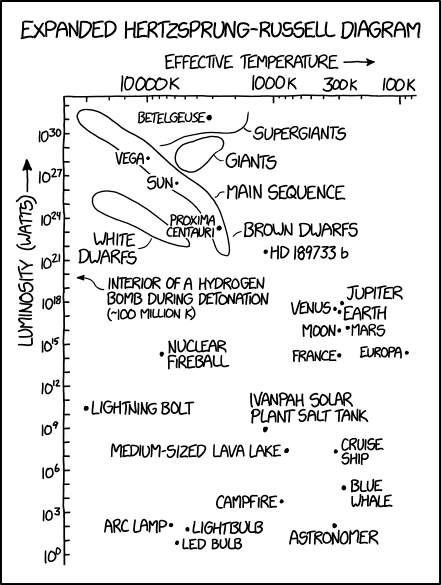
XKCD - Expanded Hertzprung-Russell Diagram

Reminds me of the interesting factoid: on a power-per-mass basis, our sun produces less Wattage than reptile metabolism. (Reptiles! Doesn't even approach mammals, an order of magnitude greater!) But that surface area-to-volume ratio is important, and as the XKCD author pointed out previously, if you had a whole planet made of mammals, it would put out a fair amount of energy in an unexpected scale-dependent phenomenon, although metabolism would not continue - turns out where powering stars is concerned, fusion beats glycolysis or respiration.

Sunday, July 29, 2018

Implications for Panspermia: Metazoans Can Survive Freezing Under Natural Conditions

Nematodes were frozen in Siberian permafrost 42,000 years ago, and were thawed in a lab, showing behaviors like feeding. This has implications for panspermia. In another unintentional experiments, other roundworms on the space shuttle survived uncontrolled re-entry and were found on the ground weeks after the accident. Stars regularly make close passes on time scales on the order of 100,000 years. 70,000 years ago, there was a star less than a light year away (Scholz's Star.) Large meteor strikes regularly (on geological timescales) send material into space. Are there thaw-able Earth nematodes (and many other things) now in order around Scholz's Star? There are definitely extraterrestrial objects in this solar system, but only in one case have we checked for biochemistry - and we at least found amino acids.

Tuesday, July 24, 2018

Look for RNA-World Rock Strata on the Moon

Schulze-Makuch and Crawford show in Astrobiology that that the Moon may have briefly been habitable - either (two options) about 4.5 billion years ago, or 3.5 billion years ago, for a few tens of millions of years, with an atmosphere and some liquid water (Gizmodo digest here.) Since the moon was formed after an impact with the early Earth, we should assume they had many of the same starting materials. The moon had less surface area and less time, and split from the Earth prior to even the earliest suggested prebiotic activity around 4 billion years ago, so it would have had to develop its own life - it could not have been "seeded."


The Moon with life (although terraformed.) From Techeblog.

Recent work by Tashiro et al suggest that a 4 billion year old rock stratum on Earth shows evidence of biological activity and may even be the fossil result of an RNA-World stage in the evolution of life on Earth. If it existed on Earth, it also could have existed on the Moon. It's not as though that rock stratum is exposed everywhere on Earth (the Tashiro people used samples from northern Labrador, Canada.) But it's interesting to think that the same stratum could have existed on the Moon if prebiotic chemistry took a similar course - and that those strata may be much easier to find and more widespread given the inactivity of the Moon relative to Earth.

Sunday, July 22, 2018

Attempts at Interstellar Communication: Receipts and Responses Within Your Lifetime

tl;dr Lots of scientists are on record saying that broadcasting messages to nearby stars is dangerous. If you take other low-probability high-consequence existential risks seriously, you should consider joining the effort (resources here.) Compared to some of the problems the X-risk community is used to thinking about, it would be relatively easy to stop active SETI (METI) and protect the future of life on Earth.

A very philosophically-minded Native American in the pre-Columbian era, sitting on the beach at night, might have thought: there might be a beach just like this one, far across these waters. And if we set up large bonfires, we can let them know we're here! What a joy it would be to meet and exchange culture and technology! We know how the exchange actually played out; if it had come a few centuries earlier, it would have been the Norse landing in New England and Virginia, and likely would have been even worse. In any event, if our pre-contact philosopher would've known exactly how friendly those people across the water would be, he would've abandoned his plan.

This was the result of contact between two groups of the same species that had been briefly (in biological terms) separated. Based on simple evolutionary psychology, contact between two completely unrelated species would likely be much, much worse. But in contrast, revealing the strangely and hypocritically self-flagellating psychology of certain people, you don't have to look far for arguments that contact between humans and aliens would necessarily be beneficial to us - because we humans are so dirty and sinful (except for the people pointing out how sinful we are of course), and any aliens technologically advanced enough to visit us[1] would necessarily be morally advanced as well (again inconsistently, morally advanced as evaluated by the sinful human making the argument.) There's no valid argument in favor of METI, and every reason to think it should be considered suicide for Earth's entire ecosystem, not just for humans. And yet it's been done repeatedly, sometimes for reasons as silly as art projects.

Consider the following list of stars that have been targeted for such contact attempts, and which are close enough that a response (or a visit, if they can travel at light speed) could be received in the medically optimistic lifetime of someone born recently.

StarSun-like?Planets?Earliest Response
Teegarden's Starred dwarfpossible2036
GJ83.1red dwarf (flare)no evidence2040
GJ273bred dwarfYES, SUPER EARTH IN HABITABLE ZONE2043
Gliese 581red dwarfYES, POSSIBLY IN HABITABLE ZONE2050
Altairwhite (A)no evidence2051
GJ526red dwarf (flare star)unlikely2059
HIP 4872red dwarfno evidence2069
Kappa CetiYES, but frequent flaresno evidence2069
HD 245409cool orange/hot red dwarf (K-M)no evidence2077
55Cancri****YESYES, POSSIBLY IN HABITABLE ZONE2085
HD 10307YESunlikely (companion)2085
47 UMa**YESpossible2093
Gl 777YESpossible2103
*Where there are asterisks, numbers of asterisks = # of contact attempts

This is by no means an exhaustive list of all messages, only those for which we can receive a response by 2110 - and only those which are publicly reported.

The argument against active SETI (or METI; Messaging ET Intelligence) is simple. Any aliens which receive the message and have the ability to travel to our solar system are very likely far advanced. Whether or not they intend to harm us - if they, it, etc. even has "intentions" - is immaterial, as any contact with them is overwhelmingly likely to be catastrophic for Earth's ecosystem as a whole, including the human race. Arguments that the aliens will be (or for some reason must be) "nice" are comically narrow-minded and provincial.

The best arguments in FAVOR of active SETI appear to be 1) if we remain silent, then we can infer other species are likely to have made the same decision and it's inconsistent to remain silent but keep listening. 2) Advanced species probably already know about us, and these efforts don't much increase the chances of being detected.

To #1, even assuming the self-indication assumption-reasoning here doesn't demand bizarre causality as Nozick argued with respect to Newcomb's Paradox, given the likely severe consequences of a visit from a species more advanced than our own, I think joining in with all the silent species and being part of the problem (i.e., leading to the Great Silence) is quite a good trade. Notice that in our own ecosystem, most animals are quiet, unless they can quickly escape by flight or into burrows, are hidden by darkness, or are surrounded by conspecifics. Those of us who assume that aliens must be friendly somehow always insist that natural selection stops applying to advanced species and across interstellar space.

To #2, if the best argument really is that "they already know we're here so we're not increasing our chances of detection by potentially destructive aliens THAT much", which is literally the argument made by Jacob Haqq-Misra, Chief Scientific officer of the Lone Signal project, then that tells you a lot about how well-thought -through the whole enterprise is. What's more, it's absolutely false. The C-index is a quick and dirty measure of our detectability - if there were a twin Earth, giving off the same amount of electromagnetic noise that we are, how close would we have to be to detect it? Currently, about 3 LY, meaning we wouldn't even be able to hear ourselves from the next closest star. A powerful directed message on the other hand would be much easier to detect from a longer distance - so these messages are in fact likely increasing the probability of our detection substantially, at least at the target stars. Otherwise why are they even sending them?


These projects are ongoing. The problem has been discussed at conferences with approaches including a moratorium backed by international law (so far only talk.) These things are slow. One approach may be to go directly to the telescopes sending the messages, as there are a limited number of such installations. In decreasing magnitude of offense with those messages, they are:

Eupatoria (Crimea, Ukraine) - 7 targets, 11 transmissions
Arecibo (Puerto Rico, USA) - 4 targets, 4 transmissions
EISCAT (Tromso, Norway) 1 target, 1 transmission (an art project!)
Jamesburg (Carmel, California, USA) 1 target, 1 transmission (crowdfunded!!)

In addition, Alexander Zaitsev is a Russian astronomer who is far and away the individual most responsible for driving METI efforts. Douglas Vakoch is a METI proponent here in the US.

Lots of scientists are on record saying that broadcasting messages to nearby stars is dangerous. If you take other low-probability high-consequence existential risks seriously, you should consider joining the effort (resources here.) Compared to some of the problems the X-risk community is used to thinking about, it would be relatively easy to stop METI and protect the future of life on Earth.

[1] I purposely avoid the word civilizations, because that is a term which describes an entity with certain characteristics that humans can collectively form. Whatever activities groups of aliens form, it will not appear like any "civilization" we would recognize. "School", "herd", "flock", "swarm" are all terms that are at least as likely be useful to human impressions to describe the collective entities that we see.