Showing posts with label evolution. Show all posts

Friday, October 2, 2020

Prediction: Venusian Phosphine is a Metabolic Product of Living Cells Already Detected As Unknown Absorbers

(Added later: since I wrote this, further research has provided evidence showing it is very unlikely that the unknown absorbers are biological. Not only was the phosphine paper a product of bad spectrometry that failed multiple attempts at replication, there are at least two papers - Jiang et al 2024, and Egan et al 2025 - that have provided good candidate abiotic explanations for what the absorbers could be.)

The last two years have provided us with the strongest evidence ever assembled of extraterrestrial life:

  1. Prior theories about relic ecosystems surviving in the more Earth-like parts of Venus's atmosphere.
  2. Detection of UV absorbers the size of bacteria in Venus's atmosphere, with no explanation as to their identity.
  3. Prior, independent advancement of phosphine as a biosignature gas.
  4. Detection of phosphine in the Venusian cloud decks with no explanation for its persistence.

Here I propose that Venus had an iron-sulfur ecosystem with a chlorophyll-equivalent that absorbs closer to the UV spectrum rather than visible light - essentially, "UV-synthetic" Venusian cyanobacteria. The oceans boiled away and Venus became hotter and more acidic from volcanism and possibly, their own Great Sulfuration (or Sulfur Oxidation, equivalent to Earth's Great Oxygenation.) The only survivors were the UV-synthetic Venusian archaebacteria that now live in the upper atmosphere. Today these have a life cycle like that described by Seager et al (2020), powered by UV and producing phosphine - Unknown Absorber Phosphine Producers (UAPPs.) They are likely related at great time depths to life on Earth. Initial research question is to see if areas of unknown absorbers correlates with phosphine, which can be done from Earth. Probes that collect material in the upper atmosphere could fairly straightforwardly check for aspects of biochemistry using an onboard instrument, and a sample return mission could be extremely productive.


Phosphine Production in the Clouds of Venus

If you're reading this you likely know that phosphine (PH3) was detected in the atmosphere of Venus - Vox explainer here; original paper by Greaves et al here. The measured concentrations are at biology-consistent levels, at an elevation where the pressure and temperature are similar to Earth's. This is by far the strongest evidence of extraterrestrial life yet discovered, with evidence from multiple sources.

Phosphine has been advanced as a possible seed compound delivered to Earth on comets or asteroids early in its history. But the chemistry of its formation in space (or on gas giants) is not mysterious. It's in the Venusian atmosphere where so far we can't explain its presence without some process that continuously replenishes it. One criticism of speculation about possible Venusian biochemistry is that just because we don't know how to make phosphine under Venusian conditions, doesn't mean we're looking at alien biology. True; but among these criticisms have not been any suggestions so far about what it might be. (Either way, we're about to learn something.) It's suggestive that this data is not completely unexpected - it can be fitted to prior hypotheses. We've been speculating more and more concretely for decades about how life might survive in the atmosphere of Venus for decades (see Morowitz and Sagan 1967.) A fairly elaborated model of microbial life in the atmosphere of Venus was advanced recently by Seager et al, consistent with observations so far. This should also increase our confidence in the Venusian-cloud-life hypothesis, that even before phosphine was detected, Sousa-Silva et al suggested phosphine as a biosignature molecule, independent of finding it on Venus.


A Related Mystery? The Unknown Absorbers


In visible light and false-color UV absorption. It's unusual to have such contrast in absorption at different wavelengths. Image credit syfy.com


For decades we have known that there are partciles about 10^-6 meters (the size of bacteria) in the Venusian atmosphere at a similar altitude (at 47 to 64km) as the phosphine detection above (at 57km and above). The dark bands we can see with the naked eye in the Venusian atmosphere contain more of them, but as you can see above in the UV image, they are much higher contrast (more absorbant). As with the origin of Venusian phosphine, the identity of the absorbers remains controversial, and Venusian biology had been advanced previously as a candidate explanation (Limaye et al 2018). The phosophine paper points out that there is more phosphine at mid-latitudes than the equator or poles, which by naked-eye examination of images of Venus, seems also to be where the absorbers are. It seems a relatively straightforward study to correlate the two, but as the absorbers move on a scale from minutes to days, data would have to be collected simultaneously. The stronger the correlation (especially within the same latitude) the more our confidence in the UAPP hypothesis of Venus cloud life would be increased.


What About Bacterial Life in Earth's Cloud Decks?

Earth's clouds do indeed contain lots of bacteria, and not just incidentally - some of them clearly evolved to take advantage of the precipitation cycle and indeed to deliberately cause ice to enucleate around it, like Pseudomonas syringae (this is actually economically relevant as the water ice-enucleation proteins produced by this species is used in the water fed into snow guns at ski resorts.) Bacteria have been found all the way up to 28 miles above the surface, where the pressure and temperature are both much lower and considerably less hospitable even to Earth's own life than the cloud decks on Venus. While we can't say there is an actual bacterial ecosystem in Earth's clouds (one which persists without interacting with the surface), we haven't really looked for one either; most of our interest in these organisms thusfar comes from studying plant pathogens that spread through weather events. It's worth pointing out that there is phosphine in Earth's upper atmosphere as well, with no clear mechanism for how it forms there. It should be noted that there is less in Earth's upper atmosphere by about 3 orders of magnitude; the levels in Venus's atmosphere are more similar to that found immediately around actively metabolizing bacteria on Earth's surface.


Toward an Evolutionary History of Venus

Why would life exist on the most hellish world in the solar system? The answer is that for at least 75% of its lifespan, Venus was a much more Earth-like planet with cooler temperatures and oceans.

There are two possible, not mutually exclusive stories that explain how this planet came to be the Venus we know today.

The first is that Venus was a little too close to the Sun, which caused its oceans to evaporate, plate tectonics to cease, and subsequent cataclysmic volcanism. As the oceans evaporated, the water vapor trapped the heat and accelerated the process. The deuterium/hydrogen ratio on Venus is about 150 times higher than Earth, where comets have at most a 3 times higher ratio than Earth, suggesting a very gradual loss to space of hydrogen from water and preferential retention of the heavier nucleus. Water lubricates plate tectonics, per Solomatov 2001. Climate modeling suggests that Venus may have had a habitable climate with liquid water at the surface until 715 MA ago (Way et al 2016.) The subsequenct evaporation of the oceans resulted in a planet where plate tectonics ground to a halt, and with no crustal mechanism to dissipate heat, and finally between 700 and 500 MA ago, Venus erupted in planet-wide massive flows that resurfaced the planet, utterly dwarfing any similar events on Earth (like the Siberian Traps.) This released the massive amounts of sulfur that we see today. This is the received wisdom and could entirely explain the modern state of Venus, and may alone be enough to explain all the sulfur.

There is another version of the story which reverses the causality - eruption causing evaporation, advanced by Way and Del Genio in 2019. It's worth noting that Venus has a thicker crust than Earth, owing to its lack of a large moon; therefore we should expect that the flows, when they do finally cause the crust to fail, are much stronger than in the parallel situation on an evaporated Earth.

The second possibility is obviously more speculative, a parallel to the Great Oxygenation in the history of life on Earth. In Earth's history, anaerobic cyanobacteria produced so much oxygen that they effectively poisoned themselves, but also set the stage for aerobic life. This could have been a great coincidence - there may just have happened to be genes close enough in design space to assemble oxyidation defenses and an aerobic metabolic pathway, and without such a coincidence, that may have been the end of life on Earth, or it may have settled into a simple bloom-and-bust oscillation as our bacterial mats may have for hundreds of millions of years evidenced by banded iron formations found in ancient rocks where they persist at the surface. (See discussion of endogenous extinctions here, which this section partly recapitulates.)

While an interesting idea, by Occam's razor we should spend no further time considering a possible Great Sulfuration, as we can explain the death of the Venusian surface ecosystem entirely based on abiotic meteorological and geological processes as above. It's also the case that the presence of increased CO2 relative to Earth can be easily explained by abiotic processes as well. Using ingenious reasoning about the necessary atmospheric pressure for flying dinosaurs' wings to function as well as the known rates of deposition of CO2 as carbon in continents and the ocean, we can arrive a figure of the equivalent of 85-100 bars' worth of CO2 trapped in the Earth's crust, similar to what is currently in the Venusian atmosphere. Presumably the atmospheric pressure of Venus was lower during its oceanic period owing to the same process, and rose subsequent to the evaporation, but I am not aware of any modeling retrodicting from oceanic evaporation 500-700 MA ago to the current pressure and mass of CO2 on Venus.

All this is to say that life on Venus may have gone a different way, but started quite similarly. We're now fairly confident the first metabolism on Earth was sea vent iron sulfur organisms, using sulfur in what is now oxygen's chemical role. The Great Oxygenation may have only happened when it did, a full 1.5 billion years after the first life and at least 800 million years after photosynthesis appeared, because an asteroid delivered molybdenum, allowing nitrogen fixation and more efficient anaerobic metabolism. Whatever the reason, had this happened prior to photosynthesis, we may have ended up with an Earth poisoned with sulfur or at least with a massive amount of oxidized sulfur.


Two Obvious Problems for the "UAPP Cells" Hypothesis for Life on Venus

There are two major hurdles to overcome in any argument that there is life in the cloudtops of Venus. The first is the question of how life operates without water, or with very little water; this would actually be a more stunning find than merely life which can tolerate high acidity! The second is the failure thusfar to detect any organics in the atmosphere. Without water and organic molecules, it's very hard to see how this won't end up being an interesting abiotic route to phosphine production along with some crystal we weren't anticipating at that altitude. That said, organic compounds on Venus may not be as unlikely as one might think - there was a Venusian equivalent of the Miller-Urey experiment performed, where under conditions of the Venusian atmosphere, organic compounds including amino acids were produced.

Furthermore, there remain arguments for an abiotic explanation for the unknown absorbers, specifically ferric chloride (Petrova 2018). Interestingly, this is partly advanced to explain another mystery which is the presence of rainbows ("Venus glory"), first observed in 2014 in the Venusian atmosphere.


Implications for Evolution in General and the Future of Life of Earth

It is more likely than not that life on Venus will be distantly related to life on Earth. A massive amount of material has been transferred between bodies in the solar system, with actual numbers calculated here; at that same link you will see reference to the survival of uncontrolled re-entry during the Columbia crash by not just bacteria, but animals (C. elegans worms, found alive on the ground weeks after the crash.) This is actually the more boring possibility, because we would learn much more about the basic principles of evolution and the possibilities of biochemistry beyond Earth's provincial commitments, if we really had a novel origin. Either way, if there is life on Venus, the likelihood of life on Mars, Europa, Enceladus and even Titan jumps dramatically, even if it's "just" a long-lost relative. I expect that ultimately the impact of finding life on Venus will be some neat new biochemistry (the old extremophiles will seem quaint) and a bit more information about how evolution can proceed.

It is unclear how we should feel about Venusian cloud UV-cyanobacteria in terms of the Great Filter, which suggests that the more life we find in the universe and the closer in terms of evolutionary stage to humans, the more concerned we should be - because the more likely our own extinction is before we can colonize planets beyond our own. If further exploration of Venus yields trilobites or vertebrates and these cells are all that are left, we should worry much more. In contrast, if Venus never got past vast floating bacterial mats (either in its clouds or ancient oceans). that's a bit more comfortable for us.


REFERENCES

Bains W, Petkowski J, Sousa-Silva C, Seager S. Trivalent phosphorus and phosphines as components of biochemistry in anoxic environments. Astrobiology 19, 7 (July 2019): p. 885-902 doi 10.1089/AST.2018.1958

Glindemann D, Edward M, Kuschk P. Phosphine gas in the upper troposphere. Atmospheric Environment Volume 37, Issue 18, June 2003, Pages 2429-2433

Greaves JS, Richards AMS, Bains W, Rimmer PB, Sagawa H, Clements DL, Seager S, Petkowski JJ, Sousa-Silva C, Ranjan S, Drabek-Maunder E, Fraser HJ, Cartwright A, Mueller-Wodarg I, Zhan Z, Friberg P, Coulson I, Lee E, Hoge J. Phosphine gas in the cloud decks of Venus. Published: 14 September 2020. Nature Astronomy (2020)

Levenspiel O, Fitzgerald TJ, Pettit D. Was the Atmospheric Pressure Different at the Time of Dinosaurs? Chemical Innovation, December 2000 Vol 30, No.12, 50 – 55

Limaye SS, Mogul R, Smith DJ, Ansari AH, Słowik GP, Vaishampayan P. Venus' Spectral Signatures and the Potential for Life in the Clouds. Astrobiology. 2018 Sep 1; 18(9): 1181–1198. Published online 2018 Sep 12. doi: 10.1089/ast.2017.1783

Morowitz H & Sagan C. Life in the Clouds of Venus? Nature volume 215, pages1259–1260(1967). 16 September 1967.

Otroshchenko V.A., Surkov Y.A. (1974) The Possibility of Organic Molecule Formation in the Venus Atmosphere. In: Oró J., Miller S.L., Ponnamperuma C., Young R.S. (eds) Cosmochemical Evolution and the Origins of Life. Springer, Dordrecht. https://doi.org/10.1007/978-94-010-2239-2_40

Petrova EV. Glory on Venus and selection among the unknown UV absorbers. Icarus Volume 306, 15 May 2018, Pages 163-170

Seager S, Petkowski JJ, Gao P, Bains W, Bryan NC, Ranjan S, Greaves J. The Venusian Lower Atmosphere Haze as a Depot for Desiccated Microbial Life: A Proposed Life Cycle for Persistence of the Venusian Aerial Biosphere. Astrobiology. Published Online:13 Aug 2020. https://doi.org/10.1089/ast.2020.2244

Sousa-Silva C, Seager S, Ranjan S, Petkowski JJ, Zhan Z, Hu R, Bains W. Phosphine as a Biosignature Gas in Exoplanet Atmospheres. AstrobiologyVol. 20, No. 2. Published Online:31 Jan 2020 https://doi.org/10.1089/ast.2018.1954

Way MJ, Del Genio AD, Kiang NY, Sohl LE, Grinspoon DH, Aleinov I, Kelley M, Clune T. Was Venus the First Habitable World of our Solar System? Geophysical Research Letters. First published: 11 August 2016 https://doi.org/10.1002/2016GL069790

Sunday, August 30, 2020

Origin of Life in RNA Computing: Independent Suggestion of Organic von Neumann Probes


Previously I had advanced the idea that, if intelligence has arisen elsewhere in the galaxy, it is likely to have colonized the galaxy in some form, and therefore we are more likely to find their artifacts here in our solar system than hear or understand their EM signals.  Specifically I argue that von Neumann probes are more likely to be entities of organic chemistry we find on low gravity bodies, that as natural selection is universal law that such entities - even if dispatched to gather information - would eventually be selected for fecundity; that is, they would inevitably become cancerous.  If the water that seeded the early Earth contained such entities, whether or not they were intact, the tumor detritis of these cancerous von Neumann probes would provide the template for life on ancient Earth.  

We have not nearly approached the amount of solar system exploration, or elaborated an abstract theory of how to recognize life or its artifacts, to be able to say we have absence of evidence.  Indeed we find nucleobases on asteroids, though so far we have no evidence so far that they originated from processes beyond the natural ones we are aware of.  

In a new paper, Hessameddin Akhlaghpour makes the observation that while the RNA information processing behavior of life on Earth is not Turing complete, with some additional (not implausible) molecular machinery, it would be.  He then argues that life originated with such a molecular machine and we have not yet found it.  (H/T Marginal Revolution)

Akhlaghpour H.  A Theory of Natural Universal Computation Through RNA.  arXiv:2008.08814


Sunday, June 28, 2020

The Earth Has Not Been Disassembled for Computation - Percent Utilization of Phosphorus and Nitrogen on Earth by Living Things

A 2015 paper by Landenmark et al estimates the total number of DNA bases in nature as 5.3x10^31 megabases. This of course leads to questions like: how much of the elements on Earth is life on Earth using? I'm aiming for an answer within an order of magnitude. This has implications for concerns about AI takeoff that I will return to at the end.


NITROGEN

Living things occupy slightly more than a billionth of the planet's nitrogen in our DNA (0.000000115%). Living things occupy 0.0023% of the planet's nitrogen overall, the lion's share of which of course is in protein. (See my assumptions below if you like.)


PHOSPHORUS

Living things are using only 0.00047% of the planet's phosphorus in our DNA - but that expands to 4.7% of the planet's phosphorus in living cells overall. This is a much more significant fraction.


Does this difference exist because life on Earth has chosen phosphorus as, effectively, energy currency to manipulate gradients? Or because nitrogen is harder to make biologically available? Even now we rely on relatively few bottlenecks to fix it.


IMPLICATIONS FOR AI TAKEOFF

There's no reason to assume that these numbers represent a global, rather than local optimum for resource utilization for replicators on Earth. That said, we've had four billion years to optimize. This is relevant because of the concern that AI taking off without regard to human welfare would disassemble the Earth into atoms for computation - the farther we are from truly optimized resource utilization, the more an intelligence explosion would be disruptive to the status quo. I found the Bar-On paper on amount of DNA in the biosphere from a link in a discussion about the computational efficiency of nucleic acids in cells. The latter paper suggests that protein translation is several orders of magnitude faster than the fastest current computers, and only an order of magnitude under the Laundauer limit. Of course, resource utilization and computing speed are two different variables, but it seems computation is getting near optimized already - and yet, no disassembly of the Earth for phosphorus. Not even 5% of the energy currency atoms are put to work! Of course, an AI would be qualitatively and quantitatively different in unpredictable ways from what came before, in which case there is no point in discussing this - but the replicators that exist in reality make the best starting point for such a discussiong.

What's more, protein translation is computation in the service of replication. It is quite likely that AIs would end up being selected in much the same way as cells have, with limited resources to be dedicated to refining the model of the universe (getting smarter.) The ivory tower AI super-minds would be dominated by the silicon bacteria. Of course, this is still no reason to think a hard AI takeoff could be disastrous for all life on Earth, an extinction like we've never seen - which the AIs themselves might not have the foresight to survive - but if they do, the best bet is that they will "revert to the mean" of all replicators, with making copies as the goal.


An imperfect analogy. In nature, you have to make do with what's there. The shapes aren't friendly for efficient packing and there are a lot more holes.


Assumptions:

I could not find estimates of the overall mass of nitrogen and phosphorus in the biosphere, so I used the percentage weights in living cells, and derived from a paper estimating the mass of carbon in the biosphere at 5.5x10^14 kg (Bar-On et al 2018), along with carbon being 18% of the atoms in living things.

For both I used 2884.6 kg/m^3 mass of the Earth's crust (weighted the differently dense continental and oceanic crusts at 0.3 and 0.7 resp.) My number for nitrogen comes from nitrogen in the atmosphere, plus nitrogen in the top meter of the Earth's crust, estimating mass of the atmosphere as 5.15*10^18 kg, of which 78.09% is nitrogen, and abundance in the crust as 0.002% by mass (there was some conflict over this between sources actually of up to an order of magnitude; but there is so little nitrogen in the crust compared to the atmosphere, about 347,000 times less using this number, that it's still a rounding error. I assume that there are an equal number of A T C and G which means 3.75xnitrogen atoms per base.

For phosphorus, I used a crustal abundance of 0.1% mass, ignoring the negligible phosphorus in the atmosphere. There is 1xphosphorus atom per base. The major "slop" in this figure occurs because different organisms have different fractions of phosphorus, for one thing since phosphorus is used in structural molecules like bone (85% of phosphorus in humans is in bone; even the same organism at different ages differs substantially, e.g. 0.5% in infants, close to 1% in adults.) Bacteria come in at 0.9% (3% dry weight, assuming 70% water mass per cell) so I used that figure, since bacteria outweigh us by a factor of a thousand, and the number is intermediate even for the values for vertebrates.


REFERENCES

Bar-On YM, Phillips R, Milo R. The biomass distribution on Earth. PNAS June 19, 2018 115 (25) 6506-6511.

P. Kempes CP, Wolpert D, Cohen Z, Pérez-Mercader J. The thermodynamic efficiency of computations made in cells across the range of life. Philos Trans A Math Phys Eng Sci. 2017 Dec 28; 375(2109): 20160343.

Landenmark HKE, Forgan DH, Cockell CS. An Estimate of the Total DNA in the Biosphere. PLoS Biol. 2015 Jun; 13(6): e1002168. Published online 2015 Jun 11. doi: 10.1371/journal.pbio.1002168

Michael Schirber. Chemistry of Life: The Human Body. Livescience.com. https://www.livescience.com/3505-chemistry-life-human-body.html#:~:text=Oxygen%20(65%25)%20and%20hydrogen,%25)%20is%20synonymous%20with%20life.

Tuesday, February 4, 2020

The Singularity Will Be An Extinction Event, and an Endogenous One

There have been exogenous extinctions, ie not from an ecosystem's "internal contradictions." Examples are massive magma flows like the Central Atlantic Magmatic Province at the Triassic-Jurassic boundary, or the asteroid strike like the K/T Boundary. These were at least partly caused by out-of-context events that life on Earth did not influence. Then there are endogenous extinctions, which were caused entirely by the actions of the system itself, with no external disturbance. The best example is the Great Oxygenation Event, where the cyanobacteria inadvertently poisoned themselves, and paved the way for a whole new kind of metabolism. About every 26 million years, a superpredator develops and kills everythinghumans are filling this role currently – and even if there's not an extinction, there's a local minimum in biodiversity and ecological robustness.

Since we're the aerobic beneficiaries of the Great Oxygenation, we like to narrativize this in the form of a teleologic happy ending. That is: the story becomes, yes the cyanobacteria poisoned themselves, but it was to make way for the glory of oxygen-breathing life. That oxygen they fatally polluted themselves with turned out to be an improvement, a new fitness landscape. Any endogenous extinction clears the way for evolutionary progress!

This is false. Of course the Great Oxygenation Event turned out to be survivable, because we're here looking back on it. But choose any other model example of a closed ecosystem where the endogenous activity of the local organisms is rapidly changing their environment, and you are unlikely to find that the majority of them are success stories. Things poison themselves, and end up with no descendants that can survive. (There is no argument to exclude humans from this phenomenon. Both deforesting Easter Island and the ongoing Great Carbonization Event are good examples.)


Two implications follow:

1. The reason for the Great Silence (ie the Fermi paradox) could be that there are many watery worlds out there which evolve local cyanobacteria, but they have their own endogenous shocks, and these do not result in a survivable planet, or at least in a richer potential fitness landscape. As in Conway's Game of Life, if they're lucky they either settle into a simple oscillating system (bloom, mass extinction, bloom, same kind of mass extinction, ad infinitum) or the ecosystem collapses completely and ends.

Speculation regarding this: we're fairly confident the first metabolism on Earth was sea vent iron sulfur organisms, using sulfur in what is now oxygen's chemical role. The Great Oxygenation may have only happened when it did, a full 1.5 billion years after the first life and at least 800 million years after photosynthesis appeared, because an asteroid delivered molybdenum, allowing nitrogen fixation and more efficient anaerobic metabolism. Whatever the reason, had this happened prior to photosynthesis, we may have ended up with an Earth poisoned with sulfur or at least with a massive amount of oxidized sulfur.

In an interesting parallel observation: we're also confident that Venus was once a wetter, cooler world that had a runaway greenhouse effect. One of the mysteries of Venus is the origin of all the sulfur in its thick atmosphere; to a first approximation all sulfur on Earth's surface is assumed to be from volcanoes, but why so much more on Venus? Another mystery is the identity of the small UV absorbers (about the size of bacteria) that form the dark bands in its atmosphere; one idea is that they're cells descended from ancestors that evolved at the surface and now can only survive in the more benign lower temperatures and pressures of the high clouds. If indeed these are the survivors of a Great Sulfuration Event, while the event did not result in total extinction, it limited the Venusian ecosystem to oscillate on a barren fitness landscape, just from the bad luck of having richer crust contents or earlier impacts with potential-enzyme-cofactor-bearing asteroids that allowed more efficient iron-sulfur metabolism.

(Recent evidence however suggests a massive volcanic event 700 MA ago that resurfaced the planet after massive flows; this which may be enough to explain all the sulfur. A gradual boil off of water remains quite likely, for two reasons – the D/H ratio on Venus is about 150 times higher than Earth, where comets have at most a 3 times higher ratio than Earth, suggesting loss to space of hydrogen from water and preferential retention of the heavier nucleus; and that such a massive volcanic event could have been caused by the loss of water, and the cessation of plate tectonics which allow a cataclysmic buildup of heat. It's interesting that the Siberian trap flows and CAMP happened during a period on Earth when the continents were crammed together and perhaps less efficient at letting out volcanic heat, though these events were still nowhere near what happened on Venus.)

2. If a technological Singularity occurs, it would be an endogenous extinction. In this case we are the cyanobacteria, and our extrasomatic adaptations are the contradiction internal to the system, and the AIs are our oxygen-breathing descendants. Like them, we produced the conditions that destroyed us and paved the way for the next phase of life. It's true that cyanobacteria and anaerobic organisms persist but do not dominate the world as they did in the Archaean. Even if cellular life survives the Singularity, being relegated to the role of cyanobacteria is unappealing for most.

But then there is another possibility, in which the AIs drive themselves extinct too. Think of this as the super-pessimistic case. Singularity optimists think we can benefit from or at least co-exist with superintelligence (becoming the equivalent of cyanobacteria is actually optimistic in this scheme.) Singularity pessimists think the event will kill all biology. Here, I suggest the super-pessimist position, which is that the Singularity may kill us, then also itself, in the final, most spectacular ecocide of Earth's history. Why? One theory is that any self-improving superintelligences will necessarily disassemble matter, including whole planets, into atoms that can be used for computation. But there is no principle stating that intelligence must always exceed power; that is, that impact of behavior must grow more slowly than ability to predict impact of behavior. Certainly it didn't happen with cyanobacteria, and given the sluggishness of our response to global warming it might not be happening with humans. Even if the AIs are in fact superintelligences, they are still not omniscient. As they're disassembling everything, they may get to the end of a predictive computation and realize that part of the code has gone cancerous and is replicating out of control (and consuming matter in the process) and can't be called back, or they're going to run out of power before they get to the next planet or star system, or overheat, or whatever problem an AI might run into.

Therefore, if the Singularity does happen, it would be just one type of endogenous extinction. If in a hundred million years, aliens or their self-replicating probes visit the solar system (if such things ever occur in the history of the universe) they might find its dusty, partly-disassembled remains, and file the data under "ecosystems that ended with behavioral/artifactual singularities" and then move on. Interestingly, we have already found old planetary systems that are far dustier than we would expect, with no explanation for the inner dust ring and a some constant replenishment process. Even this assumes that the self-replicating alien probes can get there before becoming cancerous dead-ends themselves.

Saturday, April 20, 2019

If Threonine and Aspartate are Detected on Europa, They Must Have Been Recently Generated

Important paper for detecting biosignatures elsewhere in the solar system. Truong et al measure the decomposition rate of amino acids in conditions mimicking the under-ice oceans of Europa or Enceladus. Using that data, they infer whether any amino acids detected there are leftovers from early abiotic chemistry, or must have resulted from a more recent process. In particular threonine and aspartate are unstable over time and if detected at concentrations greater than 1 nM, they must have been generated recently. Click through to the paper below.

Truong N, Monroe AA, Glein CR, Anbar AD, Lunine JI. Decomposition of Amino Acids in Water with Application to In-Situ Measurements of Enceladus, Europa and Other Hydrothermally Active Icy Ocean Worlds. arXiv:1904.04407 [astro-ph.EP]

Saturday, December 22, 2018

Deoxyribose From Abiotic Space Conditions

Another biomolecule, the pentose sugar that serves as the backbone of DNA, quickly produced in un-directed synthesis under conditions that obtain on ice in space. Given the speed with which the first life formed on Earth (0.1 GA after the planet cooled to a solid form) as well as increasing evidence like this about how easy it is to make nucleic acid building blocks under prebiotic conditions, it's also very likely that life forms everywhere with water and carbon - even in ice. (See here for most recent panspermia/evolution post.)

Tuesday, July 24, 2018

Look for RNA-World Rock Strata on the Moon

Schulze-Makuch and Crawford show in Astrobiology that that the Moon may have briefly been habitable - either (two options) about 4.5 billion years ago, or 3.5 billion years ago, for a few tens of millions of years, with an atmosphere and some liquid water (Gizmodo digest here.) Since the moon was formed after an impact with the early Earth, we should assume they had many of the same starting materials. The moon had less surface area and less time, and split from the Earth prior to even the earliest suggested prebiotic activity around 4 billion years ago, so it would have had to develop its own life - it could not have been "seeded."


The Moon with life (although terraformed.) From Techeblog.

Recent work by Tashiro et al suggest that a 4 billion year old rock stratum on Earth shows evidence of biological activity and may even be the fossil result of an RNA-World stage in the evolution of life on Earth. If it existed on Earth, it also could have existed on the Moon. It's not as though that rock stratum is exposed everywhere on Earth (the Tashiro people used samples from northern Labrador, Canada.) But it's interesting to think that the same stratum could have existed on the Moon if prebiotic chemistry took a similar course - and that those strata may be much easier to find and more widespread given the inactivity of the Moon relative to Earth.

Saturday, January 13, 2018

Finding Extraterrestrial Organics is Old News; Let's Look for Evidence of Life

There's a new mass spec study[1] of crystals from two meteorites, one of which in turn has material originating from two separate parent bodies. The objects were about 4.5 billion years old, i.e. dating to the birth of the solar system, and showed evidence of organics resulting from aqeous reactions. Some findings of interest: "...signatures of low-mass C5 to C10 hydrocarbons at around 70 to 200 atomic mass units." Not much benzene, suggesting that any aromatic rings are locked up in larger structures. We're finding organics everywhere we look it seems, including Ceres, and that includes even amino acids and nucleobases. Given how quickly after the Earth formed we started seeing evidence of self-replicating molecules (at least the ancestors of cells, if not cells themselves), this means that life originated quickly on Earth, and therefore was a highly probable event.

It's also relevant that polyaromatic hydrocarbons (PAHs - for instance, tar, graphite, anthracene in coal, and fullerenes) have been found in nebulas, as well as in Titan's atmosphere. Not only are they thought to be quite common in the universe, but possibly crucial to the origin of life (see PAH World Hypothesis.) PAH's are predicted to make up a large portion of the carbon at the surface of carbon planets. While carbon planet systems (unlike our own silicate system) were theorized only recently, it turns out that the Hypatia Stone, a bizarre meteorite found in the Egyptian desert, is loaded with PAHs and originated from outside our solar system - possibly as impact debris from just such a planet.[2] (It's becoming increasingly clear that objects from outside the solar system enter it frequently. First Wild-2 (which had amino acids in it), then Oamuamua, and now Hypatia. We've found these things on the Earth's surface without looking that hard for them! Given these observations, we should expect that interstellar mixing on relatively short geologic time scales is the rule.

This suggests several things and begs several questions.

- If a pile of complex molecules were delivered to Earth - say, a bunch of RNA that survived intact inside an impactor - that pushes back the question of the origin of life, but it also suggests it's very likely elsewhere.

- Have we looked for polymerized RNA or amino acids? Mass spec can detect and distinguish small fragments.[3]

- You might ask, why RNA? Why assume any similarity to Earth biochemistry? This raises the larger question of, if there is active extraterrestrial biochemistry in asteroids, how could we detect it? This is the question asked about desert varnish (which has been speculated as evidence of a shadow biosphere of non-DNA based life operating here on Earth under our noses.) If we did find alien biochemistry, how would we know what we were looking at, against the background of organics that we already know is there? While we haven't seen anything that obviously screams "alien biochemistry", that's the point - HOW does something look if it screams "alien biochemistry"? Are there general principles of such systems? You can't just look for macromolecules - if those are composed of the some monomers, they won't necessarily carry information (e.g. aliens trying to figure out our biochemistry from sequencing the fatty acids in our membrane phospholipids will not learn very much.) So it has to be a macromolecule with a limited number of discrete subunits. So far our samples have been limited t one biosphere. If we ever get enough complex organics from a sample return mission to be able to afford to destroy some of it in aqueous chemistry experiences, that will be a boon to astrobiology.

- If there is such a thing as a simple space-borne organism - or even the remnants of aberrant von Neumann probes that have "gone to seed" after eons-long selection for fecundity over their exploration functions - it would make sense to be adapted to low gravity bodies that are cheapest to move back and forth between. If Earth's biosphere is just overgrown von Neumann probes, that might just be because we're a dead end at the bottom of a gravity well.

Previous post on alien evolution, First Interstellar Asteroid? It's Interstellar, But Not the First We've Seen


REFERENCES

[1] Queenie H. S. Chan, Michael E. Zolensky, Yoko Kebukawa, Marc Fries, Motoo Ito, Andrew Steele, Zia Rahman, Aiko Nakato, A. L. David Kilcoyne, Hiroki Suga, Yoshio Takahashi, Yasuo Takeichi and Kazuhiko Mase. Organic matter in extraterrestrial water-bearing salt crystals. Science Advances 10 Jan 2018: Vol. 4, no. 1, eaao3521. DOI: 10.1126/sciadv.aao3521

[2] Georgy A.Belyanin, Jan D.Kramers, Marco A.G.Andreoli, Francesco Greco, Arnold Gucsik, Tebogo V. Makhubela, Wojciec, J.Przybylowicz, Michael Wiedenbeck. Petrography of the carbonaceous, diamond-bearing stone “Hypatia” from southwest Egypt: A contribution to the debate on its origin. Geochimica et Cosmochimica Acta, Volume 223, 15 February 2018, Pages 462-492.

[3] Zhaojing Meng and Patrick A. Limbach. Mass Spectrometry of RNA: Linking the Genome to the Proteome. Brief Funct Genomic Proteomic. 2006 Mar; 5(1): 87–95.

Monday, September 4, 2017

General AI: Computation versus Survival, Superintelligent is Not Omniscient

It is usually assumed that a superintelligent AI would maniacally focus on improving computation. Just to highlight the centrality of computation, a recent paper in the British Interplanetary Society Journal argued that the reason we don't see aliens is they're sleeping, waiting for a time when the universe is cool enough that their computations are more efficient. The alien singularities are waiting until they don't need to be cooled.

The most common concern associated with this line of thinking is that the technological singularity would be bad because the AIs would use all available resources - starting with all matter on Earth, including us - as computational resources. While I think a technological singularity would be catastrophic, I think the reason is eve more mundane.

Of course, this assumes that the AIs in all their power are maximizing computation. I don't think this is questioned nearly enough, and a good bit of the inertia around it stems from the cultural assumptions of the programmers and engineers making the argument. The singularity is thought of as a logical outcome of Moore's law, which concerns exponential growth in computation. It's not clear that this is what an AI would necessarily be maximizing. For our part, humans and other animals maximize a host of confused and often contradictory goals. Of course we remain in this mess because we are not recursively self-modifying. Assuming that AIs with such an ability aren't automatically condemned to wirehead, it's not unreasonable to ask whether there are things to maximize that increasing computations just wouldn't fix.

Replicators whose descendants are present into the future are the result of selection for one thing - making copies - and to the extent that extra computation can improve that, then the AIs present in the future will be selecting for computation that helps them reproduce and sustain themselves. But even a superintelligent AI is not an omniscient AI, and cannot see infinitely into the future and understand ahead of time the impact of all its actions in maximizing its survival OR computation. My strong suspicion is that a hard takeoff will likely be an apocalyptic gray goo explosion, much more thorough and faster than the mass extinctions so far in the much more comparatively mildly ecocidal anthropocene, and that furthermore this is a strong candidate for the Great Filter and the Fermi paradox. That is to say, we're more likely to find the simple but fecund survivors of such an event as something that looks like post-singularity AI-algae (or free-roaming AI "cancer") than alien AIs that are interested in philosophy.

Friday, January 29, 2016

Predicting the Limits on Life by Observing Stars and Galaxies

The more that our models (using only "dumb physics") are able to effectively model the universe, the less we should assume that the large scale architecture of the universe - even the "medium" scale at the level of stars - are affected by the evolution of intelligent life.

Another way of saying this is that physical simplicity apparently dominates the architecture of stars, galaxies, and superclusters, without the complexity that we see in things like genomes and nervous systems (and the complex behavior those systems allow). If we are able to differentiate something usefully called "life" from background noise, then this complexity is certainly a core feature. At the scale of the universe, with each additional non-puzzling observation we make, it seems more certain that life has not had much effect. When we see a few stars that we can't understand, like KIC 8462852 or Fomaulhaut, that might mean some living things have crawled out of their respective primordial soups for long enough to build Dyson spheres, and we should be happy. But when we see something like dark matter, that's so mysterious it requires a whole new subatomic particle, we should rejoice! Maybe THAT is where everybody is, and that's is the ultimate fate of intelligence, uploaded at the end of evolution into some kind of ether! The sky's the limit! (Until of course, we find out that dark matter is just boring, simple, basic dumb predictable stuff.)

Whether this means that intelligent life does not appear (often), does not last long enough to have an impact, or has impacts at spatially smaller levels than this (see involution), is another question.

To argue that we can't know the impact of intelligences alien and greater than our own is to argue that we shouldn't bother talking about it, because we can't tell if any one proposition about alien intelligence is more likely to be true then another. That's a classic PEP (pointless epistemological problem).

Friday, February 28, 2014

So What If We Find Evidence of Life on Mars?

A new paper in Astrobiology makes claims for possible biogenic origins of structures seen in Martian meteorites. A not unreasonable response is: so what?

If the astrobiology fairy tomorrow gave us incontrovertible evidence of (at least) previous life on Mars, there would be massive public interest and a lot of opportunities for astronomy and basic science in general to get funding; and a whole new surge in interest among young people around the world. Consequently an unqualified "so what" might be the wrong question; "so what in terms of impact to scientific knowledge" is more appropriate. We expect to find life eventually, based on our understanding of the origins of life on Earth. Finding evidence of ancient Martian cells would add more support to our picture of an ancient wet Mars. We might, just might be able to infer something about the cells themselves, but this would be very limited. So life on ancient Mars wouldn't actually be that surprising!

Finding living cells on Mars would be huge. There's definitely a non-zero possibility that cells on Mars and Earth might have the same ancestors, which would actually be kind of boring, but would tell us something about the diffusion of life. But seeing such a novel biochemistry in action, even one that is ultimately related to our own, would give us a lot more information that we could use to understand evolution, biochemistry, and complex systems.

Wednesday, November 27, 2013

New Ecosystem Appearing Around Ocean-Borne Plastic Waste


LA Times


The idea of new replicators arising in man-made "ecospheres" is not new in science fiction - oftentimes the concept appears in fiction as machines self-assembling out of junk. This is the one interesting idea in John Updike's confused attempt at science fiction Toward the End of Time; there are "metallobioforms" that have appeared out of our waste. In the real world there is already a well-documented and very real machine ecology, albeit a virtual one, that has appeared around the stock market. Look for resources that are important to the tool makers, and there you will find the most advanced tools. The Pacific Garbage Patch is another entity that seems like it was made for speculative fiction, unpleasant though the reality is.

Consequently it's more than interesting that there is now a new micro-ecology detected growing on plastic waste in the ocean. This paper (gated) took waste from the Atlantic, and did some pretty interesting meta-genomics to see what was growing. I'm no microbiologist but I did scan the list for medically significant pathogens; the most concerning one is unidentified Vibrio species, concerning because they cause cholera among other things. But the analysis yielded a long, long list, which also included Moraxella (which causes pneumonia) and Pseudomonas, my personal favorite bacterium, which is kind of a jack-of-all trades in terms of what it can eat and what infections it can cause, and is already used for bio-remediation since many species can eat oil and other hydrocarbons. If you can get to the paper it's especially worth seeing their network analysis of hydrocarbon-metabolizing genes.

Monday, April 15, 2013

Metal Scholarship, and the Evolution of Distortion

From this Wall Street Journal article. See, I knew there were other people out there who thought deeply about metal! I'm hurt that I wasn't invited as a speaker, but I'll look past this slight for now. (See also the International Society for Metal Music Studies, and the Metal Travel Guide.)

The article and associated resources yielded a few interesting insights. First of all, I confess I'd never heard of Link Wray, the claimed originator of distortion, in his song Rumble (1958), but on reading further I disagree with this claim. Previously I'd assumed that the Kinks invented distortion in 1964, and there may have been independent discoveries. Wray was a reverse Lars Ulrich (or Ulrich is the reverse Wray) in the sense that Wray moved from San Francisco to Denmark and he's early enough that, like Elvis, his work clearly pre-dates the split between rock and southern/country music. Like a kind of musical cynodont, representing the last common ancestor between reptiles and mammals.


Elvis in the Late Permian. Note he was already putting on weight.


But to claim that Wray originated distortion when there is no direct line of inheritance is meaningless. By this same argument, Plato's Timaeus (where he discusses fictional Atlantis) is science fiction, and the people who lived in Minnesota in 5000 BC and made metal tools, then forgot about it until Europeans arrived (yes, really) founded metalworking in the Americas. If there's no continuous activity and no knowledge at all of the earlier tradition, they weren't the originators; they were ahead of their time but without them, that part of history would be the same. So that's why you can call B.S. on (for example) the claim that rock and roll was invented by Roosevelt Graves in 1929 at the Hattiesburg, Mississippi train station (even if I did actually visit that train station at one point to pay my respects.)

What's still interesting, beyond any arguments of who we can call the inventor of distortion, is that the guitar as an instrument has this tension of constantly wanting to become a percussion instrument, and in the mid-20th century technology finally allowed it to achieve this. I would argue strenuously that the nature of the instrument and the way it interacts with our nervous systems justifies such unapologetic teleology. (And note too that you don't see people doing the opposite, i.e. bowing instruments which are normally plucked, for anything but a gimmick.) String instruments started as plucked instruments and only later, probably in the Eurasian steppes of the mid first millennium, did someone think to create a sustained tone by bowing them with horsehair. While plucking gives string instruments a unique sound, it limits their volume, since the decay is so rapid. Consequently when electricity came to music, a method of increasing the punch and sustain of the guitar simultaneously was necessarily close behind. Hence three decades after the first electrically amplified guitar, Wray and the Kinks were the Wallace and Darwin of distortion, and from there in a mere two more decades, it was not an accident that a former drummer (one James Hetfield) was one of the principal architects of essentially the final percussive sound of the instrument that we know today.

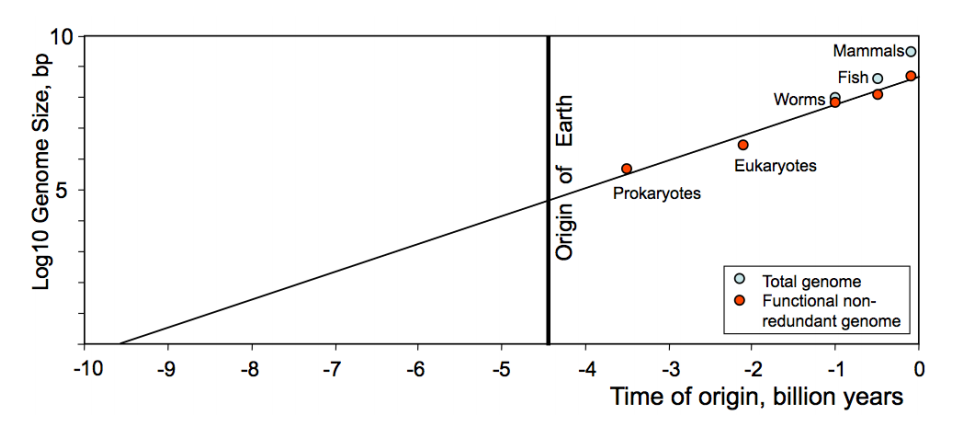
A Moore's Law Argument for Panspermia


From Sharov and Gordon's paper Life Before Earth at arXiv. The implication is clear from the figure - that life has followed a logarithmic complexity trajectory, which is cooler to refer to in terms of Moore's law, but that at 4.5 GA ago (the formation of Earth from the stellar accretion disc) the complexity is not 0. Their figure crosses that line at a complexity of about 10^4.5, meaning a 30,000 bp genome. For reference, the smallest chemical replicators in nature are viroids (RNA that reproduces in plants), mostly around 2,000 bases, although hepatitis D is a virus essentially parasitic on other viruses with a similar genome size. The smallest replicators with independent metabolism are the Mycoplasma (a medically important genus discovered by Leonard Hayflick), generally under a million bp. Your genome is about 3 billion base pairs.

The first question we should ask here is what we even mean when we say "genome size", and why we care (which the authors do somewhat address). There is a difference between absolute number of base pairs in each cell, non-repetitive DNA (information), and functional complexity. If you want to talk about plain old absolute number of base pairs by mass in the cell, then plants win that one hands down, because they sometimes have many many copies of each chromosome - 20 or more. Modern corn has 6. Fine then; you want to talk about non-repetitive DNA, i.e. the Kolmogorov complexity of genomes? If you want to make a compressed file of a genome, some organisms have long stretches of repeats that can be compressed by saying "[repeat] x a million"; I don't think that complexity is what we're talking about either. (For the record, humans have more non-coding repeat DNA than coding DNA. Coding is about 3% of our genome, and just the most common type of repeat, the Alu element, is 5%.) Even taking that into consideration, yes, vertebrates have bigger non-repeating genomes than most other organisms, but among the vertebrates, non-repeating genome size and behavioral complexity do not correlate. Unless you're willing to concede that fish are smarter than you, because they have bigger non-repeating genomes. (I'm not willing to concede that.)

I think what we're really talking about here is functional complexity - the phenotype that the DNA produces in extension - and the best approximation of this is the number of genes. The authors of this paper refer to functional non-redundant genome, and even then - are you ready? - by this measure, protozoans win. Yes, amoebas and giardia. The kicker is that Trichomonas, which causes an STD, holds the record for the most genes of any organism yet sequenced. (I debated including a picture of its effects but I decided against it. You're welcome.) So it's time to retire your vertebrate chauvinism, or at least find another justification for it, because you're not that complex. For more on this, see the C-value paradox.*


All hail Trichomonas, our genomic superior. This is the one that infects humans; another one in the same genus infected T. rex.

That said, functional non-redundant genome size may still not be a totally awful indicator of genome complexity over geological epochs, but there are still further issues worth pointing out: they assume a constant trend and argue for it based on several other provincial (terrestrial) examples of complexity. We can't really assume that an algorithmic approach to processor speed and scientific publication rates give us the correct start date, and therefore so does the origin of all life, especially when the chemical substrate must have been different early on (see the RNA World hypothesis). They also get a little greedy reducing things to big picture neat-o ideas; for example, the Singularity makes an appearance. I think it's worth pointing out that we're still working out the troublesome details of the origin of replicator chemistry under early-Earth conditions and there are some fairly good answers now, but if replicators predate the Earth that begs the question of under what conditions did they appear. I've made the argument repeatedly that replicators could spread on comets and asteroids but it's much less likely that they originated there. Too cold, too dry, boiling point of solvents too high under low pressure atmosphere.

Of course it's an interesting paper (link here) but that doesn't mean it's correct. If it is correct, it means the evolution of life elsewhere is even more certain than it was before, which makes the Great Filter all the more daunting.


*My own take on the the C-value puzzle is that it's actually not that puzzling, unless of course you assume behavioral complexity must mean genomic complexity. For one thing, those protozoans have very complex life cycles, and have managed to preserve a lot of the behavior of eukaryotes that their single-celled prokaryotic comrades never had; the vast majority of our own cells are coddled in a vast bureaucracy that protects them from the outside world, and even if they screw up and die or reproduce out of control, there are a trillion more of them and an immune system to kill them just in case. There is also very little pressure on multicellular eukaryotes not to let their genomes accumulate a lot of junk, much of which is likely to be non-coding repeat elements. The amount of extra energy it takes your cells to reproduce their Alu elements today is far, far less than the amount of energy it takes you to scratch your head, and you aren't starving because of that either.

Wednesday, January 30, 2013

The Awesomest Shirt Ever

It's mine and you can't have it. Actually if I make it public on Cafe Press you could, but then certain parties might notice and demand it be shutdown and ask for all moneys. And I'm not talking about Darwin.


Sunday, January 27, 2013

Asteroid Mining and Detecting Others' von Neumann Probes

With the announcement of "firefly", 3D-printing spacecraft to mine asteroids, we're getting closer to exploring space with multiple smaller craft, as well as more immediately economically rewarding activities, which is what will drive space exploration faster.


Of course it's also exciting because I think exploration of low-gravity bodies will give us more information about life elsewhere in the universe than we expect it to. While reasoning about extraterrestrial life invariably means making assumptions we don't even know we're making, based on what we know about the evolution of life on Earth and the number of planets in the rest of the universe, the development of some kind of replicators outside the solar system seems overwhelmingly likely. If we think at least partly self-reproducing probes are possible - and notice above that investors right here on 2013 Earth are trying to convince people they are - then we might be better off trying to get information about extraterrestrial life from artifacts already here in the solar system than from signals.

It is also likely that lower gravity bodies are better for any entity that wants to continue spreading, since gravity wells are energetically expensive to get in and out of. If you can get matter without descending onto a high gravity surface, you should. (Yes, "but what if aliens have antigravity" - but if we're going to bother thinking about it, we have to make guesses with what we know now. Otherwise maybe they'll ride unicorns. More seriously, if they don't care about gravity, why would they waste time with small gravity bodies like Earth? Mine the cores of gas giants. Hide just outside event horizons to evade detection.)

I've given previously in detail my arguments for why these artifacts might already be here, and where we might look. Comets and asteroids was the answer, so of course I'm excited that these mining probes may explore a number of asteroids during my lifetime. If there's something obvious, excellent (and frightening).

If they don't find anything it could mean:

1. There's really nothing there to find. Intelligent life is much rarer than we think. Replicator chemistry is either not as inevitable as it seems, or there's a Great Filter between algae and interstellar expansion, or life is just rare enough that we're isolated.

OR

2. Something is there to find, but we don't notice it at first.

Because we're looking for something alien - something completely outside our experience - it's hard to say what a gas chromatograph of chewed-up alien von Neumann probe chemistry would look like. (This is why I hope full rocks are towed back, so we can have people in Earth orbit doing real chemistry on them.)

So how to distinguish 1 from 2? Keep looking, and follow up any interesting chemistry we find, "interesting" meaning any low-entropy repeating patterns, either temporally or spatially, on low-gravity bodies. I very much doubt we're going to find a metal ship crouching amidst a flying rubble pile. I do think we'll find strange chemistry that's worth looking into, at least insofar as it's relevant to the origin of life on Earth, and at least with comets that's no longer controversial. I haven't yet seen a model which examines what fraction of asteroids we would expect to be colonized by theoretical replicators, so I'm not sure at what rate I should de-weight my expectation of finding alien artifacts on asteroids, as more asteroids are mined without the merest

Saturday, November 24, 2012

Fermi's Warning: Problems in Interstellar Exploration and Detection

[I have an article on the Singularity coming up at the European science/fiction magazine Concatenation in a couple months. Please visit their website ahead of time!]

With the discovery of planets around Alpha Centauri, the time for serious discussion of interstellar exploration has arrived. (And it's been going on in earnest for a while now.) Of course, the people who launch the probes will know they can't possibly see the up-close pictures of any extrasolar planets in their lifetimes. But if we're willing to set aside money in endowments to compound interest for the sake of future generations, why not do the same with long-term space travel?

A sensible approach is to send multiple small probes that behave as a network. Even if they can't reproduce, and even if they can't repair each other to some degree, this is superior to putting all your hopes into one object moving at relativistic speeds in unknown domains. It would be bad if, after millennia of waiting, your single big ship hit a comet in Alpha Centauri's Oort cloud. This is the proposal of Allen Tough and is being realized through a Cornell-initiated project now funded by KickStarter. Landers are a tougher problem, particularly on planets with thin atmospheres where we can't use high effectiveness-to-mass technologies like parachutes to slow the descent.

A Sprite chip-sat.

Human missions are much more difficult engineering problems - either of engineering the vehicles, or engineering the humans inside them. The problem of how to get humans to another star is likely to take much longer to solve than how to get unmanned spacecraft to another star. At the same time, keeping our eggs in different baskets is a good survival strategy for the long term, but that's no reason not to send machines out ahead of us.

At the same time, it's possible that if we reach other worlds similar to the one where we evolved, life (intelligent or otherwise) may already be there, and this may impact on our survival also. Consequently any program of interstellar exploration must be part of a program which acknowledges the very frightening implications of the Fermi paradox and also how to detect intelligent life, if it exists. At all costs we should avoid detection, the results of which which may be another answer to the Fermi paradox (i.e. that the Drake Equation should contain a term for predation.)

Consequently, here's a brief summary of some problems in interstellar colonization and interstellar evolution. Surprisingly, I haven't found an argument map for the Fermi paradox, the Singularity and related arguments, which is what I was initially planning to use as a figure.


1. Whatever path we take to the stars, it will likely be one that yields profit in the near term. Interstellar exploration cannot do this, and will have to be borne on the backs of ventures that produce a return for the investors and/or citizens involved, like (possibly) asteroid mining.


2. The Fermi paradox is likely to be solved by one of two things: we are alone at least in terms of intelligent life (i.e., there is a great filter in front of us) or because they exist, but we don't know what we're looking for or at. This latter option complicates things and makes the universe seem more dangerous.


3. To find places that may be useful to us and/or alien life - assuming complex replicators made of matter (will we even recognize complex replicators that aren't?) we may also assume the following are more likely than not, and constrain our search accordingly:

3a. We should look where there is more matter, and more mature stars (longer for life to evolve and expand beyond its home world). This means to look inward toward the galactic center. On Earth, evolutionary innovation comes from the equator and expands north, for a similar reason: more energy into the system, more liquid water, and more evolutionary innovation. A similar principle may describe the distribution and migration of life in a spiral galaxy.

3b. Look for places with the best reaction media to produce replicators. Standing liquid makes the emergence of replicators more likely because you're creating an environment that favors the rapid interaction of molecules. Water is an especially good solvent because of the number of combinations it allows. This isn't an aqueous-carbon chauvenist argument - if there are other environments that allow replicator building-blocks to interact more rapidly and richly, then those environments will be better places to look for life than places with water.


Basis for aqueous chauvenism: it doesn't have to be a planet-wide ocean, but we don't
know of any reaction media that encourage diverse chemistry as well as water.


3c. Suspect life in proportion to reaction volume. If we're talking about water, this means more surface area, and more depth. As origin zones, possibly liquid-water-bearing super-Earths are then more likely to originate life than small worlds.

3d. Look for places with a good reaction medium as in 3b, but with low gravity. This directly conflicts with 3c, but low-gravity bodies with water would be good places for life to spread to (i.e. Enceladus) because of the economics of shallow vs. deep gravity wells. A watery moon of a warm gas giant would be even better. In this sense, super-Earths are interstellar East Africas; places like Enceladus are an interstellar Polynesia. (Admittedly intra-Earth colonization is a dangerous analogy in this discussion.)


4. We should look for artifacts at least as much as signals. Artifacts may be easier to recognize as extrasolar better than artificial signals; and, if some form of interstellar colonization is possible, or at least exploration, we should expect to find artifacts in our own solar system already, unless we think we're the first or are somehow amazingly lucky. The presence of artifacts is also a better test for te possibility of interstellar travel than signals. If von Neumann probes are possible (or "space algae", if we can tell the difference) we should look for evidence on small bodies in the solar system, again because of the economics of gravity wells. If we don't find evidence of artifacts once we've explored even a fraction on any low-gravity bodies, and von Neumann probes are possible, then the possibility of life or its artifacts expanding beyond its home solar system is de-valued significantly. (I would put this on Long Bets but at the rate of current exploration, don't think the question will be settled in my lifetime of maybe half a century more.)


5. I've already made many huge assumptions here, and I'm being more conservative than most. It bears keeping in mind that we have N=1 and we don't know what we're looking for or at.

Saturday, November 17, 2012

Intelligence Itself as the Great Filter

[I have an article on the Singularity coming up at the European science/fiction magazine Concatenation in a couple months. Please visit their website ahead of time!]

I referred to the Great Filter in an earlier post.  This is the idea that the great silence the Fermi paradox seeks to explain is not illusory:  we really are alone.  If that is the case, then since we know of one example of life and intelligence which did evolve, there must some event or set of events that dramatically decreases the odds of life evolving, becoming intelligent, and spreading from its home or at least signalling its presence.  By self-indication arguments, we can assume that many other species have achieved a level of intelligence similar to our own, but that something must have happened afterward to keep them from persisting or expanding.  This means it is also likely that the filter is still in front of us, i.e. that we will go extinct or at least be permanently confined to our solar system.  I'm increasingly unable to discount the idea that intelligence itself is probably, usually, an evolutionary dead end. 

The less interesting version of this idea is that given the way evolution works, intelligence is invariably layered on top of older systems like emotions and appetites, which were previously constrained by the limits of their behavior but once amplified by intelligence quickly destroy the surrounding ecosystem.  (Essentially, the Special Agent Smith argument, but stripped of misanthropic moralizing.)

The more interesting version is that once a self-aware entity understands that pleasure and survival are separable - i.e., that its survival signal is not the same as its actual survival - and has the means to manipulate the former intentionally (ie full simulation and/or goal manipulation, which are the ultimate ends of heroin, pornography, and ideology) then the end is close.  This is a much more pessimistic version of involution.  Singularities could be thought of as either of these - a form of ecologic degradation that doesn't result in interstellar colonization, or as an opportunity to dissolve into fantasy worlds.

Finally, it could just be that it's incredibly unlikely that any life which evolves from matter, at the bottom of a gravity well, with a life-cycle inextricable from such an environment (needing an atmosphere, solvent, a complex web of other replicators), simply cannot expect to expand across a universe where even inside the comparatively cluttered galaxies the possible new homes are separated by light years.  To a first approximation, the universe is made of vacuum with some dark matter.  It may be then that every star is surrounded by an insurmountable Wallace Line.

Saturday, April 28, 2012

Saberhagen's Berserkers and McDevitt's Engines of God

I just read Fred Saberhagen's collection The Berserker Wars (1981).  Many of my criticisms are those you would get from 50s-60s science fiction (these were actually written from '67 through '79).  While Saberhagen was not the first to write about self-reproducing autonomous machines, he was the first to make them the central theme of his stories - in this case, they're the still-functioning weapon of a now-extinct species whose greatest weapon exterminated both their enemies and then their creators.

I didn't enjoy the collection, and as someone who obsesses about the advent of hostile self-reproducing machines, I was really looking forward to it.One issue I had is that Saberhagen was a chemist and electrical worker by trade but there's not much technical detail on these subjects in his writing.  Why not?  This is the kind of thing I was hoping for from him. 

My biggest complaint is that, for a series of stories about self-reproducing machines, there doesn't seem to be a lot about how machine intelligence or consciousness (if any) is different from us, what it's like to deal with them, the inevitability of civilizations building such machines, or any number of other deeper questions.  What he does do, in keeping with one of military science fiction's biggest character flaws, is just re-frame a real historical battle in science fiction terms - in this case, both Midway and Lepanto receive such a treatment.  For most people, when they want to read about certain historical battles, they read about them.  Yes, Asimov re-told the late antiquity and early medieval period of Europe with Foundation, but there were other lessons to be gleaned (i.e., direct examination of theories of history, types of governments, the predictability of human action over time) but Saberhagen's recasting of these battles, aside from changing costumes, doesn't ask or add anything.

My final complaint is that the machine aliens were nowhere near as alien or remote or sinister as they could have been to be the ultimate life-exterminating protagonists.  Daleks are scarier than these things, seriously, although too-human aliens are not unique to this book.  Which is my segue to another book, borrowed from friend Greg despite his protestations that I wouldn't like it, Engines of God by Jack McDevitt.  (It's bash science fiction day here at Speculative Nonfiction.)  McDevitt seems to have set out to create a hybrid hard + anthropological sf, and turns to the trope of "solving" ancient myths by recasting them in modern terms - in this case, the story of Sodom and Gomorrah as an attack by a force which destroys technology-using species.  I would say "spoiler alert", but the characters spend the whole book stumbling around ruins trying to figure out if there's any connection between the planets they're excavating, and events on Earth, and any reader not in REM sleep knows that there must be!  Kind of like vampire novels where the police find the third victim drained of blood by two puncture wounds in their necks and say "Dangnabbit, this is the third one what ended up like this, what could this mean?"

Besides the, again, very human-like aliens (so that anthropological principles apply to them - religion, fertility cults, you name it - I'm not going to spend any more time on that) you have to ask, how is it possible that aliens happened to achieve the same technological level as us within 50,000 years or so, given the much vaster sweeps of time to be had on the scale of the galaxy as a whole?  It's hard to be impressed by science fiction where one alien race is considered ancient because they began traveling in space 100,000 years ago - because that's still an amazing coincidence!  100,000 years in terms of the lifespan of the universe is essentially simultaneous with us. "Ancient" would be if they did it before the Earth formed.  Even if they did it within 1% of the evolution of life on this planet, that would have been during the late Eocene, when most of the east coast of North America was still a jungle and we were only finally starting to get familiar looking mammals because clear orders had finally emerged (primates, carnivora had at least branched into cats and noncats, etc.  Certainly if the aliens that developed space travel within 1% of Earth life's evolution landed, there wouldn't be anyone to talk to.)  Even if later in the series it turns out some engineer species had indeed designed all the local intelligences to emerge onto the interstellar scene within a few dozen millennia of each other, that this isn't obviously a coincidence to all the characters right at the beginning makes it very hard to suspend disbelief.

Okay, I'm done beating up science fiction books.  That comment about the mammals of the late eocene prompts a question:  at what point in Earth's history was a primate the smartest thing on the planet?  The ancestral primate was not a brilliant-looking fellow (see below).  What were the smartest things before then and during what periods?

Above: your grandmother just 1% of Earth-life-time ago. And people are impressed with the ancientness of aliens that were traveling in space 50,000 years ago? Dude, that's pretty much simultaneous with us.

Friday, August 6, 2010

Crocs Can Eat You, and Also They're Getting Smarter


Yes, that's his hand over there. Image credit Northern Territory News.


Saltwater crocodiles the scariest animal in the world, hands down. Lions are scary but you usually know when they're around. Great white sharks are scary but they don't come out of the water for 200 meters and drag you out of your tent, like these guys have. What's worse, now they're getting smart. The one above was photographed herding fish to eat them. Forget Bears Discover Fire, this is much worse. There are also unconfirmed reports that this one has learned to handle currency and was seen negotiating for a ride into downtown Darwin where he could eat more people.

I think I want the AI Singularity to happen before the Crocodile Singularity.