Showing posts with label politics. Show all posts

Monday, December 5, 2022

Why Are UAPs Associated With Naval Aviation?

We're more likely to find artifacts from technology-using aliens - self-reproducing (von Neumann) probes - rather than the aliens themselves, or even to recognize and understand their signals against background, if any. Indeed, humans may be just at the technological threshold of building such probes right now, but we're far from any serious discussion of manned interstellar travel, and in fact it may never be biologically feasible. Such objects are likely to be found associated with lower gravity objects, ie the asteroid belt, where they can obtain materials and build more of themselves. The further they are from home, the less likely they are to adhere to some "mission", and the more likely they are to have mutated and been selected merely for fecundity (reproductive ability.) Therefore it's not obvious that they would be particularly interested in finding other examples of intelligence. They could very well be much more interested in finding other von Neumann probes, and humans might therefore not be the most interesting thing in the solar system to them. If this is the situation that obtains, this resolves a contradiction: other technology-using species have indeed appeared before us, but there's little evidence of them here.

If the von Neumann probes are built from metal, and one planet over the last few centuries suddenly has large metal objects moving around its surface (ships) and smaller metal objects moving much faster through the atmosphere - then THOSE might be interesting. You might expect the probes to be especially interested in locations with lots of ship and air traffic, and especially the ones with the fastest air-objects, especially if the fast air-objects come and go from the large metal objects on the surface. It's been observed separately by other writers that, from the standpoint of an off-world but in-solar-system alien observer of Earth's behavior in terms of natural processes, the appearance of metal objects in the atmosphere and then suddenly in orbit is the most interesting phenomenon that has appeared here for many millions of years at least.

The fact that it's US Navy aviators who have reported many of the UAP sightings is obviously relevant. Given that the reported observations are made by multiple modalities (naked eye, radar, thermal) and official US agency reports describe as likely mostly physical objects, it's unlikely these are glitches: that is to say, either they're real, or they're made up, possible as sort of intelligence or misinformation operation that we civilians are caught in. But if it's real, two questions are important to the hypothesis.

First: is there really a higher rate of UAP sightings around US Navy aviation areas (as there seems to be so far, with sightings concentrated around San Diego and Virginia Beach) or is this just bias because there are more instruments and observers there? Such is the frequency of these events according to the reports that a relatively low-budget operation with some weather balloons over a low-traffic area could move the needle on whether naval air stations are "enriched" for these objects. (If it does not make any such observations, it would suggest either it's a misinformation campaign, or they're real but concentrated around naval air stations.) Related: do JFK or LAX have similar sightings? Or Heathrow? Narita?

Second: is it really an American (or mostly American) problem? Is the pattern repeated around the world at other countries' naval air stations? China or Russia might not be interested in sharing this kind of information, but NATO allies might be. That said, if an unfriendly country discloses it is seeing the same thing, and it has no explanation, then it's much more likely that these objects are real, and at least are not human-created phenomena.

Monday, December 10, 2018

Space Colonies Will Be Run By Dictators; Or, Why Science Fiction Is About Government Space Travel

Settling colonies in the age of exploration was easy. Jamestown in particular seemed like a breeze. There was air, water, food, and even people who would sometimes help you if you were nice to them. Even still, it wasn't until the third ship arrived from England that the colony became self-sustaining. The Norse were unable to hold onto Greenland at all, and we still in 2018 have not put a self-sustaining colony on Antarctica . That the land does not provide basic life-sustaining commodities for free - that there is no indestructible commons where air and water is concerned - has led some political scientists to speculate that the natural state of any off-Earth colony would be that of "Oriental despotism", which earlier historians associated with the culture of the Middle East. Another way of looking at this is that there's a predisposition to strong central authority anywhere that central coordination is required for survival. This might mean political rent-seekers who control the water by force, as in parts of the Middle East, or the coordination of crops that are massively productive when huge teams of people harvest it, as with rice in East Asia. This also solves the mystery of why states emerged initially in places that were actually quite marginal for agriculture - the dry high altitude Mexican Plateau, the Nile Valley, and the Fertile Crescent (with the exception of China - still explained by a benefit of central authority's ability to coordinate labor.) On the other hand, places where berries and game almost jump into your mouth are not famous for producing large states - though they do often produce impressive cultures, like the Pacific Northwest. When you get angry at some tribal council decision, it's too easy to storm off and take your family into the next valley and start hunting and gathering there. Not so when your life depends on predicting and collectively exploiting, say, the flooding of the Nile.

But there is still another reason to think that space colonies (planet-bound or not) will resemble the walled fortress of a desert, or the absolute authority of an Eastern monarch, more than a democracy. (Yes, it gets worse.) How do you get your family to your new valley? You can walk - even if it takes a while. If you got sick of Ohio and wanted to head west, you might have to pool your funds with other families but it didn't take that many families before you could put a small wagon train together. Leaving a gravity well and building a habitat are massively complicated and expensive undertakings. This is why space launches are the province (so far) of wealthy states and so far, just one corporation. For economic reasons of massive capital requirements, space travel will therefore be performed in a way that advances the interests of wealthy states and/or corporations. (This is similar to the reason movies are more constrained, i.e. less imaginative, risk-taking, and creative than writing or visual art - they're very capital-intensive and it's much more important in this medium to make back your investment!) Science fiction typically continues to imagine it this way, likely correctly - but rarely explores the pitfalls of large organizations having a stranglehold over the means of transportation in this brave new world - or the impact of, say, aliens appearing and handing out technology that allows individual humans to cheaply travel between planets. (Libertarians - if you think having private corporations do it, you not only have to explain how they will obtain such a position in the company of a cartel of violence-monopolizing organizations called states, you have to explain why it's better to be oppressed by a privately held rather than public organization. Left-leaners, if you think states are the ideal organizations to undertake such ventures, keep in mind that the first country with a real rocketry program was Nazi Germany, and the fastest growing one today is free-speech-crushing, putting-Muslims-in-concentration-camps China.)

It's also worth pointing out that, for related reasons, such colonies will be dependent on Earth for a long, long time, much longer than Jamestown was dependent on England. Why? First off, people are much more comfortable now. Second, when the first settlers arrived in Jamestown, they were able more or less to build on their own the technology that they were accustomed to in England. Yes, in the case of iron production, English colonists actually reverted to a medieval version for a while, but they were still making the nails and blades and gun barrels and plows that they needed. What about the first settlers on Mars? Will they be able to make a smartphone? Will they be able to make another spaceship, or habitat, or geodesic farming equipment, or satellite dishes? Even assuming zero surplus mortality from the harsh Martian environment, how many ships and people are necessary before the Martian Jamestown is self-sustaining? The Martian despot will likely be interested in not just controlling the oxygen and water, but the shipments coming from Earth.

Wednesday, April 13, 2016

Mad Max Is Not the Old West; Also, Why Does Everything Alway Get Worse?

In the peri-marketing articles that appeared with the release of Fury Road, there was a lot of comparison to Westerns. This comparison is never explored, probably because it's wrong, and frustratingly so. Mad Max and Westerns both feature a lone warrior with a rough sense of justice fighting the good fight against desert savages. The difference is that in Westerns, the sheriff is fighting to protect civilization because he knows that things will eventually get better. In Mad Max he keeps fighting despite knowing that things will only get worse. In Westerns, good folk set up homesteads on the frontier knowing full well that there are savages around, but the settlers can be reasonably assured that the sheriff or the cavalry will gallop to their aid from the unassailable (if remote) centers of civilization back East. In Mad Max, there's no hope; the raids tomorrow will be worse than the ones today, and for damn sure there will never, ever be any cavalry to help you. (In fact, you should assume a lot of the savages used to be the cavalry.) Yet, despite this, Max does retain something we recognize as a sense of right and wrong, which appears increasingly absurd given the futility of resisting the overwhelming tide of barbarians and madness. And that's why he's interesting. The free will to choose right instead of wrong is the only thing left to him, and he chooses right. Mad Max is much more like Dr. Rieux in The Plague than he is like any frontier lawman.*

That leads to the second part. Mad Max movies revel in how much nastier the world keeps getting each day. Mad Max movies are apocalpyse porn. Through the four movies we watch as life gets progressively more nightmarish. We go from some punks robbing people in the first one, to an irradiated Darth Vader wasting water in front of dying old people and imprisoning women for their wombs and milk. Why this dystopia fetish? As always with any fictional narrative, we can break the answer into two kinds of influences: forces internal to the logic of the narrative (what happens in the story), and forces external to the medium (that is, economic forces in the real world where the story is a product). Internally, we get the filmmakers' message that oil-based society will crash badly, and that nuclear war would have grotesque consequences. Externally, over time these movies found themselves in a market with more and better action movies and had to sell tickets. Utopias offer few opportunities for violent conflict and therefore ticket sales. And frankly, there's also a very real pornographic aspect to making the world more and more hellish that emerges in post-apocalpytic fiction generally.

Absent from the movies after the first two is any kind of collapse-of-moral-authority warning that social conservatives love to illustrate in detail: that if we let the softies and criminals take over, well then the strong men are justified taking matters into their own hands to give the baddies a dose of their own medicine.** (Maybe all social order requires a threat of violence somewhere at the core of the system, and the very real but better-socialized psychopaths currently in charge get mad at the threat from outsider psychopaths, and ache to respond in line with their true natures.) In the first movie, Max is a cop, guarding the roads and avenging his family. Certainly by Thunderdome, there is no longer a clear source of legitimate moral authority (at least with armed, loyal adherents to enforce it) for Max to defend anymore. Was there ever a legitimate authority? Possibly the greatest cruelty of the world of Mad Max has been to take away even the past by exploding the comforting myths of history. And possibly, this bothers us because we've had the same thoughts.


*Deserts tend to figure in existential and/or exotic fiction for Europeans and people/cultures of European descent - even cultures that have deserts, like the U.S. and Australia - because to European eyes, the desert is bizarre, and open, and by its nature obviously threatens our continued survival and even our sense of our own significance in the scheme of the universe. Science fiction may rely a little too heavily on this trope, although granted, Dune would not have been the same in a boreal forest. Still, I can't help but wonder at the source of the different roles that deserts play in the psyche and literature of Australians and Americans. American deserts are a little more liveable, and they have mountains and therefore rivers and occasional green spots - versus Australian deserts, which have much nastier critters, and which look like Mars with a few tufts of grass, and are about as good at growing crops. Australia doesn't celebrate its desert-crossing pioneers to the same degree as America, because mostly what the Aussie explorers got was a clap on the back from their countrymen that they made it, after accurately reporting back "Yep, it sure sucks out there." Australia also doesn't celebrate its homesteaders, because to a first approximation it doesn't have any, and can't. Consequently, American deserts became places of optimism and adventure and conquest, and Australian deserts are places devoid of meaning and best avoided.

**Have you noticed the following pattern with Mel Gibson's characters and scripts? A moral man driven to darkness by his enemies, angst-ridden, often taking vengeance on those enemies in horrifying ways only slightly less insane or evil than them. Mad Max, Lethal Weapon, Apocalypto...and what was that Roman-Middle Eastern one?

Wednesday, July 23, 2014

Avowed Metalhead Now President of World's Largest Muslim Country

More here on Joko Widodo, president-elect of Indonesia.


Given his shirt, I wonder if he is "chuffed". Indeed, perhaps his father said, "Turn that dine. Turn that unemployment dine. Wot koinda policies are them." Napalm Death inside jokes have a limited audience, but such is my refined taste in humor.

Friday, July 12, 2013

And This Wouldn't Even Be the Singularity


From the Berkeley Robotics Department.

Economist Tyler Cowen asks "What is the political equilibrium when insect sized drone assassins are available?" All answers are unpleasant. This isn't even the Singularity, just a seemingly very likely possibility as mobile electronics continue to get smaller. They don't even have to be autonomous.

The smaller that automation gets, the more potential for disruption. We vastly underestimate the disruption from small autonomous flying robots. You'll move (or run) if you're walking somewhere and see bees. And bees are stupid and mostly want to ignore us, and can't even kill us.

Saturday, June 15, 2013

China Sends Astronauts to Its Own Space Station

Three astronauts have arrived at Tiangong-1. I'm amazed at how little media attention this event has received in the West.

Thursday, June 13, 2013

Are People Less Likely to Become Colonists Now?

As compared to a few centuries ago? Certainly. Humans in general today are less likely to strike out to a new land and become colonists. Why is this?

(This is cross-posted to my science fiction and fact blog, The Late Enlightenment.)

1. The environments that are available to us are harsher. Seasteading? The Antarctic? The Moon or Mars? Come on, do you really want to live in any of those places? Sure, Virginia may have had a bit more malaria than England but it has a) solid ground, b) it never drops below -50 C and c) it has a 21% O2 atmosphere. Consequently, it takes a more complex and developed economy to allow survival in the harsher land. And even Jamestown wasn't self-sustaining until the third ship full of people and supplies arrived. (More on Jamestown and Mars here.) And think: how big would a colony in Antarctica have to be in order to be self-sufficient, and make all the equipment they need to survive, not to mention to trade with the rest of the world? (See below for places that are much more amenable to humans than Antarctica and frontiers ripe for settlement right now, but somehow are still not filling up with colonists, in some cases despite the local government's attempt to draw them.)

2. There is a bigger skills gap between the median person and what a colonist needs to know. Even if a new island appeared above the ocean and had a nice temperate climate, few of us (especially in the developed world) would be able to take advantage of it. In Jamestown, people plowed and planted fields, hunted, chopped wood, and built small structures. That's pretty much what they were doing at home except for the building part. Even in the developing world, the gap between the skillsets required of someone living day-to-day versus what they would need to do in a terra nova is much wider than what the settlers of the New World faced, or the Polynesians that expanded across the Pacific. And the hunter-gatherers who crossed the land bridge from Siberia to North America almost certainly didn't even know they were on a new continent (and why would they have cared?)

3. We're just more comfortable. Yes, there are still people in desperate poverty, but not as many of us three centuries ago. The median human is much happier, and if they move, they have more information about which countries offer better opportunities, rather than helping to build a country from scratch.


The exceptions I alluded to above are Siberia and the Canadian interior and the Australian Outback. That's a significant chunk of the Earth's land surface. Seriously, if you think that there is no more wilderness and no more frontiers, just buy a few coats and a hunting rifle and move to the Yukon. West Australia is the size of America's Western and Pacific time zones combined and has a population of 2 million, 1.5 million of which are in one city, and at least near the coast a Mediterranean climate quite like California's, and massive mineral wealth to boot - and even with all that, the Australian government has been desperately and unsuccessfully trying to get people to settle it. In any of these places you can quite easily meet Daniel Boone's requirement of refusing to live anywhere that you can see the smoke from your neighbor's chimney. But you won't do this, despite any belly-aching you might have done along these lines. Why not? Because you have a good life already and you have no idea how to hunt, that's why.

Tuesday, June 4, 2013

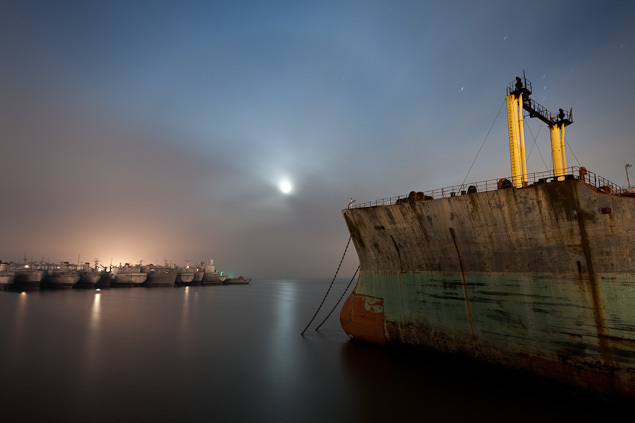
The Ghost Fleet In San Francisco Bay

Cross-posted to my outdoors blog, MDK10 Outside and Facebook too. Find me on Facebook here.

You know that ghost fleet floating in Suisun Bay (the Bay Area)? No? Why not? Images from these maritime "urban" explorers here. Via BoingBoing and Maggie Koerth-Baker, who has an amazing knack for writing/linking THE most interesting science (etc.) stories on the web, period.

Maybe what the government needs to finally do something
with these ships is a few planet bombs. Next thing you
know they're putting wave motion engines in them,
Vallejo's economy picks up, whammo. Win-win-win.

Monday, March 4, 2013

First Law Making Drones Illegal for Individuals, Okay For Government

This is also posted at my economics blog, The Late Enlightenment.

A Senator in New Hampshire - a Republican (more on this below) has proposed a law that would make all aerial photography but government aerial photography illegal.

Francis Fukuyama warned that governments would soon become threatened by this technology, and outlaw it except for their own use in enforcement.

Regarding the New Hampshire Senator's party afiliation: I would like a party that safeguards individual rights, but the GOP is clearly not it at the moment.

Monday, February 18, 2013

The Law-Giving Machines

This post also appears at The Late Enlightenment. This article includes story spoilers.

There are now actual drones in our skies, both watchers and hunter-killers. But they're (so far) only semi-autonomous, and they're on missions to protect us legally and militarily, rather than sent by fellow machines to exterminate. Thought experiments in fiction about automatic law-giving devices have been much more interesting than apocalypse porn about bad AI.

Two short stories come to mind here, one of which has enjoyed recent attention, Robert Sheckley's Watchbird (1990) and Larry Niven's Cloak of Anarchy (1972). Both these stories involve surveillance drones with some degree of autonomy and that can hurt or kill their targets. In Watchbird, the drones are police devices, intended to kill murderers before they commit their crime; the drones are able to learn on the job and once released, they expand their definition and start protecting all living things and even some machines. In the end, another drone is released to kill the first drone species, but of course it soon expands its own definition of what it should kill. (Watchbird was adapted for film here.)

The drone in Cloak of Anarchy is the copseye. In this future world, there are "free parks" where anything is allowed except violence against another human being. The floating copseyes watch over the park,a nd if violence is imminent, the copseye stuns both the aggressor and aggressee, and both wake up later, calmed down and with a hangover. Then someone finds a way to short circuit the copseyes, and within hours factions have formed inside the park and violence breaks out.

The stories present us with two different sets of concerns, based on the problems that occur. In Watchbird, the central concern is the autonomy of the devices. Their ability to learn is what allows the problem to grow, but the protagonist is preoccupied with the very fact of machines executing laws without intervening humans. On one hand this could almost seem like a reactionary position: one of the greatest inventions of modernity was nations of laws and not of men. Intervening humans with narrow self-interest executing these laws have always been the problem! (Hence this proposal for a legal programming language in which to write laws that then have to compile with previous laws.) But even without that quibble, his point is well-taken that when autonomous law-givers are able to immediately carry out their sentence and we can no longer modify them, they might become paperclip maximizers, in Less Wrong parlance: that is, a moral rule which seems universalizable has consequences that humans could not foresee when implementing it in all-powerful enforcers which can no longer be called back. The protagonist has no problem with more efficient enforcement, but the moral mutations allowed by the machines' autonomy.

To this end, naively, little mention is made of the interests of those authorizing and supporting the program. Still, Watchbird does peripherally make the point that technology allows concentrations of power in the hands of individuals in a way that distorts society. With sudden increments in enforcement power, some humans are able to apply laws with an all-pervasiveness and immediacy that had just never been possible before. Even someone with good intentions and what you would have called good values would suddenly find him or herself in a position of dictatorial authority. It's not even that power corrupts (although it does); it's that this centralization is so unnatural as to be impossible to handle with a good outcome. The best example is this exchange with the protagonist early in the bad behavior of the Watchbirds:
"One of the watchbirds went to work on a slaughterhouse man. Knocked him out."

Gelsen thought about it for a moment. Yes, the watchbirds would do that. With their new learning circuits, they had probably defined the killing of animals as murder.

"Tell the packers to mechanize their slaughtering," Gelsen said. "I never liked that business myself."

"All right," Macintyre said. He pursed his lips, then shrugged his shoulders and left.
One man is suddenly in the uncomfortable position of morally disapproving of whole industries and forcing them to change. What's more, this previously reluctant man does not seem so reluctant now.

It bears mentioning that the conclusion of the story, where the Watchbird-killers are now expanding their prey definition, is recapitulating one of the problems of a Singularity solution of building anti-AI AIs: there could conceivably be a parallel to an auto-immune reaction disease if humans fell into the definition of AIs.

At first glance the problem in Cloak of Anarchy is a curious one - that humans immediately revert to violent tribalism when the violence control mechanism is defunct - since Niven is elsewhere clearly sympathetic to libertarian concerns. The obvious interpretation of the story is the paternalistic one, that humans need authority to make them behave. But there's another interpretation, which is that the drones created the problem. That is to say, when we are coddled by perfect enforcement from drones, we lose the ability to exercise moral choices, as well as the ability to appreciate the consequences of poor choices. When it is physically impossible to harm another person, why learn restraint? Why worry about what happens when you pick a fight? When suddenly the daddies aren't around to break up the fights and bail everyone out, we shouldn't be surprised at what happens.

The watchbirds do exist today, although with less autonomy and more firepower. The changes are incremental; there won't be a red carpet unveiling of AI even as profound as the release of the watchbirds (or copseyes). They'll be to areas where there's the most pressure for advance, and the least opportunity for public awareness and understanding. It will be, and is, the addition of subroutines allowing a drone to apply the laws of war to a kill it's about to make (instead of getting slow permission from a JAG in an office in St. Louis who might be in the bathroom). It's the growth of autonomous stock trading algorithms. It will even be in advertising on porn sites.

Friday, December 9, 2011

Hari Seldon's Latest Disciple

"While Toynbee was impressing me with the history of civilizations, Isaac Asimov was shaping my view of the future in equally profound ways...For a high school student who loved history, Asimov's most exhilarating invention was the 'psychohistorian' Hari Seldon. The term does not refer to Freudian analysis but to a kind of probabilistic forecasting of the future of whole civilizations. The premise was that, while you cannot predict individual behavior, you can develop a pretty accurate sense of mass behavior. Pollsters and advertisers now make a good living off the same theory."

- Newt Gingrich


From "Newt Gingrich, Galactic Historian" at George Mason University's Heritage News Network. "If men are from Mars and women are from Venus, Newt Gingrich is from the planet Trantor..." Gingrich is not the first person to be inspired by Hari Seldon to do things in the real world; Al Qaeda and Shoko Asahara (sarin-in-the-subway guy) both thought his ideas should be reified as well.

Saturday, November 20, 2010

A One-Way Trip to Mars Would Be Easier

This has been proposed recently as a way to accelerate a manned visit to Mars. An unexamined question is whether it would be easier politically for the world's large dictatorships, and I'm thinking of one in particular that has the money to do it, one which just passed Japan to become the second-largest economy on the planet. China has no shortage of people with difficult lives who a) would be disposed to going where the central government tells them, and b) might not even complain if they think they'll at least get a place in history, let a lone have a chance at personal independence. One of the costs of life being good in Western democracies is that people don't want to leave it; do you know anyone personally who would want to permanently leave for the Martian Jamestown? The people who came to Jamestown didn't leave England (and Poland) because things were so great back home.