 |  |
Sunday, May 26, 2013
The Real-Life Captain Okita (Captain Avatar)

Saturday, May 25, 2013
The Evolution of Metalheads, Or Metal as Confrontation - A Review of Immolation
I've written before about metal as a modern war dance. We'll come back to that in a second. I was listening to Immolation's Kingdom of Conspiracy, which has received great reviews.
Briefly: music is organized sound that evokes emotion - specifically, sustainable non-aversive basic emotions. That is, the basic emotions that you can experience at length and that don't make you want to get away. That means in music we have happiness, sadness, anger, but not fear, disgust or surprise. That does explain most music. And interestingly, this German-Canadian research study comparing the reactions of Europeans vs. Pygmies listening to each others' never-before-heard music shows that a given piece of music might stir different emotions, but a) they would still activate basic emotions and b) they would do so to about the same extent. That is, maybe when Pygmies are listening to Beethoven they get sad instead of happy, but they got sad to the same degree the Europeans get happy, and the Pygmies didn't get contemptuous or disgusted. I found this fascinating because these two groups of people are not only culturally isolated, they are also about as genetically unrelated as it is possible for two groups of humans to be.
Until the mid-to-late twentieth century, there was a hole in Western music in the sense that anger was not represented. Sure, we have military marches, but those are limited in exposure (because most of us are not warriors, and most of us don't have warriors in our families), and associated with large institutions that young males in need of angry music probably don't want to submit to. (Although it must be said, many metalheads also like military marches, myself included, and some metal sounds like military marches.) So it might not be surprising that in the West we re-invented war dances, right down to the posturing, threats and war paint. Seriously. Watch the by now, fully established faces and movements of metal performers and then listen to a Lakota war song or watch a Maori haka. The angry young males of the West had a vacuum in their experience and metal filled it.
So what does this mean when those angry young males become less angry, and much less young? Listening to Immolation, I wondered about two things that have changed in many venerable metalheads' appreciation after decades of listening, for art generally, and metal specifically.
1) For art generally, you become acutely sensitive to structure and format.
To this end, most death metal described as "technical" or "innovative" actually doesn't depart much from the standard format of rock in general established over half a century ago (and frankly dating to blues before that). Intro, verse chorus maybe another verse chorus, bridge, maybe solo, verse chorus outro. (The leads on this record are my favorite thing about it, but they're not new. They're kind of Kerry King meets Michael Amott.) These are the rules of metal, and deviations are reckoned against them. But the reality is that if music deviates too much from a recognizable format, it's not enjoyable, and it's hard to follow; see much of modern classical or avant garde music, which you can't remember immediately after listening to it. All nervous systems have a balance between recognizing patterns, but having enough novelty (mismatches or otherwise unexpected elements in the information) that it causes more attention to be paid. This becomes an increasingly difficult feat as a genre's possible space (given its rules) is swept out by compositions; maybe this explains why new genres tend to appear in big bangs of punctuated equilibrium as a new compositional space is broken into, rather than being best predicted by artistic gradualism. But I notice that us old metalheads, explicitly no longer value novelty like we did (or claimed we did). Someone is intentionally going to write a Part II to Reign in Blood? Sign me up! (Sadly, occasionally bands say they'll do something like this, but then they don't.)
2) For metal specifically, I'm tired of the confrontationalness of it.
As mentioned, metal songs are for the most part modern war dances. And you get past that. If you can't see the performers or the music as intimidating, you can no longer appreciate this part of it; and there's not much else to say on this front. The fantasy of powers that the music projects, either from direct threats and claims of strength or gaining power through taboo violation (a known theme in anthropology) becomes harder to take seriously; there are people and things in the world to be legitimately afraid of, and at a certain point, your boss getting angry at you or your kid getting hit by a car become much scarier than any corpsepaint ever could be, even in some state of suspended disbelief during a show. It also bears mentioning that for young genre music enthusiasts, consuming that particular genre does part of the job of establishing your identity (why should being a metalhead or hip hop fan have anything at all to do with how you dress or any other aspect of your life but what's on you iPod? But clearly they do.) As music fans get older, their identity gets filled in by other things - in particular, profession and family. You hope. Unless that profession is "musician".
The point is not to say, "I'm too old to like metal anymore, and soon you will be too." It's a call to performers and consumers to recognize that innovation for its own sake is not usually productive and it's actually preferable to focus on writing killer music within the rules; and also to establish new rules not for their own sake, but to produce new material that relies on tonal and rhythmic interaction (which itself can make you angry or scared; heard of Opeth?) and not how scary everything is supposed to be.
Oh yeah, the Immolation review. Like I said, I mostly liked the leads. There were a couple big, hummable riffs too.
Briefly: music is organized sound that evokes emotion - specifically, sustainable non-aversive basic emotions. That is, the basic emotions that you can experience at length and that don't make you want to get away. That means in music we have happiness, sadness, anger, but not fear, disgust or surprise. That does explain most music. And interestingly, this German-Canadian research study comparing the reactions of Europeans vs. Pygmies listening to each others' never-before-heard music shows that a given piece of music might stir different emotions, but a) they would still activate basic emotions and b) they would do so to about the same extent. That is, maybe when Pygmies are listening to Beethoven they get sad instead of happy, but they got sad to the same degree the Europeans get happy, and the Pygmies didn't get contemptuous or disgusted. I found this fascinating because these two groups of people are not only culturally isolated, they are also about as genetically unrelated as it is possible for two groups of humans to be.
Until the mid-to-late twentieth century, there was a hole in Western music in the sense that anger was not represented. Sure, we have military marches, but those are limited in exposure (because most of us are not warriors, and most of us don't have warriors in our families), and associated with large institutions that young males in need of angry music probably don't want to submit to. (Although it must be said, many metalheads also like military marches, myself included, and some metal sounds like military marches.) So it might not be surprising that in the West we re-invented war dances, right down to the posturing, threats and war paint. Seriously. Watch the by now, fully established faces and movements of metal performers and then listen to a Lakota war song or watch a Maori haka. The angry young males of the West had a vacuum in their experience and metal filled it.
So what does this mean when those angry young males become less angry, and much less young? Listening to Immolation, I wondered about two things that have changed in many venerable metalheads' appreciation after decades of listening, for art generally, and metal specifically.
1) For art generally, you become acutely sensitive to structure and format.
To this end, most death metal described as "technical" or "innovative" actually doesn't depart much from the standard format of rock in general established over half a century ago (and frankly dating to blues before that). Intro, verse chorus maybe another verse chorus, bridge, maybe solo, verse chorus outro. (The leads on this record are my favorite thing about it, but they're not new. They're kind of Kerry King meets Michael Amott.) These are the rules of metal, and deviations are reckoned against them. But the reality is that if music deviates too much from a recognizable format, it's not enjoyable, and it's hard to follow; see much of modern classical or avant garde music, which you can't remember immediately after listening to it. All nervous systems have a balance between recognizing patterns, but having enough novelty (mismatches or otherwise unexpected elements in the information) that it causes more attention to be paid. This becomes an increasingly difficult feat as a genre's possible space (given its rules) is swept out by compositions; maybe this explains why new genres tend to appear in big bangs of punctuated equilibrium as a new compositional space is broken into, rather than being best predicted by artistic gradualism. But I notice that us old metalheads, explicitly no longer value novelty like we did (or claimed we did). Someone is intentionally going to write a Part II to Reign in Blood? Sign me up! (Sadly, occasionally bands say they'll do something like this, but then they don't.)
2) For metal specifically, I'm tired of the confrontationalness of it.
As mentioned, metal songs are for the most part modern war dances. And you get past that. If you can't see the performers or the music as intimidating, you can no longer appreciate this part of it; and there's not much else to say on this front. The fantasy of powers that the music projects, either from direct threats and claims of strength or gaining power through taboo violation (a known theme in anthropology) becomes harder to take seriously; there are people and things in the world to be legitimately afraid of, and at a certain point, your boss getting angry at you or your kid getting hit by a car become much scarier than any corpsepaint ever could be, even in some state of suspended disbelief during a show. It also bears mentioning that for young genre music enthusiasts, consuming that particular genre does part of the job of establishing your identity (why should being a metalhead or hip hop fan have anything at all to do with how you dress or any other aspect of your life but what's on you iPod? But clearly they do.) As music fans get older, their identity gets filled in by other things - in particular, profession and family. You hope. Unless that profession is "musician".
The point is not to say, "I'm too old to like metal anymore, and soon you will be too." It's a call to performers and consumers to recognize that innovation for its own sake is not usually productive and it's actually preferable to focus on writing killer music within the rules; and also to establish new rules not for their own sake, but to produce new material that relies on tonal and rhythmic interaction (which itself can make you angry or scared; heard of Opeth?) and not how scary everything is supposed to be.
Oh yeah, the Immolation review. Like I said, I mostly liked the leads. There were a couple big, hummable riffs too.
Monday, May 20, 2013
Sunday, May 19, 2013
Metal Appreciation Degrees, Cont.
Tyler Cowen writes about the metal degrees earlier noted here in "How to Make the Rate of Return on Higher Education Negative". When this post is on your screen, the pixels between the letters will emit not just light but silent sarcasm. It's truly wonderful.
Starship Century Symposium UCSD
With Gregory Benford, David Brin, and others. At Atkinson Hall, UCSD. More information here.
Wednesday, May 8, 2013
Those As I Lay Dying Lyrics Have a Different Meaning Now
Kind of like re-watching the old Naked Gun movies where OJ is a cop. Story here. I've often said I liked As I Lay Dying Songs because they don't f*ck around and I didn't know how correct I was. Fellow metal fans are often not kind to Christianity and in As I Lay Dying's case I encouraged them to overlook this.
Monday, May 6, 2013

Sunday, May 5, 2013
Saturday, May 4, 2013
Skynet is Already Practicing on Pigs
Wild pigs are being exterminated with drones. At least the apocalypse will have bacon.
Thursday, May 2, 2013

Wednesday, May 1, 2013
Interview with Yoon Ha Lee in Clarkesworld Magazine
I've posted links to her work before. So much great in this interview, including:

Most of the time I write didactically, as if a short story were a proof. There is some object lesson, or ethical question, I want to leave the reader with. "Ghostweight" is a good example of this; it doesn't pretend not to be didactic. So when I build the character and their strengths and weaknesses and motivations, when I build the setting, the majority of it needs to be in support of that point. With a proof, you want to include all the necessary axioms and arguments, but leave out the extraneous. A short story is very similar.Another great point she makes, in keeping with this motivation in her work, is that her characters are marionettes who serve other purposes in the story and that she's not attached to. Her clarity in this regard is one of many things which makes her prose stand out.
Sunday, April 28, 2013
Metal Philosophical Cosmology
The universe is not beautiful or sensible or meaningful (of course it's not) and it's totally justified being annoyed at the idiots who gasp with horror when someone dares express this, and - seemingly worse - isn't particularly bothered by it. What arrogance and ignorance would make us think it should be in the first place? Outside of the slice where our oversensitive distorted provincial little brains evolved and are able to knit into
a sensible story, it's a mess, exactly as philosopher Jim Holt states here:
As if that's not metal enough, there are occasional other metal things like dark lightning. Gamma ray bursts on Earth! That's metal as hell dude.
...the universe is more ugly than it is beautiful...the form we can expect reality to take at its most general level is that of an infinite, incomplete mediocre mess. The laws of physics are not particularly elegant. The ingredients of the universe show no aesthetic parsimony. There are 60 odd elementary particles. That's way more than is necessary. If the universe is created by a God it's a God with no sense of economy or elegance. There's way too much suffering in the universe. Childhood cancer shouldn't be a part of any decent universe. And even though it's infinitely removed from nothingness the universe also falls infinitely short of containing all imaginable realities.And where's the character-building in a nice universe anyway? If it's all made for us like some kind of eternal terrarium, or even happens to be a nice place to live, you can be a wimp and still survive there. We live in an indifferent mess whether or not we like it anyway. And we can say that without trying to be depressed or shocking about it; it's just a fact. To insist otherwise about the universe is not only deluded, it's clinging to illusion out of weakness. Because most of us are happy we're here, and we survive and prosper in it.
As if that's not metal enough, there are occasional other metal things like dark lightning. Gamma ray bursts on Earth! That's metal as hell dude.
Sunday, April 21, 2013
A Fun Game: Postmodern Writing vs. Written by a Human?
Please enjoy this postmodern text generator, in line with previous writings on Markov chains (here, here and here). This is sort of a reverse Turing test. If people in a given genre of academic writing are generating texts that can't be distinguished from Markov process outputs - and even the people who claim to most understand these kinds of writings can't distinguish them - isn't that kind of a reverse Turing test?
Monday, April 15, 2013
Metal Scholarship, and the Evolution of Distortion
From this Wall Street Journal article. See, I knew there were other people out there who thought deeply about metal! I'm hurt that I wasn't invited as a speaker, but I'll look past this slight for now. (See also the International Society for Metal Music Studies, and the Metal Travel Guide.)
The article and associated resources yielded a few interesting insights. First of all, I confess I'd never heard of Link Wray, the claimed originator of distortion, in his song Rumble (1958), but on reading further I disagree with this claim. Previously I'd assumed that the Kinks invented distortion in 1964, and there may have been independent discoveries. Wray was a reverse Lars Ulrich (or Ulrich is the reverse Wray) in the sense that Wray moved from San Francisco to Denmark and he's early enough that, like Elvis, his work clearly pre-dates the split between rock and southern/country music. Like a kind of musical cynodont, representing the last common ancestor between reptiles and mammals.

Elvis in the Late Permian. Note he was already putting on weight.
But to claim that Wray originated distortion when there is no direct line of inheritance is meaningless. By this same argument, Plato's Timaeus (where he discusses fictional Atlantis) is science fiction, and the people who lived in Minnesota in 5000 BC and made metal tools, then forgot about it until Europeans arrived (yes, really) founded metalworking in the Americas. If there's no continuous activity and no knowledge at all of the earlier tradition, they weren't the originators; they were ahead of their time but without them, that part of history would be the same. So that's why you can call B.S. on (for example) the claim that rock and roll was invented by Roosevelt Graves in 1929 at the Hattiesburg, Mississippi train station (even if I did actually visit that train station at one point to pay my respects.)
What's still interesting, beyond any arguments of who we can call the inventor of distortion, is that the guitar as an instrument has this tension of constantly wanting to become a percussion instrument, and in the mid-20th century technology finally allowed it to achieve this. I would argue strenuously that the nature of the instrument and the way it interacts with our nervous systems justifies such unapologetic teleology. (And note too that you don't see people doing the opposite, i.e. bowing instruments which are normally plucked, for anything but a gimmick.) String instruments started as plucked instruments and only later, probably in the Eurasian steppes of the mid first millennium, did someone think to create a sustained tone by bowing them with horsehair. While plucking gives string instruments a unique sound, it limits their volume, since the decay is so rapid. Consequently when electricity came to music, a method of increasing the punch and sustain of the guitar simultaneously was necessarily close behind. Hence three decades after the first electrically amplified guitar, Wray and the Kinks were the Wallace and Darwin of distortion, and from there in a mere two more decades, it was not an accident that a former drummer (one James Hetfield) was one of the principal architects of essentially the final percussive sound of the instrument that we know today.
The article and associated resources yielded a few interesting insights. First of all, I confess I'd never heard of Link Wray, the claimed originator of distortion, in his song Rumble (1958), but on reading further I disagree with this claim. Previously I'd assumed that the Kinks invented distortion in 1964, and there may have been independent discoveries. Wray was a reverse Lars Ulrich (or Ulrich is the reverse Wray) in the sense that Wray moved from San Francisco to Denmark and he's early enough that, like Elvis, his work clearly pre-dates the split between rock and southern/country music. Like a kind of musical cynodont, representing the last common ancestor between reptiles and mammals.

Elvis in the Late Permian. Note he was already putting on weight.
But to claim that Wray originated distortion when there is no direct line of inheritance is meaningless. By this same argument, Plato's Timaeus (where he discusses fictional Atlantis) is science fiction, and the people who lived in Minnesota in 5000 BC and made metal tools, then forgot about it until Europeans arrived (yes, really) founded metalworking in the Americas. If there's no continuous activity and no knowledge at all of the earlier tradition, they weren't the originators; they were ahead of their time but without them, that part of history would be the same. So that's why you can call B.S. on (for example) the claim that rock and roll was invented by Roosevelt Graves in 1929 at the Hattiesburg, Mississippi train station (even if I did actually visit that train station at one point to pay my respects.)
What's still interesting, beyond any arguments of who we can call the inventor of distortion, is that the guitar as an instrument has this tension of constantly wanting to become a percussion instrument, and in the mid-20th century technology finally allowed it to achieve this. I would argue strenuously that the nature of the instrument and the way it interacts with our nervous systems justifies such unapologetic teleology. (And note too that you don't see people doing the opposite, i.e. bowing instruments which are normally plucked, for anything but a gimmick.) String instruments started as plucked instruments and only later, probably in the Eurasian steppes of the mid first millennium, did someone think to create a sustained tone by bowing them with horsehair. While plucking gives string instruments a unique sound, it limits their volume, since the decay is so rapid. Consequently when electricity came to music, a method of increasing the punch and sustain of the guitar simultaneously was necessarily close behind. Hence three decades after the first electrically amplified guitar, Wray and the Kinks were the Wallace and Darwin of distortion, and from there in a mere two more decades, it was not an accident that a former drummer (one James Hetfield) was one of the principal architects of essentially the final percussive sound of the instrument that we know today.
A Moore's Law Argument for Panspermia
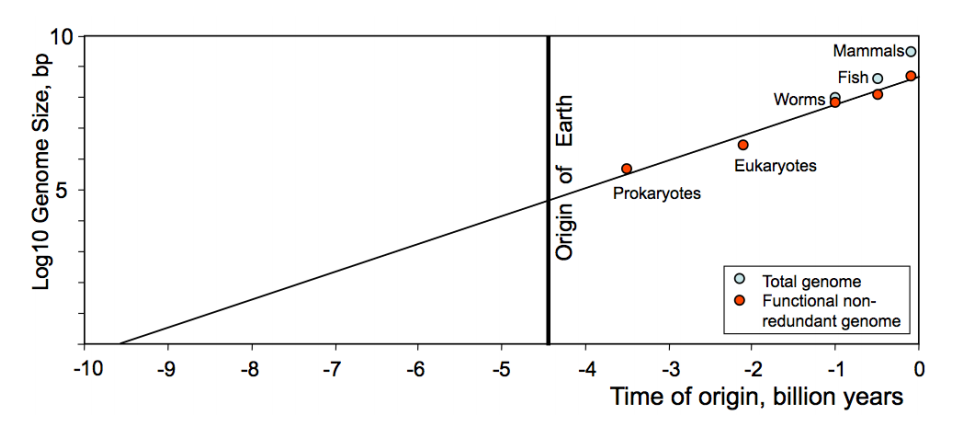
From Sharov and Gordon's paper Life Before Earth at arXiv. The implication is clear from the figure - that life has followed a logarithmic complexity trajectory, which is cooler to refer to in terms of Moore's law, but that at 4.5 GA ago (the formation of Earth from the stellar accretion disc) the complexity is not 0. Their figure crosses that line at a complexity of about 10^4.5, meaning a 30,000 bp genome. For reference, the smallest chemical replicators in nature are viroids (RNA that reproduces in plants), mostly around 2,000 bases, although hepatitis D is a virus essentially parasitic on other viruses with a similar genome size. The smallest replicators with independent metabolism are the Mycoplasma (a medically important genus discovered by Leonard Hayflick), generally under a million bp. Your genome is about 3 billion base pairs.
The first question we should ask here is what we even mean when we say "genome size", and why we care (which the authors do somewhat address). There is a difference between absolute number of base pairs in each cell, non-repetitive DNA (information), and functional complexity. If you want to talk about plain old absolute number of base pairs by mass in the cell, then plants win that one hands down, because they sometimes have many many copies of each chromosome - 20 or more. Modern corn has 6. Fine then; you want to talk about non-repetitive DNA, i.e. the Kolmogorov complexity of genomes? If you want to make a compressed file of a genome, some organisms have long stretches of repeats that can be compressed by saying "[repeat] x a million"; I don't think that complexity is what we're talking about either. (For the record, humans have more non-coding repeat DNA than coding DNA. Coding is about 3% of our genome, and just the most common type of repeat, the Alu element, is 5%.) Even taking that into consideration, yes, vertebrates have bigger non-repeating genomes than most other organisms, but among the vertebrates, non-repeating genome size and behavioral complexity do not correlate. Unless you're willing to concede that fish are smarter than you, because they have bigger non-repeating genomes. (I'm not willing to concede that.)
I think what we're really talking about here is functional complexity - the phenotype that the DNA produces in extension - and the best approximation of this is the number of genes. The authors of this paper refer to functional non-redundant genome, and even then - are you ready? - by this measure, protozoans win. Yes, amoebas and giardia. The kicker is that Trichomonas, which causes an STD, holds the record for the most genes of any organism yet sequenced. (I debated including a picture of its effects but I decided against it. You're welcome.) So it's time to retire your vertebrate chauvinism, or at least find another justification for it, because you're not that complex. For more on this, see the C-value paradox.*

All hail Trichomonas, our genomic superior. This is the one that infects humans; another one in the same genus infected T. rex.
That said, functional non-redundant genome size may still not be a totally awful indicator of genome complexity over geological epochs, but there are still further issues worth pointing out: they assume a constant trend and argue for it based on several other provincial (terrestrial) examples of complexity. We can't really assume that an algorithmic approach to processor speed and scientific publication rates give us the correct start date, and therefore so does the origin of all life, especially when the chemical substrate must have been different early on (see the RNA World hypothesis). They also get a little greedy reducing things to big picture neat-o ideas; for example, the Singularity makes an appearance. I think it's worth pointing out that we're still working out the troublesome details of the origin of replicator chemistry under early-Earth conditions and there are some fairly good answers now, but if replicators predate the Earth that begs the question of under what conditions did they appear. I've made the argument repeatedly that replicators could spread on comets and asteroids but it's much less likely that they originated there. Too cold, too dry, boiling point of solvents too high under low pressure atmosphere.
Of course it's an interesting paper (link here) but that doesn't mean it's correct. If it is correct, it means the evolution of life elsewhere is even more certain than it was before, which makes the Great Filter all the more daunting.
*My own take on the the C-value puzzle is that it's actually not that puzzling, unless of course you assume behavioral complexity must mean genomic complexity. For one thing, those protozoans have very complex life cycles, and have managed to preserve a lot of the behavior of eukaryotes that their single-celled prokaryotic comrades never had; the vast majority of our own cells are coddled in a vast bureaucracy that protects them from the outside world, and even if they screw up and die or reproduce out of control, there are a trillion more of them and an immune system to kill them just in case. There is also very little pressure on multicellular eukaryotes not to let their genomes accumulate a lot of junk, much of which is likely to be non-coding repeat elements. The amount of extra energy it takes your cells to reproduce their Alu elements today is far, far less than the amount of energy it takes you to scratch your head, and you aren't starving because of that either.
Sunday, April 14, 2013
New Call to Regulate Drones: from Google Head Eric Schmidt
This is cross-posted at my technology blog, The Late Enlightenment.
Article here. There's a clear motivation for governments and the enforcer class to have a monopoly on this technology, and Frank Fukuyama among others had predicted some time ago that governments would start creating this monopoly shortly (is this why Chris Squire put down his capital investment of a drone manufacturing facility across the border in Mexico?), but why from the private sector? I'm not sure what Schmidt is doing here. Is he just going on record stating his discomfort with drones so Google can distance itself from perceived vague connections to sure-to-come abuses of technology?
In any event, if you're uncomfortable with your neighbor having a drone, I'm ten times as nervous when the police are allowed to have drones but the rest of us are not.
Article here. There's a clear motivation for governments and the enforcer class to have a monopoly on this technology, and Frank Fukuyama among others had predicted some time ago that governments would start creating this monopoly shortly (is this why Chris Squire put down his capital investment of a drone manufacturing facility across the border in Mexico?), but why from the private sector? I'm not sure what Schmidt is doing here. Is he just going on record stating his discomfort with drones so Google can distance itself from perceived vague connections to sure-to-come abuses of technology?
In any event, if you're uncomfortable with your neighbor having a drone, I'm ten times as nervous when the police are allowed to have drones but the rest of us are not.
Sepultura, Territory (Chaos A.D., 1993)
The riff that begins at 2:33 is one of their best ever and crushes my frickin brain every time I hear it. The percussion on this album was a revelation and showed the evolution that a lot of metal bands undergo as they relax their rigid metal compositions and move to a more instinctive sound reflective of their own country's idiomatic musical heritage. This is interesting, but doesn't always produce the best metal; Metallica's move to nylon strings and an overall more country sound in some of their work being the best example). In this sense Chaos A.D. was Sepultura's Archaeopteryx in their transition from straight ahead death-thrash on Arise, to a uniquely Brazilian grind on Roots.
I Feel the Earth Move, Carole King (Tapestry, 1971)
I always thought this rather groovy song could be re-interpreted with ominous science fictional overtones.
Subscribe to:
Posts (Atom)


