Sunday, August 18, 2013

An XKCD Reader Asks About the C-Index

The C-Index is a way to think about the difficulty and likelihood of detecting other civilizations. It's a distance, in light years. The question is "What's the farthest away a twin Earth with the same technology could be so that we would hear each other, given how 'loud' we are and our detection technology?" Interestingly, we couldn't hear our own radio waves more than about a half light year away, and we're actually getting quieter, not louder.

A reader of XKCD's What-Ifs asks Randall Munro pretty much this exact question: "Let's assume there's life on the the nearest habitable exoplanet and that they have technology comparable to ours. If they looked at our star right now, what would they see?"

Saturday, August 17, 2013

Asimov's Foundation: The Meta-Cult?


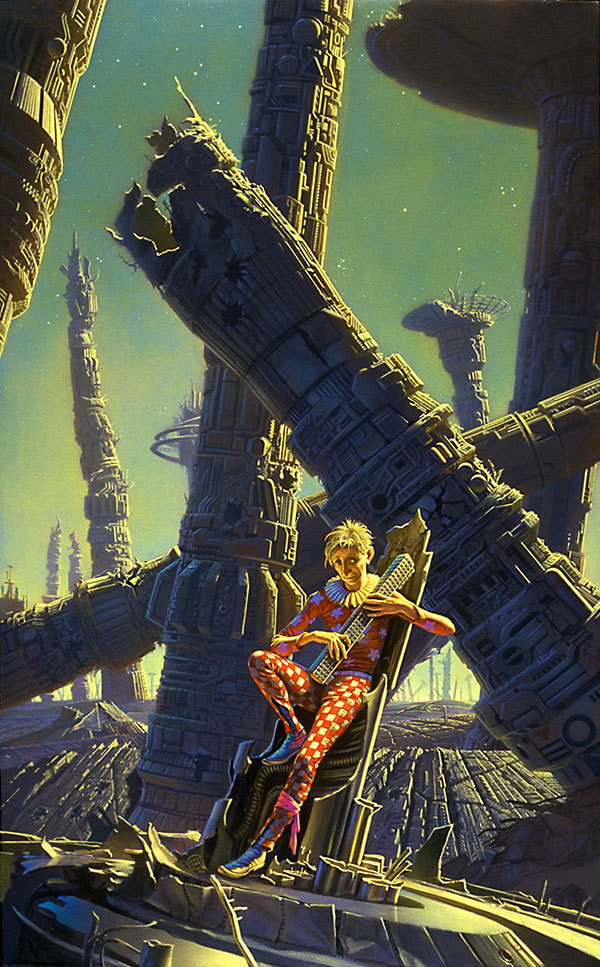
Above: apparently, the idol of Paul Krugman, Newt Gingrich, and Osama bin Laden. Asimov Aqbar!


Peter Turchin is a historian who has written a book claiming to scientifically predict future history based on past patterns (War and Peace and War); it's no surprise that he is an Asimov fan, and to his credit he gets the reference out of the way quickly. But it's not just psychohistorians who Asimov's work influenced. Newt Gingrich and Paul Krugman are unabashed fans of the Foundation series, crediting it with their inspiration in politics and economics. And it turns out, so was Shoko Asahara, the Tokyo subway nerve gas guy who founded Aum Shinri Kyo, and who wanted to start the real Foundation. There's even speculation that Bin Laden was a fan and that Al Qaeda is his Foundation.

Consequently, when I was reading about Keith Raniere and his cult-like NXIVM in a Forbes article, I almost fell out of my chair when I read: " As a boy he read an Isaac Asimov sci-fi novel about a brilliant scientist who knew his galaxy was in irremediable decline and had reduced all human behavior to elegant mathematical equations. It inspired Raniere later to try to do the same."

What, did old Isaac accidentally write a cult handbook? Maybe L. Ron Hubbard made the mistake of being too overt and should have buried his ideas in fiction! Granted, the idea of an algorithm for building a strong civilization - sort of like the Ten Commandments written in Python - is certainly seductive, but there are lots of seductive ideas in sf that haven't had this degree of influence. (I was reminded of Heinlein when non-naturalized U.S. residents who fought in Iraq were given citizenship immediately upon returning in 2003, but that's the strongest I can think of.) Maybe all these people think they're going to be the Mule, only smarter.

By now I imagine the NSA must have a list of people who check this out of libraries.

Without Constraints, How Do Humans Behave?

Cross-posted to my politics and economics blog as well as Cognition and Evolution.

Life on Earth evolved in an environment of constraints: resource limitations, disease and predation all put lids on behavior and reproduction. Consequently, the mechanisms to deal with those constraints have no "brakes", because nature provided them. There's no reason to have tight control on over-eating, because such a situation rarely arose. There was no reason to protect reward circuitry in general from overstimulation. But now we're starting to remove those constraints. Solve food scarcity, and we get obesity. Go straight to the reward center (without a real external reward), and we get heroin and video game addiction.

This is the biggest problem we face in any post-scarcity world, or (more broadly) in any world where our behavioral regulation is freed from the constraints that sculpted it for billions of years, whether in reality (because there really is more than enough food) or virtually (because you can just shoot up and feel good). This problem has even been advanced to explain the Fermi paradox, since whatever behavior regulation intelligent aliens evolve, presumably when they solve their own constraints, they will run into the same problems - perhaps with species-destroying consequences. The more complete and effective a representational system is*, the faster and greater the instability it creates in the system.

You might think of a science fiction story where curious and powerful aliens have put humans in a kind of terrarium where the weather is always fair, there's always enough to eat, there's no physical danger, and where there is always another territory to move into, with no loss of security, if you burn too many bridges with the ones in this one. That is to say, someone looks at you the wrong way, or your significant other mildly irritates you - why stick around? The aliens have guaranteed there will be another handsome gentleman/pretty lady waiting for you when you get to the new territory. And when you get there you wonder idly if these are real humans also in the experiment, or were whipped up and memory-programmed by the tissue replicator twenty minutes before you got there; or maybe you were, before your new mate got here. But you're taken care of; does it matter? (California sometimes feels like it's almost there.) In a world of limitless security and resources and even others' company, why ever tolerate the least inconvenience?

A scenario similar to this that happens in the real world is the strange discomfort of working alongside someone who is wealthy independent of their jobs. Why are they even here, people might ask resentfully - and indeed, from anecdotal experience, when these people get annoyed, they quickly leave, because why not? They have security and more territory.

So what happens to people when all the constraints are removed, when they're both wealthy and not subject to censure by broader political forces? That is to say, how do humans behave when all the brakes are off?Predictably. From "The Prince Who Blew Through Billions" by Mark Seal, from Vanity Fair in July 2011:
On the brother of the Sultan of Brunei, Prince Jefri Bolkiah, who has "probably gone through more cash than any other human being on earth.": "The sultan's biggest extravagance turned out to be his love for his youngest brother, Jefri, his constant companion in hedonism. They raced their Ferraris through the streets of Bandar Seri Begawan, the capital, at midnight, sailed the oceans on their fleet of yachts (Jefri named one of his Tits, its tenders Nipple 1 and Nipple 2), and imported planeloads of polo ponies and Argentinean players to indulge their love for that game, which they sometimes played with Prince Charles. They snapped up real estate like Monopoly pieces—hundreds of far-flung properties, a collection of five-star hotels (the Dorchester, in London, the Hôtel Plaza Athénée, in Paris, the New York Palace, and Hotel Bel-Air and the Beverly Hills Hotel, in Los Angeles), and an array of international companies (including Asprey, the London jeweler to the Queen, for which Jefri paid about $385 million in 1995, despite the fact that that was twice Asprey's estimated market value or that Brunei's royal family constituted a healthy portion of its business).

"Back home, the sultan erected a 1,788-room palace on 49 acres, 'which is without equal in the world for offensive and ugly display,' in the words of one British magnate, and celebrated his 50th birthday with a blowout featuring a concert by Michael Jackson, who was reportedly paid $17 million, in a stadium built for the occasion. (When the sultan flew in Whitney Houston for a performance, he is rumored to have given her a blank check and instructed her to fill it in for what she thought she was worth: more than $7 million, it turned out.) The brothers routinely traveled with 100-member entourages and emptied entire inventories of stores such as Armani and Versace, buying 100 suits of the same color at a time. When they partied, they indulged in just about everything forbidden in a Muslim country. Afforded four wives by Islamic law, they left their multiple spouses and scores of children in their palaces while they allegedly sent emissaries to comb the globe for the sexiest women they could find in order to create a harem the likes of which the world had never known."
This reads like an account of what each of us would do if we found out tomorrow we were in a simulation, with power over said simulation. This is what happens when the brakes are off. If you object that this is an exception or an extreme example - I guarantee that this behavior happens more among the fabulously wealthy and powerful. Well of course, you again object, other people can't behave that way! But then if the tendency wasn't there, why should it happen at all? And (more to the point) do you seriously think you would be any better-behaved? Of course you would; you're biologically and/or morally superior to these folks and would never let that kind of thing happen. (Also note that lottery winners, with a sudden random infusion of karma or whatever you call the points in our game - that's right, "money" - are known for going off the rails, and being more miserable and more likely to go bankrupt than the general population. Also, see "athletes from poor backgrounds suddenly signed up to multi-million dollar contracts in pro sports".)

An astute observer will say, "So what if people descend into depravity? If you're in a simulation or the aliens' zoo or you're royalty and don't hurt anyone, if you're happy with harems and Ferraris, fine!" That would be fine. But the problem is these people often seem not to be happy. Here it's hard to get data, but they are not invariably happier than other humans and in fact often have considerably troubled emotional lives. Again, they're using nervous systems built for an environment of resource and social constraints. It should not be surprising that they experience boredom, restlessness, and emptiness. In fact in the developed world it's not just the ultra-wealthy that experience these things. That said, it's sure better than starving or being eaten by tigers, but it seems those are our two alternatives: obese or at best bored, versus running from predators, starvation, and stronger neighbors. Yes, I fully recognize the pessimism of this position.

So, there's an addition to Malthus here. Malthus merely pointed out that when all constraints are relaxed but one, that constraint will limit (and his rule concerned, specifically, energy input as the unrelaxed constraint, but you can imagine for example a dense population of well-fed non-preyed-upon humans being periodically cut down by plagues). The addition is that when all constraints are relaxed, the system becomes unstable, whether that system is a cell (cancer) or an individual. The more powerful the system - which can be approximated by how fast it can change - the faster it will become unstable.

*The first representational system to evolve on Earth was the gene: the proteins it codes for are indirect mirrors of a DNA strand's environment - and as the environment changes, the genes change. As life became more complex, systems appeared that became able to more and more rapidly and/or accurately reflect parts of the environment beyond the replicator: the cytochrome P450 system which is a remarkably non-specific but effective metabolism system (which is how most drugs are broken down even though life on Earth has never seen these molecules before) and the immune system, which produces high-affinity molecules with a process of directed by limited somatic mutation. The ultimate such system however is the development of large numbers of cells signalling with ion channels, which can represent much more information much faster, and in humans has expanded to allow the assignment of arbitrary symbols to novel relationships (language). While we still can't assume that our language-enhanced nervous systems can represent every possible state external to themselves (any more than the immune system can do so), it's still by far the fastest-acting system and the one most likely to spell its own demise. As an aside, it's probably no surprise that plants that have begun to evolve "behavior" of a sort - the carnivorous plants - also use ion channels. Assuming causality is unidirectional, what happens first matters, and therefore so does speed.

New Mammals Being Discovered, Aliens Obviously Not In Solar System


The discovery of a new mammal had been announced by the Smithsonian - not a new insect or worm, a new mammal, in 2013 - and meanwhile, we can confidently say we have enough information to rule out alien artifacts in the solar system.

Saturday, August 10, 2013

De Niro As Hilarious Patronizing Satan

The movie Angel Heart with Mickey Rourke and De Niro is undeservedly forgotten (how could it be bad with those two in the same movie?) And, spoiler alert, De Niro plays the devil (but you don't know that until the end). Easily my favorite De Niro role. How can you not just roll on the floor at his mockery of concern for others and decency in general in these scenes:


Saturday, August 3, 2013

Asteroids and Comets Exist On A Spectrum

At least some asteroids have an internal reservoir of ice (along with organics); that's the thought for objects like 24 Themis, which retains a high albedo despite being inside the frost line. We also have evidence that centaurs (the outer-system asteroids) are really just relatively close-in comets. Recently a team showed that there are dead comets residing in the asteroid belt among possible dormant ones.

Increasingly it's clear that comets and asteroids are really the same type of objects - mineral objects coated and/or filled with water and sundry organics - with their visual behavior and surface characteristics determined mostly by their position in the solar system. If they've been out at the edge of the system for most of their life and make a sudden close pass to the Sun, they'll lose a lot of water, quite spectacularly. Others (like Vesta) have been stably far enough inside the frost line for long enough that they're dry. For those of us who think the organics we'll find on and inside these objects will be the most interesting thing about them, the limited information we have so far is very frustrating. Consequently I'm more than eager for Dawn to arrive at the much more primitive, wetter Ceres in February 2015.

It's worth emphasizing that we can't be too humble about our level of knowledge about our own solar system. Fuzzy images of Ceres were only compiled by 2007, showing some interesting surface features (craters and a bright spot). That is to say, if aliens had landed on Ceres and made a giant sign with letters 100 miles high insulting us - on the biggest asteroid in our solar system mind you - we would only have finally have noticed it six years ago. I'm not worried that the bright spot will turn out to be a dirty picture drawn on the surface, but it's worth keeping our state of knowledge in mind before we start saying we have no evidence of [fill in the blank] in our solar system.

Wednesday, July 31, 2013

Borges and Characters

But I think, perhaps, that the real reason he never wrote a novel was that the form is largely dependent on character, and Borges had no real interest in, or facility for, the creation of psychologically vivid people. (Try relating Leopold Bloom orally in five minutes, or Mrs. Dalloway, or Anna Karenina. Their greatness as characters arises out of their irreducibility to the facts about themselves.) He wasn't much for fleshing out, and he was not the kind of writer whose characters ever had a chance of "taking over" from their creator.
- From the New Yorker


More here on the underrated optionality of character in fiction.

Friday, July 26, 2013

How Close Are We to Becoming a Kardashev II Civilization?

Kardashev II civilizations have the power capabilities of an entire star. One way to do this would be to capture the star's energy with a Dyson sphere (below).


Futurists and science fiction types (myself included) often over-simplistically extrapolate current, very strange trends (in terms of the rest of history and nature), especially exponential ones. Despite that, people are looking for Dyson spheres for real as part of SETI. I think this program carries so many assumptions that it's doomed; but let's have some fun and say Dyson spheres are for galactic wusses that don't have the stones to just generate the power themselves. If we humans are eventually going to produce enough power to match our own star, how close are we? Is this something that should be discussed during the next election cycle?

Take a guess. Here are the numbers: the current energy output of humans is about 5x10^20 J per year (since this is energy over time, we're really talking about power). The Sun's output is 1.2x10^34 J per year. So how close are we? A factor of 24 trillion, that's how close.


Let's assume, even more stupidly, that our energy curve will continue to rise the way it has in the twentieth century (see above), despite the fact that the vast amount of that area under the energy-time curve (again, power) came from spending stored chemical potential energy in fossil fuels. The curve has gone up 1x10^14 J about every 15 years - arithmetically, not geometrically. At this rate of increase, the sun will have burned out long before we ever match it. (If you want to be a smartass, you could say that this means that we will eventually match the sun's power because the sun's output will drop drastically. But even then the constraint which determines this is the sun, not how fast our energy output grows.)

Another way of looking at it: if you wanted to match the sun's power by burning fossil fuels, then using the energy density of oil, you would have to burn an amount of oil equal to the mass of the Earth, 50 times per second.

What is this, XKCD?

You're saying, "Fossil fuels? Of course you idiot, you can't get to the Kardashev big leagues powering your civilization on combustion engines!" Fine, let's make an Earth out of antimatter, and gradually crash pieces of it into this Earth. You could put out as much as the sun for about a hundred million years, by shooting pieces of the anti-Earth at us at a rate of a million tons per second. (I guess you hold the Earth together with duct tape to keep it from flying apart during all these shenanigans.) Assuming you don't start with the part of the Earth where you're sitting it would probably look cool, but even so I bet you'll quickly be getting some neat-o cancers from all the high-energy photons this produces, and maybe even just diffuse axonal injury knocking you unconscious in minutes. Incidentally my suggestion is to start with Belgium.


Above: Belgium, at left.


There will still be people objecting, i.e. the Ray Kurzweils of the world, that problem-solving abilities (AI) will grow exponentially, and therefore the energy-producing capacity will follow. Fine. The question for them is what is going to power these other exponential trends, at much more mundane time horizons? (Like the singularity that's apparently scheduled for seven decades from now.) If the answer is "AIs will have god-like intelligence and they'll be able to do it and we can't understand", then why shouldn't we also believe doomsday prophets like Harold Camping who say their gods are coming, and make their claim with exactly the same amount of verifiability and comprehendibility? If you think Kurzweil makes sense, you should also read about the economist Julian Simon's commodities bets, because you should agree with him - although I find that singulatarians somehow find reasons to dislike over-optimistic economists, probably mostly just out of mood afiliation and status considerations.

Final answer: we are not going to become a Kardashev II civilization any time soon, and no one really knows how to get there or what this means, because the definition necessarily involves processes we don't understand. But I'm still fine with dropping large amounts of antimatter on Belgium.

ADDENDUM: This is from Wikipedia about the sun's power generation and for some reason I find this shocking.
The power production by fusion in the core varies with distance from the solar center. At the center of the Sun, theoretical models estimate it to be approximately 276.5 watts/m3,[54] a power production density that more nearly approximates reptile metabolism than a thermonuclear bomb.[b] Peak power production in the Sun has been compared to the volumetric heats generated in an active compost heap. The tremendous power output of the Sun is not due to its high power per volume, but instead due to its large size.
Putting it in socioeconomic terms, the sun is like China - the per capita income is actually not impressive but it's huge, so the multiplier is big.

Monday, July 22, 2013

For The Over-Optimistic

Brief online debate between David Brin and Aubrey de Grey here. Brin points out that the low-hanging fruit for life-extension have already been picked, and that any life extension on the order of decades (not to mention indefinite extension) will require "thorough" intracellular nanotechnology. Agreed. There is always a component in every make of car that fails first, and even if you keep replacing components, eventually you'll be putting new parts in every day. This is why people don't keep repairing their cars indefinitely! What's more, a car is not a person. Your transmission is not you. Your brain is you. And we don't know how to replace that practically, and we still don't understand consciousness and self even at a basic philosophical level.

Living a long time is emphatically a worthy goal but we will not have this technology in the next few centuries.

Friday, July 19, 2013

RE No Country For Old Men: Chigurh's Brain

If you haven't seen No Country For Old Men, what's wrong with you.

The fascinating thing about this movie for me was the behavior of Anton Chigurh (played by Javier Bardem) relative to other characters. Chigurh seems to be the only guy in this movie with frontal lobes, particularly in terms of his ability to model the other characters' behavior, while they're utterly at sea about his next action - like a human playing with a dog. The difference in the use of language is particularly striking: the rural hayseeds he victimized throughout the movie are uncertain, approval-seeking, making simple, naively truthful declarations. Chigurh only speaks to cause an effect - his words are noises that move things - and the effect is sometimes a certain behavior from one of the hayseeds, and sometimes to amuse himself. If he says something true, this is incidental.

What's so fascinating about this? Because although Chigurh might be the only person in the movie who has free will (as opposed to reflex and instinct), he seems not to believe in free will: he has placed his behavior, or believes it is inevitably, under the control of rules and fate. In this scene, he is (we assume) determining whether he'll kill a gas station attendant based on the flip of a coin:


The tension in this scene is among the best in the history of film. Do note the unplanned choking on the peanuts. There was no rule, no fate there, and it hurt him.

Later in the movie, when Chigurh is about to kill Woody Harrelson's character, he asks if "If the rule you followed brought you to this, of what use was the rule?" The ending is interesting in that Chigurh gets into a bloody, near-fatal car accident - accident.

Monday, July 15, 2013

Consuming Random Elements and Werewolves

I'm kind of jealous of the first half of the twentieth century. It was a time when you could just feed frogs rubidium and write down what happened. I once argued that based on its rarity, ruthenium was actually a better currency standard than gold; gold is (or was) a standard by historical accident of having a high redox potential, therefore being the only metal found in nature in its non-oxidized form, plus monkeys like shiny things. Okay, forget the common isotopes of elements; what happens when you start feeding, so heavy water to living things? Not much, actually. No eye lasers, no phasing through walls, you don't even turn into a werewolf. It doesn't even taste any different (according to Harold Urey)


Nope. Not even close.


So what do you have to do to poison yourself with heavy water? To show the initial effects, you'd have to drink about a quarter of your water weight. Those initial effects in mammals are sterility - D2O in high enough concentrations is toxic to rapidly dividing cells, just like radiation or free-radical generating chemical species; this is a result of the altered kinetics when free protons begin to be replaced with slightly-more-than-twice as massive deterium nuclei. Consequently as the concentration increases, the damage begins to effect other high-turnover tissues next, like the GI tract and after that, presumably the central nervous system. Mammals given only heavy water die after a week. It turns out a disgruntled employee at a Canadian nuclear power plant spiked the office water cooler with D2O back in 1990, but it wasn't enough to replace any significant water weight as mentioned above, and no one was injured.

One interesting (but simplistic) idea was that in slowing the reaction kinetics of an organism's biochemistry, you could slow the organism's aging. And indeed it was shown that Drosophila given D2O did live longer. No telling what's going on to their gametes or nervous systems, or what would go on in a longer-lived more neurologically complex organism!

The question of why our ancestors made some very basic chemical commitments (nerves based on sodium, potassium and calcium flux, for example) is interesting but ultimately not useful, very likely having to do with the happenstance of what was available and soluble at the Earth's wet crust. Lithium is similar enough to sodium that it can fool certain sodium channels in the central nervous system and decrease the rate or amplitude of mood swings in bipolar people, but that's a coincidence.

By the way, the werewolf formulas are pretty disappointing. There was one where you can use a mixture of nightshade and children's blood and smear it on your skin during a full moon but it didn't work. Maybe you can't use your own blood like I did (but I was ten, so it should count.) Another way is to drink water out of a wolf paw print in the Harz Mountains in Germany. I'll have to import the wolves since they're not extirpated in Germany.

Sunday, July 14, 2013

Into the Void (Orig Black Sabbath, covered by Soundgarden feat. Chief Seattle, Satanoscillatemymetallicsonatas, 1992)

I never knew this existed until five minutes ago. I always thought this song seemed written by Soundgarden. Chief Seattle can't rhyme for sh*t.

Saturday, July 13, 2013

The Big Rip Is Already Happening

From this interesting piece at Less Wrong, which shows we're losing about one galaxy per year due to the accelerating expansion of spacetime - also, associated arguments on why we must maximize the chances for successful colonization.

Friday, July 12, 2013

Late 1800s Political Science Fiction

Cross-posted to the Late Enlightenment.

Here's an interesting old science fiction book: Better Days: Or, a Millionaire of To-morrow, by Thomas and Anna Fitch. This should rank with Bellamy's Looking Backward. Set in the authors' near future of the 1890s, in it a wealthy industrialist develops bombs powerful enough to level cities, that can be launched accurately from zeppelins or boats. To be clear, this is a utopian work - although it involves an early prediction of the nuclear age, the authors assume it would necessitate a global detente. The authors correctly understood some of the political ramifications: that these weapons would have to be regarded in a special category and their manufacture restricted by international agreement so that they did not proliferate; and so he also predicts a version of the League of Nations. What he failed to predict was how this would be accomplished; by a cartel of countries who openly have such weapons, and a secondary cartel of those who everyone knows has them but don't openly declare them. The book features various heads of state realizing and announcing that they must cease prosecuting wars and allow all their territories to return to home rule to avoid their own capitals being destroyed by other states or even small groups of revolutionaries who make the explosive agent ("potentite"). If it's that easy, it would seem his international non-proliferation police wouldn't be able to do their jobs. U-235 is harder to make than potentite and we still seem to be nervous about Iran. We should be glad it was nuclear weapons and not potentite! (Or microwaved sand as Nick Bostrom speculated.)


Above: Coronado is the north-pointing peninsula at top, and the islands are to the south.


Of local San Diego interest: the initial tests for the various heads of state are carried out from Coronado, long before it was selected as a naval airfield. Unfortunately the Coronado Islands are destroyed in the demonstration. (Although last time I looked out the window of Hillcrest Hospital I could see them just fine; so for this and other reasons, this is alternate history now I guess.) The authors were possibly more interesting than the book; the husband seems himself like a character made up for historical fiction. Thomas Fitch was an attorney and politician who served in the legislatures of no less than four of the states and territories of the time (California, Nevada, Utah and Arizona), which explains why his knowledge of the Western U.S. of the time was more than the caricature we often see from contemporary writers on the East Coast. In his legal career he also represented Brigham Young and Wyatt Earp. He proofread Mark Twain's manuscripts and hung out with Leland Stanford. Finally and most significantly, as an orator, he was credited with keeping California in the Union. Even if you can't forgive his book's inconsistencies and failed predictions, I think he did okay.

And This Wouldn't Even Be the Singularity


From the Berkeley Robotics Department.

Economist Tyler Cowen asks "What is the political equilibrium when insect sized drone assassins are available?" All answers are unpleasant. This isn't even the Singularity, just a seemingly very likely possibility as mobile electronics continue to get smaller. They don't even have to be autonomous.

The smaller that automation gets, the more potential for disruption. We vastly underestimate the disruption from small autonomous flying robots. You'll move (or run) if you're walking somewhere and see bees. And bees are stupid and mostly want to ignore us, and can't even kill us.

Monday, July 8, 2013

The Fermi Paradox Thickens: More on Colonization Times for Von Neumann Probes

In a previous post I discussed the possibilities of replicators being aided in their diffusion between star systems by close passes; I also pointed to an interesting paper by Forgan et al looking at projected travel times of interstellar probes, based on powered vs. gravity-assist travel. A new paper (on which Forgan is the senior author) looks again at this problem using a Monte Carlo simulation approach, and gets an interesting but as always frustrating answer.

First, the paper would be valuable if all it contained was the excellent review of prior work done on this NP-hard version of the traveling salesman problem. (You think planning your road trip taxes a server?) In particular, they point to a prior paper arguing that von Neumann probe expansions could be slowed or stopped by mutant probes where a predator-prey dynamic evolves in the population and the probes hunt themselves to extinction. I had previously written about self-replicating probes becoming cancerous (a statistically more likely outcome) and turning to expansion above any other mission they previously had; but this only makes the Fermi Paradox more vexing rather than solving it.

Their approach was to simulate the galaxy as having 1 star per cubic parsec (so no local "backwaters"), with self-replicating probes moving at approximately the speed of Voyager I, 1000 m/s. They then compared replicating and non-replicating probes; not surprisingly, self-replicators were much much faster, exploring 100% of a box of 100,000 stars in at most 30 million years. In the replicator condition, the number of probes is no longer the constraint, and contact can occur in (possibly massive) parallel rather than serially. Of note: the authors also include a requirement for communication of which stars have already been explored, although if we assume a robustly replicating probe, this is unnecessary. ("Robust" means that the time and ability to replicate enough probes to successfully reach the neighboring stars are small relative to travel time.)

The authors correctly note that this short time frame makes the Fermi Paradox more vexing. So the alternatives with respect to self-replicating probes are:

1. They're here and we haven't found or noticed them yet.

2. They're not here, because
2a. Replicating probes are not possible or not effective (they can't be made at all, or they mutate)
2b. intelligence capable and willing to build such probes appears more rarely than once every 30 million years in a volume of 100,000 stars (they choose not to, or they don't evolve in the first place, or they wipe themselves out before they create them)

2a seems unlikely because we already know that replicators can develop through natural selection. This leaves us with 1 and 2b. It is certain that we have only the barest knowledge of the rest of our solar system, and gravity wells are expensive to get out of. My prediction is that we'll find evidence of such probes on low gravity bodies (asteroids, comets, small moons) as we continue to explore, but that once we find something strange, it will take time for us to understand what we're looking at.

Hat tip to Ben Weaver.

Good Libertarian Attacks on Rand

Cross posted to the Late Enlightenment.

Recently I ran across David Brin (a libertarian) and his writings on Ayn Rand. These should have their own special genre; one which deserves our attention. 1984 was Orwell's answer to what he saw as the developing problems with socialism, and (as an understatement) it is an important work.

Before giving you the sharper points of another writer's attacks, what is good about Rand? What do people get out of it?

- The power of capitalism to eliminate human suffering.
- The power of the individual; it's not surprising that young people establishing their own identities are the ones to whom this most appeals, and (I would argue) it's important that young people have things that reinforce their confidence in themselves and their goals and values.

The piece in question is here. The most interesting argument he makes is that (in his view) Rand is clearly influenced by Marx in terms of her teleological thinking. He misses a chance to mention her infamous standing-on-one-foot answer, which was a ripoff of Rabbi Hillel. She borrowed at least once, either (most charitably) unaware that she was doing so, or assuming that her audience would not be familiar with these sources. (Which itself says something else about her.)

A point worth disagreeing with, not just here but with other writers, is that it's not a valid criticism to say that her novels lay out a plan for bringing Rand's values to the world. Not because the world in Atlas Shrugged is a great one, but because the novels don't claim to be a blueprint for what the world should look like and the actions to take to get there, even with a 70-page monologue. (I'm unfamiliar with her having made this claim in non-fiction. If you're aware of any such claims, please point me to the evidence and I'll change my position.) Compare to Marx, who in a non-fiction manifesto, laid out a plan for the dictatorship of the proletariat, which Lenin followed fairly closely.

(Another article that Brin links to makes the argument the Atlas Shrugged is part of trilogy. Interesting non-fiction plot twist in that one.)

Other weaknesses that have always appeared to me likely because of my background: a lack of familiarity with evolution and in one case a distrust of how it could have produced an intelligent animal; a strange proclivity to imply heritable positions in her characters (all while decrying decadent monarchies elsewhere); and implicit assumptions about gender roles including disparaging comments about possibly gay characters. To the last point, defenders might say "But this was the 1950s; you can't fault someone for being a product of their times," to which an appropriate response is "But this is someone who was claiming the absolute, correct and final version of morality; if she missed something, that makes it irrelevant whether or not the ambient culture produced those blind spots." When you claim to have produced the final answers, rather than improving the process to get the answers, these are the kinds of problems you're open to. (Defenders might also say that homosexuality is morally wrong, and then the discussion devolves to a more profound level about the origins of morality. The kind of people who take this position will have a hard time showing themselves to be on the side of reason and not irrational authoritarianism here.)

A final problem that Brin mentions is the inverse state worship that afflicts objectivists and libertarians, but this is not unique to Brin's critique or to Rand. Suffice it to say the state is not the only institution ever conceived that can make humans suffer.

Wednesday, July 3, 2013