Showing posts with label writing. Show all posts

Thursday, June 21, 2018

The Trigon Disunity by Michael P. Kube-McDowell - Emprise, Enigma, and Empery)

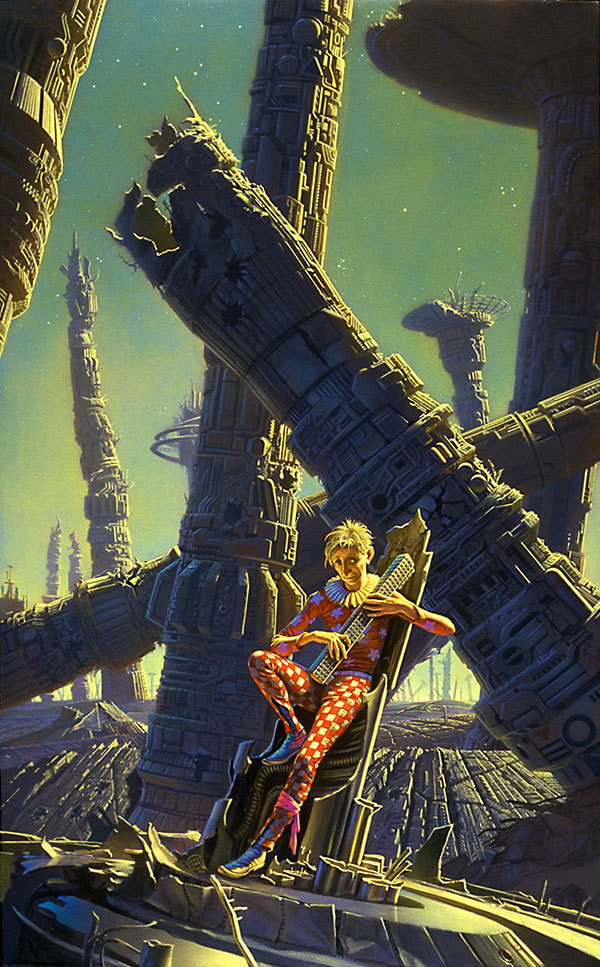
I'd always wanted to do a blog post on this really solid series from the 80s, which I just learned on going back to read about, was nominated for some awards. There's always some satisfaction learning that the books you liked most as a kid, and stayed with you because they had some substance, get some recognition. I wouldn't call it space opera or hard sf per se, mostly because Kube-McDowell demonstrates a real knowledge of human dynamics and psychology that make the story better and keep his characters from being mouthpieces for ideas. The story is central here - but there are really interesting ideas spread throughout. Much like I rue that there is no good thrash metal being recorded today (despite the occasional band that will claim to be writing the next mid-to-late-80s-sounding Metallica album - and then never delivers), I wonder if a series like this could be written today. Its technology, historical and social sensibilities put it squarely in the 80s but not in a bad way. If I had to put it in a genre, I'd call it "late paleo space opera". It also has cool cover art. To this day I have an aversion to science fiction that is NOT in a small paperback with cool cover art, and was shocked as a kid to learn that hardbacks are somehow more prestigious.

It's been 30 years since I read this so I may be getting some details wrong, but in any event what I like about the series is some of the ideas - like science fiction pearls. The ability to create and include these ideas is why the genre exists.


In short: the first book opens in an exhausted, resource-depleted, post-half-assed World War III near future Earth that starts getting signals from a ship approaching the Solar system. Soon it's determined that the signal is binary, and based on a very simple code - 1 for the letter A, 2 for B, etc. And (spoiler) it turns out the aliens are not aliens, but rather humans. Earth is indeed the homeworld of humanity, but there was actually a first technological civilization that predates our own, and sent out colonies. There was a collapse after an attack from the Mizaris (I think; described below) and all the colonies were cut off. The humans entering the Solar system were the first ones to reconstruct the technology needed to make the trip back. Subsequently, Earth's governments unify, and in partnership with the other humans that came home, we begin exploring our corner of the galaxy to re-contact the other isolated colonies. There ARE aliens - the D'shanna, and and the aforementioned Mizari.

So far this seems very similar to Left Hand of Darkness (which is also great), although unlike in Leguin's novel, the contact teams in these stories were not so coy about introducing themselves when they found a new lost colony. What I liked at the time, and remember today, are those little nuggets. Without further ado, here they are (again, major spoilers.)
  1. Ever wonder what it would be like to have "the answers in the back of the book" - for all of reality? The D'shanna I mentioned were energy beings that humans on one colony communicated with. When the contact team found that planet, they were only able to contact an unfriendly diplomat sort of fellow who kept stalling them. Finally they landed despite his objections, and realized the planet was all but abandoned, with this lone gentleman the only human on it. It turns out that the D'Shanna gladly gave this colony the final answers to all reality, and this so drained the humans on this planet of meaning and the will to live that they all perished (just stopped having families vs mass suicide, can't remember.) I liked this idea a lot, because it was something I've thought about too much - an actual objective truth machine. Much to their chagrin, in the D'Shanna, the humans effectively found one.

  2. If you write a book with humans already mysteriously spread across the galaxy, and they did it on their own, you have a problem to solve - Either

    • Earth is NOT our homeworld, and there are powerful progenitors - in which case since the 1990s you had to explain why we're related to everything here. Larry Niven wrote these kinds of stories in the 60s and 70s, and I wonder how or if he ever solved it (he didn't feel the need to go back and re-write Mars stories where there was nitric acid everywhere, I think in a very wise decision.) The Aliens franchise doesn't really fully explain this problem either but then I don't want to see what dumb explanation they might come up with.

    • OR, Earth IS our homeworld, and we're the progenitors - in which case, where are the ruins of spaceports and rayguns? Here, it's solved by making all of the first civilization's technology ice-based and melting, which leaves no trace. (G.I. Joe stole this idea later.)

  3. The simple code used by the first human ship back to Earth was actually noted by a scientist's daughter. One scientist is completely ruined by having missed it, and ends up reading six levels of complex interpolation into the code, thinking that the approaching beings are antennaed moth-men (which obviously they turn out not to be.) Interesting reflection on the psychological impact and compensation mechanisms for missing something right in front of you, as well as a comment on reading too much into things.

  4. The author creates a social custom for one of his planets of adolescents having rubbing stones. Every day you rub them with your fingers, and you're an adult once they're finally smooth. Of course some adolescents don't have the discipline to keep rubbing, and they remain rough; others try futilely to accelerate the process, only to end up with bloody finger tips. This stayed with me for some reason.


  5. Mizar (the brighter one), home of some really alien aliens. (from skyandtelescope.com)

  6. He includes really alien aliens. I understand why on Star Trek they have aliens whose only difference is a forehead ridge (the reason rhymes with "schmudget".) But in a halfway serious science fiction novel, it's inexcusable, and if that's the best you can do when you have no such constraints you might as well just include elves and dwarves while you're at it. The D'Shanna are truly alien as well, energy entities who mostly inhabit another dimension and can see all of our reality (like Tralfamadorians in Slaughterhouse Five, but much cooler and nicer) and the Mizari are electric domes of rock covering the surface of a planet orbiting Mizar (the star that makes the bend in the Big Dipper.)

  7. The initial mission to go meet the aliens that turned out not to be aliens had a crew consisting of:
    • A white European scientist
    • A black American minister
    • A south Asian military/political guy (he was in charge I think)
    • A Chinese crewmember, who I can't remember what he did

    I thought it was interesting how the different strands of human experience were also represented by different ethnic backgrounds.

  8. In near-future science fiction, you really can improve your verisimilitude by including a familiar setting, which Kube-McDowell does occasionally, mentioning his native Pennsylvania a few centuries hence - the Susquehanna Spaceport! He now lives in Indiana and in Alternities uses that setting.

Friday, September 15, 2017

The Paradigm Shift Problem in Science Fiction Movies: How Will Blade Runner 2049 Solve It?

A paradigm shift is a plot twist that changes the setting and therefore the whole meaning of what the characters are doing. Science fiction suffers uniquely from this because it's unique in having paradigm shifts (the rare action movie notwithstanding.) In Alien, we find that the crew is not dealing just with a face-crab, but with a predator that bursts from people's stomachs. In V, it's that the friendly human-like aliens are literal cold-blooded reptiles. In the Matrix, it's that we're all in a simulation. In Star Wars it's that Darth Vader is Luke's father - a bit more like a traditional plot twist, but still profound.

When a movie depends on the paradigm shifts for its money shot, what do you do to keep the fires burning? You could either make an entirely different reveal in the next movie - and that's hard. You can just keep having things bursting out of people's stomachs (boring!) or just have, I don't know, the personification of the Matrix reveal you know, a little bit more (so lame!) Or, you could add a whole NEW paradigm shift. That's difficult and dangerous. Not only are good paradigm shifts are hard to come by, but introduce a new one, and suddenly you've changed the whole tone, and it no longer seems like a movie from that franchise. This is hardly ever done, although Highlander 2 does come to mind, and it was so bad that Highlander 3 ignored it as essentially un-canonical.

Of course audiences are getting smarter, and harder to please, as we see the man behind the curtain, because we're saturated in media and we've become a bit too savvy and aware of how plot structures work and we roll our eyes at call-backs (Sarah Connor telling Kyle Reese "come with me if you want to live", WOW! I can't believe that it's reversed now!) The innovation here is the J.J. Abrams trick of making the characters aware of their past and having them consciously do the call-backs - Kylo Ren looking at Vader's helmet - and possibly even having the reversed Vader-Luke interaction, and having the bad son succeed in killing the good father.

I'm nervous about Blade Runner 2049 running into the same problem, but there's a difference, and here I'm afraid the title of the post is a little misleading. Blade Runner kind of doesn't have to solve the paradigm shift problem. Blade Runner doesn't rely on "Is Deckard a replicant?!?" for its punch to the same degree that the franchises above do. Its success is in the overall tone set by the first movie, so Villeneuve isn't as trapped into focusing on the paradigm shift as the core of the story. The Fifth Element was probably the movie that was at its debut most compared to Blade Runner, and the film-making is such that, if it has a sequel, it also won't be forced to make such difficult no-win writing decisions. The new short that takes place in 2048 is obviousy a Blade Runner film, by the sound just as much as the famous vision. My main complaint is that it seems that nothing much in that world seems to have changed in 30 years. But we will see!

Wednesday, November 20, 2013

World-Building: Delusions and Reference in Fiction

I'm in the middle of my interview cycle right now for psychiatry residencies, and one of my interviewers pointed me to the article that the movie KPAX was based on. You may remember this as the one where Kevin Spacey is a delusional patient who thinks he's an alien...or is he?

The movie actually annoyed me because (spoiler alert) they kept it neatly ambiguous, which I think is the lazy way out. More interesting is the true story that inspired the movie, The Jet Propelled Couch, a case study of a delusional patient which appeared in Harper's in 1954. (Since the 70s people have debated whether the anonymized patient in the article was actually science fiction writer Cordwainer Smith, and they have a decent case.) The psychiatrist who was treating the patient was himself a science fiction fan, and found himself eagerly awaiting installments from the patient's delusion. Ultimately the patient was cured of his delusion in exactly this way, when the psychiatrist found repeated internal contradictions in the material the patient was providing - for instance, in the distances of star systems from each other - but instead of saying to the patient "Aha! You have been caught and must now admit this is all nonsense!" the psychiatrist would suggest ways that the inconsistencies could be corrected - maybe the navigators who made the maps were using different units, and request that the patient correct the information for the next session. After enough of this, the patient finally realized he was making it all up.


This approach intrigued me because it works as a rhetorical approach with not-fully-delusional ideologues. Try this sometime. Instead of immediately pushing back against the declared beliefs, take them seriously, and follow their direct implications "out loud" for the benefit of the ideologue. This usually leads to glaring contradictions pretty quickly. This is a tough one for the ideologue, unless they're willing to come out and say "I demand you stop taking my ideas seriously!"

Many of us science fiction types enjoy learning the details of worlds and histories that don't exist, not to mention inventing our own. Scratch a science fiction fan and you may find a reluctant world-builder. But world-building doesn't require us to be delusional. (Articles on non-delusional world-building here.) I've met some frighteningly devoted Trekkies, but not a single one who thinks that Klingons existed. Then again, as a kid I did have the following odd experience: at about 14 years old, I had created a future universe where humans encountered the Ptranians, or the "space rats" as they were not undeservingly called, for their ferocity and hardiness. These unpleasant fellows evolved on a large moon of a gas giant orbiting Algedi, a place with violent, toxic geology and worse weather, and subsequently were very difficult to kill. Physically they were bipedal, covered with green and blue scales, with no hair but rather thick bristles that ran in a long mohawk-strip from their heads to their tails. In 2691 an Earth colony at 61 Cygni - to which we were only connected by light-speed transmissions - went silent, and then in 2712, the rats were here, attacking Earth. Anyway...one day, in the height of my fevered imaginings, I thought to myself "well if somehow NASA were to point some new state-of-the-art telescope at Algedi, they wouldn't see this planet and all the Ptranian ships right? They're not really there, right?" And I realized that for a few seconds I couldn't fully convince myself - didn't want to convince myself - that no, if there was anything at all orbiting Algedi, it wasn't space rats. It was a bizarre feeling of my thoughts about this being blocked. That scared the hell out of me. Fortunately my mind today is unclouded by delusional thoughts, which is important for someone as powerful, brilliant and handsome as myself.

All this does beg some questions about the linguistic problem of reference with respect to fiction - how can you say Yoda isn't 6 feet tall? He doesn't exist, he isn't any feet tall! - which seems (boringly) solved by recognizing that what we're really doing is interpreting inconsistent marks on a page that cause images in people's heads, which are extended according to assumed rules. Sometimes these rules are broken by enterprising writers (e.g. unreliable narrators) but somehow the contradictions and paradoxes thereby engendered do not cause the universe to implode in a pile of contradictions.

Thursday, September 19, 2013

The Improbable Convergent Evolution of Caucasians in Science Fiction


Yes Captain. I too am puzzled as to how white people evolved independently on every planet we go to; not only that, but how over time Khan appears to be a kind of deep space Michael Jackson. From startrek.com.

This is an expanded version of a comment at writer Marshall Maresca's blog. Maresca's original post is Perils of the Writer: Writing Race in SFF. In it he addresses that interesting convention, the occasional African-American alien in Star Trek:
My college roommate and I were watching Deep Space Nine, and in the episodes a small group of Bajorans were meeting with Cmdr. Sisko. One of the leaders of the Bajorans was played by a black actor.

"That's cool," my roommate said, "They have African-American Bajorans." Then after a moment he said, "Of course, that's inaccurate. He's Bajoran. Bajor is a different planet, there's no Africa, there's no America."

Over the course of the series, we saw that the Bajorans were as racially diverse as humans are*, but we never learn any real details of that diversity. And that's fine, because it didn't need to be directly addressed, it just was a part of their reality, easily achieved by color-blind casting.
Oddly, it was always the lack of racial diversity that stuck out to me in Star Trek. Does anyone seriously think there will be fewer multiracial people in the future? On one hand, Star Trek (and every other science fiction show and movie) is casting actors that their mostly-white audience will relate to; it's unfortunate, but I understand why. ST does have the occasional non-white regular cast member, and an occasional extra or non-recurring non-human played by not white actors, like the Bajoran Maresca mentions. But to the extent that we consider Star Trek to be in any way a plausible future as opposed to a Game of Thrones fantasy, then how amazing is it that not only are most of the aliens we meet humanoid, but they're Caucasian! Incredible! (Literally. Crabs I could believe, but extraterrestrial white people? Come on. I know that makeup and effects cost money so not everyone can be a Tholian, but there are plenty of non-white actors.)

In truth, I kind of view black Bajorans/Vulcans/etc. the same way that I view non-European actors in Shakespeare - in and of itself, you don't really take these casting decisions as making any point inside or outside the story, that's just who the actors are, and you forget about it. Did it really affect Voyager's storyline after the debut that Tuvok was a black Vulcan? Was there some interesting or painful chapter of history on Vulcan that this built into his character? And come to think of it, have there been Asian aliens with speaking roles in ST? I can't think of any examples. (If you tell me the Vulcans and Romulans count as Asians because they correspond to China and Japan in the original Gene Roddenberry one-alien-race equals one-nationality scheme, I'll punch you. I really will.)

The problem is that token aliens only make the lack of diversity and specifically, multi-racial characters in science fiction film and TV more obvious. Wait, it's the year 2330 (or whatever) and you're telling me not only is Starfleet still mostly white, but there aren't many multiracial humans? The modern U.S. Navy is more diverse than this! And why did they jump straight to multi-species characters? That is obviously intentionally making a point, which is useful and interesting, both inside and outside the story. Great, a half-Klingon faces discrimination and questioning looks, and some viewers will identify with that. What about a half-black half-Filipino actor that Paramount and the writers somehow couldn't fit into the twenty-fourth century? Those actors are absolutely out there.* Again, I imagine Paramount would make no bones about saying, "We cast people the audience will identify with." It's the audience's accepting this as being remotely representative of the future that's mystifying. "Not every science fiction show and movie has to be Fifth Element," people might say, and that's certainly true, but then you can't complain if you see people using 8-track tape players in the future either.

To the question of race in writing more broadly - it certainly can give a feeling of verisimilitude, but if someone has the chance to write race (in a supposed future world) and doesn't touch on the actual real-world hair triggers, I think they're wasting an opportunity unique to speculative fiction. Most alien races are just science fiction demi-humans; for all many writers do with them, just go ahead and put elves on Alpha Centauri and be more honest about it! But if you actually want to use your aliens for something, you can be District Nine. Even if you insist on Caucasian aliens, you can still be Alien Nation. If you don't have aliens, you can be subtle like Asimov in The Currents of Space, where he wrote something that was clearly about mid-century segregation in the U.S. even if the color scheme was reversed. Case in point, in Elysium, people speaking Spanglish down on grimy Earth, security forces speaking German up on the space station. (Ouch! This German-American saw that and said "Oh no you didn't!") But it gets people thinking who might not have thought before. My own "debut" novel (that is, the one I'm furthest along on) takes place far enough in the future that any descendants of ethnic groups we might recognize are distant myths, although the characters are definitely not Caucasian-looking. The protagonist is a member of an occasionally-persecuted sometimes-tolerated minority religion; he's a powerful man but still sighs at the bizarre, annoying, sometimes dangerous blood libels that persist against them. Any takers on who this is about?


*Of course you can name lots of multiracial entertainers who have been successful - Keanu Reeves, Dwayne "The Rock" Johnson, Moon Bloodgood, Vanessa Williams and Dean Cain for starters - and many more are certainly coming. The interesting thing is that there is no narrative and therefore easily-understood character for "multiracial" to fit into, so these people are still either white or black. (Fine, Moon Bloodgood was Native American in Terminator Salvation. But still not hapa.) I would argue that the believability of multiracial actors in other roles by people who know their background is a positive but, but these actors are mostly thought of in the same terms that all American race issues are still mostly framed: white or black, no option for other.

Monday, September 9, 2013

Morality Machines in the Distant Future Universe

Far Futures is a collection of stories put together by Gregory Benford, with contributiosn from Greg Bear, Poul Anderson, Haldeman, Kingsbury, and Sheffield.


Not going to happen. But great story. If you don't like it, then re-write it with a Maxwell's demon catching particles as the universe continues to accelerate outward, trying to predict which ones it should grab based on current projected but not-quite-there solutions. Now would that really make the story better?

They're all excellent as you might expect from a Benford-edited collection, but the one story in particular that stood out to me was Bear's Judgement Engine. The story is a collision of thermodynamics, morality, and metaphysics. At the Big Crunch there remains a single library where the far future's remaining minds remain, crunching through possible solutions to suffering and the nature of existence.

Essentially, consciousness requires life, which requires energy, which requires things to prey on other things, and in all the aeons of existence, no one has found a way around this brute fact of reality. There is either non-existence, or there is suffering - which includes things making each other suffer. As the edge of the universe and the end of all things draws quickly and inexorably closer, this Problem is the last unsolved conjecture at the end of time. Why do they care? Because (in an homage to Buddhist ideas about death and reincarnation) their thoughts at the moment of the Big Crunch will determine the nature of the entire universe that will appear at the next Big Bang. A story like this can only end in tragedy.

Saturday, August 17, 2013

Asimov's Foundation: The Meta-Cult?


Above: apparently, the idol of Paul Krugman, Newt Gingrich, and Osama bin Laden. Asimov Aqbar!


Peter Turchin is a historian who has written a book claiming to scientifically predict future history based on past patterns (War and Peace and War); it's no surprise that he is an Asimov fan, and to his credit he gets the reference out of the way quickly. But it's not just psychohistorians who Asimov's work influenced. Newt Gingrich and Paul Krugman are unabashed fans of the Foundation series, crediting it with their inspiration in politics and economics. And it turns out, so was Shoko Asahara, the Tokyo subway nerve gas guy who founded Aum Shinri Kyo, and who wanted to start the real Foundation. There's even speculation that Bin Laden was a fan and that Al Qaeda is his Foundation.

Consequently, when I was reading about Keith Raniere and his cult-like NXIVM in a Forbes article, I almost fell out of my chair when I read: " As a boy he read an Isaac Asimov sci-fi novel about a brilliant scientist who knew his galaxy was in irremediable decline and had reduced all human behavior to elegant mathematical equations. It inspired Raniere later to try to do the same."

What, did old Isaac accidentally write a cult handbook? Maybe L. Ron Hubbard made the mistake of being too overt and should have buried his ideas in fiction! Granted, the idea of an algorithm for building a strong civilization - sort of like the Ten Commandments written in Python - is certainly seductive, but there are lots of seductive ideas in sf that haven't had this degree of influence. (I was reminded of Heinlein when non-naturalized U.S. residents who fought in Iraq were given citizenship immediately upon returning in 2003, but that's the strongest I can think of.) Maybe all these people think they're going to be the Mule, only smarter.

By now I imagine the NSA must have a list of people who check this out of libraries.

Wednesday, July 31, 2013

Borges and Characters

But I think, perhaps, that the real reason he never wrote a novel was that the form is largely dependent on character, and Borges had no real interest in, or facility for, the creation of psychologically vivid people. (Try relating Leopold Bloom orally in five minutes, or Mrs. Dalloway, or Anna Karenina. Their greatness as characters arises out of their irreducibility to the facts about themselves.) He wasn't much for fleshing out, and he was not the kind of writer whose characters ever had a chance of "taking over" from their creator.
- From the New Yorker


More here on the underrated optionality of character in fiction.

Monday, July 8, 2013

Good Libertarian Attacks on Rand

Cross posted to the Late Enlightenment.

Recently I ran across David Brin (a libertarian) and his writings on Ayn Rand. These should have their own special genre; one which deserves our attention. 1984 was Orwell's answer to what he saw as the developing problems with socialism, and (as an understatement) it is an important work.

Before giving you the sharper points of another writer's attacks, what is good about Rand? What do people get out of it?

- The power of capitalism to eliminate human suffering.
- The power of the individual; it's not surprising that young people establishing their own identities are the ones to whom this most appeals, and (I would argue) it's important that young people have things that reinforce their confidence in themselves and their goals and values.

The piece in question is here. The most interesting argument he makes is that (in his view) Rand is clearly influenced by Marx in terms of her teleological thinking. He misses a chance to mention her infamous standing-on-one-foot answer, which was a ripoff of Rabbi Hillel. She borrowed at least once, either (most charitably) unaware that she was doing so, or assuming that her audience would not be familiar with these sources. (Which itself says something else about her.)

A point worth disagreeing with, not just here but with other writers, is that it's not a valid criticism to say that her novels lay out a plan for bringing Rand's values to the world. Not because the world in Atlas Shrugged is a great one, but because the novels don't claim to be a blueprint for what the world should look like and the actions to take to get there, even with a 70-page monologue. (I'm unfamiliar with her having made this claim in non-fiction. If you're aware of any such claims, please point me to the evidence and I'll change my position.) Compare to Marx, who in a non-fiction manifesto, laid out a plan for the dictatorship of the proletariat, which Lenin followed fairly closely.

(Another article that Brin links to makes the argument the Atlas Shrugged is part of trilogy. Interesting non-fiction plot twist in that one.)

Other weaknesses that have always appeared to me likely because of my background: a lack of familiarity with evolution and in one case a distrust of how it could have produced an intelligent animal; a strange proclivity to imply heritable positions in her characters (all while decrying decadent monarchies elsewhere); and implicit assumptions about gender roles including disparaging comments about possibly gay characters. To the last point, defenders might say "But this was the 1950s; you can't fault someone for being a product of their times," to which an appropriate response is "But this is someone who was claiming the absolute, correct and final version of morality; if she missed something, that makes it irrelevant whether or not the ambient culture produced those blind spots." When you claim to have produced the final answers, rather than improving the process to get the answers, these are the kinds of problems you're open to. (Defenders might also say that homosexuality is morally wrong, and then the discussion devolves to a more profound level about the origins of morality. The kind of people who take this position will have a hard time showing themselves to be on the side of reason and not irrational authoritarianism here.)

A final problem that Brin mentions is the inverse state worship that afflicts objectivists and libertarians, but this is not unique to Brin's critique or to Rand. Suffice it to say the state is not the only institution ever conceived that can make humans suffer.

Wednesday, July 3, 2013

Great Piece on the "Literature of Ideas"

Here is an excellent article from World SF on "The Persistent Neoteny of Science Fiction". In it Athena Andreadis points out - even-handedly - that defenders of "literature of ideas" are often really just bad or lazy fiction writers. On this blog I have often defended stories of ideas from literary purists from elsewhere on the literary spectrum (in particular, in reviews of Mieville's Embassytown), but Andreadis's point is an excellent one. Stories that work based on their ideas can afford to de-emphasize other aspects of story-telling, or dispense with some of the elements altogether; but this claim is very different than saying that these elements should be inferior and added only with the ham-handedness that comes with reluctantly obeying a form. ("Well it's fiction. We need characters I guess.")

Her central argument: "...SF/F suffers from a peculiar affliction: persistent neoteny, aka superannuated childishness. Most SF/F reads like stuff written by and for teenagers – even works that are ostensibly directed towards full-fledged adults." And the even-handedness: "Now before the predictable shrieks of "Elitist!" erupt, let me clarify something. Adult is not a synonym for opaque, inaccessible or precious. The best SF is in many ways entirely middlebrow, as limpid and flowing as spring water while it still explores interesting ideas and radiates sense of wonder without showing off about either attribute."

Do read the whole thing, but the introduction alone is applause-worthy:
When Margaret Atwood stated that she does not write science fiction (SF) but speculative literature, many SF denizens reacted with what can only be called tantrums, even though Atwood defined what she means by SF. Her definition reflects a wide-ranging writer’s wish not to be pigeonholed and herded into tight enclosures inhabited by fundies and, granted, is narrower than is common: it includes what I call Leaden Era-style SF that sacrifices complex narratives and characters to gizmology and Big Ideas.

By defining SF in this fashion, Atwood made an important point: Big Ideas are the refuge of the lazy and untalented; works that purport to be about Big Ideas are invariably a tiny step above tracts. Now before anyone starts bruising my brain with encomia of Huxley, Asimov, Stephenson or Stross, let’s parse the meaning of “a story of ideas”. Like the anthropic principle, the term has a weak and a strong version. And as with the anthropic principle, the weak version is a tautology whereas the strong version is an article of, well, religious faith.

The weak version is a tautology for the simplest of reasons: all stories are stories of ideas. Even terminally dumb, stale Hollywood movies are stories of ideas. Over there, if the filmmakers don’t bother with decent worldbuilding, dialogue or characters, the film is called high concept (high as in tinny). Other disciplines call this approach a gimmick.

The strong version is similar to supremacist religious faiths, because it turns what discerning judgment and common sense classify as deficiencies to desirable attributes (Orwell would recognize this syndrome instantly). Can’t manage a coherent plot, convincing characters, original or believable worlds, well-turned sentences? Such cheap tricks are for heretics who read books written in pagan tongues! Acolytes of the True Faith… write Novels of Ideas!

Saturday, June 22, 2013

For the Clarionites: Best Posts

Hello Clarionites! As discussed, here is a selection of posts from the last year and a half. Enjoy!

Science Fiction Reviews and Essays

#Shortcuts in World-Building
#More Reviews of Mieville's Embassytown
#Aliens and Their Strange Obsession With Intelligence
#The Law-Giving Machines
#The Dying Earth Genre As Horror of the Irrational (also featured at The Night Lands)
#What People Often Don't Like About Fantasy
#An Optimistic Turn in Science Fiction


Science Fact: Interstellar Travel, Chemistry, and the Fermi Paradox

#Cassini Measures Enceladus Chemistry
#Fomalhaut
#Asteroid Mining and Detecting Others' Von Neumann Probes
#A Moore's Law Argument for Panspermia
#Mars, Antarctica, Jamestown: Environmental Constraints on Human Expansion
#Close Passes Between Stars and Cross-Contamination
#The C-Index: How Far Away Could We Hear Ourselves?
#Where to Find Von Neumann Probes - And How They Work


Favorites of Internet Philosophy: Singularities and Simulations

#A Singularity Solution: Anti-AI AIs
#Singularity Solutions
#Some Ongoing Problems of the Simulation Argument


Science Fiction and Local Interest

#Los Angeles Always Makes Me Think of The Terminator
#The 70s Science Fiction Landscape of California
#The Very Large Array and Skynet
#The Tacoma Narrows Bridge Designers

Stories Without Characters and Plots

We're told that all fiction, and especially commercial fiction, must have characters and plots. Is this really true? In the last couple years I've noticed a number of outstanding science fiction stories which are really expositions of ideas, with no pro/antagonist conflict to resolve, no clear narrative current; it's a lot like reading non-fiction, and it's often excellent. What's more, I find that imagination can fly more freely in this style of fiction because the writer can keep piling on ideas and innovations one after another, and isn't that why we're reading speculative fiction, for ideas? If you disagree and you like Borges, then you have some explaining to do. Even when he does have characters, they often function only to introduce a puzzle at the beginning of the piece, and then exeunt as the ideas take center stage. (Not everyone appreciates fictions of ideas, or they miss the boat entirely; more here in the context of criticism of Mieville's Embassytown.)

Granted, it may be good advice for aspiring writers to master the more traditional and likely easier structures of modernist, character-and-plot driven narrative fiction - but there are subgenres of science fiction which are clearly about ideas, and they suffer for their conservative insistence on crowbarring characters into the story. This is hard science fiction's cardinal sin; how many stories have you read that seems grudgingly salted with characters whose dialogue is basically to read aloud the technical manual for some interesting concept the writer is considering?

Since I greatly enjoyed Ken Liu's Hugo-nominated story, I've been devouring everything by him I can find, and his "The Bookmaking Habits of Select Species" is an excellent example of this expository style. The story delivers exactly what the title promises: a description of how various aliens write and regard books, and it's nothing short of addicting. Rarely have I been so sorry when a story ends. Liu also seems to anticipate his reader's thoughts and objections, and you feel as though you're in a dialogue with him as you read. (He's a practicing attorney; this may not be a coincidence.) Kij Johnson (whose Spar I loved) is nominated for the Hugo for Mantis Wives, which is more clearly allegorical, but getting to what that allegory places more demands on the reader.

The writer I've seen doing this most explicitly - and discussing it explicitly in inteviews - is my favorite new writer, Yoon Ha Lee; another piece linked here.

Wednesday, June 19, 2013

Ken Liu's Mono No Aware Deserves the Hugo

Really, the only bad thing about this short story is the title, which might lead you to believe it's trying to garner attention with superficial exoticism. It deserves the Hugo for best short story, for which it has correctly been nominated. And for the way he just manipulated me as a reader, let me just say Ken Liu, you son of a bitch.

Tuesday, June 4, 2013

Short Stories Set On Real Exoplanets


A picture of a planet 300 LY away.

Hey, I got your hard science fiction right here. Actually, the Kepler scientists do. It's kind of strange; if people keep writing science fiction about stars that are near Earth and the details of their solar systems don't match what we now know, isn't that fantasy now? I mean, of course it's all fantasy, and we're all Romans imagining Africans with faces in the middle of their chests (which they really did, out of ignorance + curiosity) or Spaniards believing the tales of wyverns in Patagonia - but still, now we know something about these places, and these stories are doing it right. Otherwise, this is the equivalent of writing about battles and countries in Southeast Asia or Central America that never existed. Interstellar alternative history of a sort. (Really, click there. Cool alternative histories.)

Wednesday, May 1, 2013

Interview with Yoon Ha Lee in Clarkesworld Magazine

I've posted links to her work before. So much great in this interview, including:
Most of the time I write didactically, as if a short story were a proof. There is some object lesson, or ethical question, I want to leave the reader with. "Ghostweight" is a good example of this; it doesn't pretend not to be didactic. So when I build the character and their strengths and weaknesses and motivations, when I build the setting, the majority of it needs to be in support of that point. With a proof, you want to include all the necessary axioms and arguments, but leave out the extraneous. A short story is very similar.
Another great point she makes, in keeping with this motivation in her work, is that her characters are marionettes who serve other purposes in the story and that she's not attached to. Her clarity in this regard is one of many things which makes her prose stand out.

Monday, September 24, 2012

William Gibson: SF Writers are Screw-Ups

...when it comes to making real predictions anyway. He makes the excellent point that we remember only the successes, but we don't compare that number against the overall denominator of all predictions. Most of which are goofy and wrong. SF is great because it allows us to bring an additional element of literature into play (setting) instead of just accepting it as a given, thus considering counterfactuals and asking questions that we would not be able to otherwise. But as fiction, it's always a mirror of the people writing and reading it, and the time and place they live.

Thursday, December 1, 2011

Ballard's Complete Short Stories


The Temptation of St. Anthony, Max Ernst


I've just read the Complete Ballard short story collection that came out after his death. It's thick and took me two borrowings to get through it. Before this my experience of Ballard was limited to Crash, the film adaptation of Empire of the Sun, and the novel the Crystal World. Certainly his fans (especially one old friend and sometime reader of this blog) play up his strangeness and the oblique apocalyptic imagery of his work, and maybe this is why I'm left a little cool by his short stories - my bar for shock and surprise were set a little high. In fact I would put most of these stories on the margin of mainstream 60s-90s science fiction; in fact P.K. Dick, with his non-hierarchical realities and attendant narrative structure games and unreliable narrators, is inarguably further outside.

Positive observations: it's hard not to get the sense that Ballard is a guy who spent a lot of his time alone in introspection, and the essential isolation of his protagonists is near universal, whether they're in some kind of inexplicable post-London wasteland or in an unhappy marriage. His imagery of the deserts and ruins, and especially his accounts of the internal dialogue of the characters wandering them, are expertly drawn. His description of the strange malaise of the permanent desert-beach resort dweller is also incisive. Ballard also solves a narrative problem of speculative fiction - the extended character-less, plot-less extrapolation - by taking out the characters and action, and writes like a historian a journalist, in broad brushes. Hard science fiction especially often grudgingly salts a story with characters just so there are mouthpieces to describe the device or alien ship they've found, but Ballard sometimes tosses them out as superfluous and writes honest prose more true to its narrative purpose.

One trick that Ballard occasionally pulls out is to take advantage of his genre's tolerance of the fantastic by descriptions where it's unclear whether he's speaking metaphorically, or we're seeing the sci-fi version of magical realism. For example: in one story he makes frequent references to a woman who has twitching insect legs for eyelashes. Few of us would be romantically drawn to such a woman, if he's describing her literally. Is this magical realism, i.e. a change in technology which in turn has changed social norms, so the characters react acceptingly to something which would shock us? Or are we to take it as a metaphor, in deliberately alienating terms? More interestingly, is this ambiguity his intention? Without resolving the question of metaphor or realism, it's hard to know whether the characters react as expected or even visualize the story, which produces an interesting and distancing reading experience, and if he conceived and executed this deliberately it's easily my favorite Ballard signature - although so far as I detected, it occurs only in his early works.

The ambivalent: without taking sides in any piece of writing with political overtones, we can observe that those overtones are dated, and Ballard's 80s writing also carries the disdainful flavor of the frustrated liberal at that time in the political wilderness, writing self-satisfied allegories. (Again, I wasn't expecting such a supposedly strange writer to fit so neatly into worn slots left by his contemporaries.) Also around this time or slightly before we see his investigations into the parallel reality produced by consumer culture; maybe even due to its successful penetration of popular awareness, this species of bludgeoning anti-commercialism hasn't aged well either; I found myself thinking, "Yes yes, I get it." I'd rather read Umberto Eco's nonfiction on hyper-reality than this.

Ballard's self-reflection, when encountered repeatedly in a collection like this, is probably less charming than when seen in a single story or novel. But here his obsessions are on full display and in repeated screenings they get stale quickly. In particular, there is the frequent apperance of medical authority figures and psychiatrists in general - not surprising, since Ballard began medical school intending to be a psychiatrist but didn't finish - and in this at least he's different from his early contemporaries, whose heroes were often physical scientist-adventurers with seemingly no internal dialogue. (I'm in medical school right now and psychiatrist is on my short list of specialties, which initially endeared Ballard to me, but the effect didn't last. Introspection is difficult to make interesting to people besides yourself.) His non-standard (at least for mid-century science fiction) protagonists are refreshing but again, certainly not strikingly innovative.

Oddly, one of the aspects of Ballard's short stories that has aged well is a nuanced techno-optimism that places him squarely within the science fiction mainstream. This is probably what surprised me most about the bulk of these stories, relative to his reputation. Although unlike his mainstream sf contemporaries he recognized that science isn't magic and often induces social and moral conflicts that weren't anticipated (sometimes spending too much time on questions that medicine and science either has now answered or which the public became generally comfortable with), at base he shared what many now consider mid-century naivete; technological progress is inevitable, will lead to the betterment of mankind in important ways, and is pushed forward by rugged individuals with scientific training, even if they're a little more reflective than other science fiction protagonists.

The negative: Easily Ballard's most annoying tic is his strong tendency to make a point pretty clearly through allegory or symbolic analogy - and then in the very next paragraph, explicitly state the point he was making. I first noticed this years ago in The Crystal World; the same tic is on display in several of his short stories in this collection. The real issue is that there's no charitable interpretation of this habit. Either he's insulting his reader by feeling he has to explain what he's doing; or he's insecure in his own delivery and just can't bear that someone might miss it; or his editor suggested he make the message more explicit, and he dropped these clunking paragraphs into his stories and left them there, un-smoothed, out of spite or laziness; or he just didn't realize that this repetition would make such an impression. Even if he deliberately wants to annoy the reader (which would be a completely valid goal) there are much better ways to do it, and there's no sign that he's being so clever.


The lesson to me is that Ballard's reputation does him a disservice by setting expectations out of line with his writing. His work is worth our time but it would be much easier to appreciate him if he weren't consistently presented as science fiction's Dali.

Wednesday, November 30, 2011

My Three Stories For Clarion, Revised

Moctezuma meets Fernan Cortez in Tecnochitlan


To those of you on my email list who gave your votes for what Clarion wants, my thanks. I'm glad I put it up for a vote, because it's hard to objectively judge the appeal of your own work. No one liked the Pristine Dome, the thriller/alternate history piece set in a divided Cold War era Japan. Lots of people liked The Nightmare Collector. Here's my updated list of what I'm submitting, and my public commitment of when I'm finishing them. Feel free to harass me in public - that's the point of posting this here!

Story #1 - completed on 15 Dec - The Nightmare Collector - a technology is developed to develop PTSD, to record nightmare images from traumatized people, in an attempt to treat the disorder. A community of fetishists arises that collects women's nightmares. One man has to confront the morality and hypocrisy of what he's doing and the nature of his flawed character when his own wife, an Iraq war vet, has her own nightmare recordings stolen. (Note: in a creepy twist, I'm the nightmare collector; every nightmare in this story is a real recurring nightmare I took from a woman I knew.) I'm getting this one out of the way first because it's the one I've least developed so far.

Story #2 - 31 Dec - The Tuesday Fire at the American Place - a shy and awkward thirteen year-old boy growing up in an American refugee village in Eastern Siberia tries to impress the daughter of one of the village's Russian commanding officers, by reading chapters to her from the diary of his grandfather, an officer in the old U.S. Marine Corps during the December War against China. In the process he finds things out about his own family, as well as the Russian officer's. (One of my original picks.)

Story #3 - 15 Jan - Cherax Destructor - an American drug runner and a giant, bioengineered, multilingual crawfish share stories and cigarettes on an island off the coast of Honduras. They seem to have a good relationship - the man helps feed the crawfish, the crawfish kills law enforcement and rival drug runners - but the man isn't just there with the crawfish as an innocent drug runner, and the crawfish begins to figure this out.


There was a tie for third place and I picked Cherax Destructor instead of one of my own original picks, The End of Everything, because people seemed more enthusiastic about it and End of Everything is a moody and not very uplifting meditation on the possibility of meaning. In addition to not wanting to be depressed, I'm betting that Clarion wants people to demonstrate an ability for pacing and action and dialogue before they get all Camus. Plus, giant chain-smoking crawfish that speak Mayan are funny.

Sunday, November 13, 2011

My Three Stories for Clarion

Cortez burning his ships at Veracruz.


Given the contents of this blog, it may be no surprise that I occasionally write science fiction. I would like this to count for something. But writing is hard and keeping up with writing goals very hard. So I'm making a public writing commitment.

I will submit to the Clarion workshop this year. This requires three stories. Here are the story titles, descriptions, and dates on which on I will complete them.

Story #1 - completed on 15 Dec - The Pristine Dome - an alternate history where the U.S. never used atomic weapons against Japan. The action is a cut-throat espionage story in a divided early 60s Japan, with a Japanese-American jazz columnist-turned-spy uncovering a possibly world-ending plot by short-sighted cynics on both sides.

Story #2 - 31 Dec - The End of Everything - in flagrant contradiction of our understanding of physics, the sun collapses into a black hole. The survivors on Earth face certain near-term extinction. Wondering why they continue persisting in the dark deepening freeze and waiting for the Earth to be fried and pulled apart, they beam records of the existence of Earth into space and search for brittly-frozen food in the pitch darkness of braille-labeled streets and empty stores, knowing that the very information of their existence will disappear.

Story #3 - 15 Jan - The Tuesday Fire at the American Place - a shy and awkward thirteen year-old boy growing up in an American refugee village in Eastern Siberia tries to impress the daughter of one of the village's Russian commanding officers, by reading chapters to her from the diary of his grandfather, an officer in the old U.S. Marine Corps during the December War against China. In the process he finds things out about his own family, as well as the Russian officer's.


These are my calls, but I have a number of incomplete stories to pick from, and a few trusted advisors who will tell me if I'd be much better off going with those others. So in a future post the stories might change, but the dates won't.