Saturday, July 28, 2012

The Stuff on the Radio Really Does Suck

And now we have quantitative evidence. This shouldn't be surprising. If you're hearing it on a for-profit radio chain, why should it appeal to taste? It just needs to be inoffensive; the Budweiser of music as it were. This is even truer of film, where the medium requires greater initial investment so business interests are more risk-averse. Profit and business are great, but not necessarily for producing great art. When we pay attention to what organizations are maximizing, the world makes more sense.

Remember That Lou Reed-Metallica Album?

Fortunately, neither do I. But this Chuck Klosterman piece on Loutallica says it all. Attempts at innovation are to be commended but the reason not everyone does it is that they very often don't succeed. And I'm sure Lars Ulrich will see this on the internet and start crying.

Saturday, June 30, 2012

The Theory of Everything Really Might Be

Swiss AI researcher Jürgen Schmidhuber makes a computational argument for the possibility that our universe is completely deterministic - apparently random events are not, and therefore predictions for everything (everything!) can be compressed into short strings.  I got this from the list of "higher order" conspiracy theories here.  Note that he's not making a formal argument but rather making a weaker statement that we have no evidence that our universe does not have these characteristics.

Tuesday, June 26, 2012

Saturday, June 23, 2012

Evolutionary Algorithms Produce Music

We need to do this but with the feedback coming entirely from metalheads.

Tuesday, June 19, 2012

Sunday, June 10, 2012

Prometheus Spoilers

[Added later:  without looking for them I encountered a number of negative reviews of Prometheus on the web, every last one of them bad.  Links to them at the end.  The one by Julian Sanchez is the funniest.  Also, someone I saw the movie with pointed out that there are fixes to some of the apparent plot holes, the biggest of which is that this is NOT the same planet as the rest of the movies!  I and most of the audience had missed that completely.]

Not only are there spoilers, but also there's me complaining for several paragraphs.  So steel yourself against the onslaught of whingeing.  I tried to keep myself from having unrealistically high expectations, and the other folks I saw the movie with seemed to like it.  The following reiew is written assuming you've seen it.  Note that if I walked into a science fiction movie and it was deep enough that it was even possible to critique it on this level, I would be very happy.  But I have high standards for Ridley Scott films.  Starting out positive:


The Good

1) The universality of meaningless struggle and violence and smallness.  In the later movies, nasty small-minded humans are trying deliberately to get the xenomorphs as weapons.  This is portrayed as a sign of the awfulness of human behavior, and yet that's exactly what these things were designed as in the first place, and in fact our wonderful creators were going to use them on us, not even for any reason that we could understand. My favorite scene in Alien is Ash's monologue on the amoral perfection of the xenomorphs, and the one that comes close here is David pointing out the disappointment of finding out the desultoriness of one's creators, but how they might in fact be one's moral inferiors.  (There are echoes of the scene in Tyrrell's bedroom with Roy Baty and his own creator.)

2) Surprises.  a) That the space jockeys are humans wearing helmets. b) That Vickers is Weyland's daughter (clearly android like in the beginning). I was expecting another android though for a while I was convinced it was the captain. (Problem, not unique to this movie: advanced technology advancing further. David is an early model android. Presumably 28 years later, Ash is better than him, and 85 years later Bishop is better still. I didn't notice that much of a difference.  More on this below)

3) Body horror:  An alien parasite results in actual pregnancy, vs. just an exogenous parasite in your stomach. The medical capsule scene got to a lot of people. Which is good.


The Bad (in roughly decreasing order of badness): 

1) Underdeveloped immortality.  The theme of the quest for immortality and its consequences was badly underdeveloped.  Show how it's a naive fantasy and the universe is at best indifferent to our dreams and values; or show how it's actually immoral or a tragic flaw, and leads directly to our downfall.  As it is, we don't know which it is, or frankly if the writers even thought about it.  It's right in the middle:  prominent enough to draw attention, not coherent enough or given enough time to matter or make sense.

2) Underdeveloped characters.  I'm certainly not the only one to notice this.  Elizabeth Shaw is somewhat well fleshed-out, as is Ms. Vickers (Charlize Theron) and David the android.  But even the well-built characters have cloudy motivations (Vickers is the only consistent one) and make decisions based on knowledge they couldn't have or at least be certain of.  Examples:  Shaw's mate and colleague mopes around the ship after finding all the space jockeys are dead, but we don't know enough about him to understand his moping.  He's just co-discovered the biggest find of all time, as he himself states!  He certainly doesn't come across as a true believer on the level of Weyland.  And when the previously infertile Shaw is suddenly pregnant (something that seemed important to her just hours before) she has no ambivalence at all about slicing out the fetus before she's even seen it, though granted she wanted to and David wouldn't let her.  Why does she so rapidly switch from awe at the creators to demanding (futilely) to ask to their faces why they were going to kill us?  David's Freudian/Oedipal "kill your parents" line came out of nowhere - yes, he's an android, but he had no character non sequiturs before that point.  And how did the captain know that those things on the ship were weapons?  And why did the flight crew so easily believe Shaw's claims that the ship was going to Earth as to commit suicide?

3) Context.  It would've helped our understanding of the characters' reactions a lot to know where humans are in terms of finding life elsewhere in the universe.  Have we already found alien algae?  Alien civilizations, or at least dead ones?  Here in the real world, we've crashed a spacecraft into Jupiter to avoid crashing onto and contaminating Europa, and here these yahoos are taking their helmets off inside an alien temple.  They're about as cavalier as you could possibly be, landing on a (previously inhabited by intelligent aliens!) alien planet for the first time.

4) Strange choice of weapons.  a) They weren't necessarily expecting an oxygen atmosphere and yet they brought flamethrowers.  b) The space jockeys must rely on weapons that come after you like giant predators and bust out of your abdomen?  Really?  Yes, those critters are nasty, but if the space jockeys are masters of biology, you'd think it would be easy to create a virus that kills us but not them, and then they have Earth to themselves.  The zombie virus that infected one of the crewmembers would be a lot more effective.

5) Continuity.  When Vickers got buried, I thought "Okay, this is why future expeditions didn't find human bodies and a pod.  Then when the space jockey comes into the escape pod to kill Shaw, I thought, "How does he end up back in the pilot's chair?"  Of course we find out in the end that there are ships all over the planet, which gets them out of arranging things like they're found in Alien - but not out of why later expeditions (and colonists!) didn't notice the temples and ships all over the planet!   Even if Scott said the hell with Aliens and later films, we need continuity at least with his own.

6) Common problems of science fiction.  The following are problems that aren't unique to this movie since they arise constantly from certain commonly used science fiction elements. 
 
  a) This planet was, if not one of the first interstellar systems humans visited, one of the early ones (30-odd LY away).  So in the next ~28 years before Ripley's crew goes there (apparently on the way back from somewhere else even further away), no one else notices anything odd?  Or notices the distress beacon?  But this same problem exists elsewhere; in Star Trek Enterprise we meet aliens that are nowhere to be found in later series, even though presumably these are aliens that are closer to Earth than others because we meet them so early in our first tentative explorations. 

  b) There are 35,000 year old cave paintings in Scotland.  The dead space jockey was 2,000 years old.  So is an already advanced race really so substantially similar, in appearance and technology, after 33,000 years?  Again, this is an almost insoluble problem in science fiction dealing with long periods of time in the future, when the starting point is already far beyond us technologically. 

  c) In movies that rely on a paradigm shift for the money shot - think the red pill awakening in the Matrix, or finding out the aliens are lizards in V - it's very hard to do a reboot, or frankly even make additional movies.  You're trapped into either doing something different, in which case the people who went to see the movie are disappointed, or you do the same reveal, in which case no one gives a damn because they already knew, or you do it half-assed.  (But the movies get made, because we buy tickets; you don't get a refund if you complain enough in a blog post.)  Prometheus used the third option, with things going down people's throats.  Yes, it's invasion of one's habitus but it's not things bursting out of stomachs, and it's not as good or surprising as the first time.  But we're seeing the Alien prequel, so we're expecting it.


A counterargument that was offered to my critiques is "Maybe it's a science fiction movie."  (Thanks Colin.)


Technical quibbles: 

- The language that David was practicing did appear (in my brief glimpse of it) to be proto-Indo-European. (The gh's.) Indeed there's a tradition, thanks to Marija Gimbutas and others, of imagining the ancestral Indo-Europeans as pale, dark-haired militaristic super-men who swept out of the plains north of the Black Sea and descended on the poor Basques and Dravidians and whoever else got in their way. If this reminds you of the Kurgan from the Highlander, you're right on, since kurgans are burial mounds in the Ukraine that are thought to be the remnants of Indo-European culture prior to the diaspora. The problem with the space jockeys being Indo-Europeans is that there was no written form - the first written IE language we know is Hittite, about 2000 BC - so David would have been out of luck. This will certainly be the only blog post in the world calling the film out on this so I don't think I'm going to hurt anyone's feelings.

- Most obvious, you can't see things as small as DNA, not with visible light.  Yes, this film is not a course in electron microscopy, so I took it as expressionism.  Or something.

- We don't know any mechanism that would put and keep oxygen in a planet's atmosphere, other than biology.  So they should've been very interested in that.  Maybe it was the terraforming temples, but they don't discuss this.

- They were able to determine that the space jockey was human.  Fine - but he clearly isn't any kind of human we (or they) have seen before.  Their awesome late 21st century sequencer should have seen this, and it might have made the movie more interesting to add, "He's most closely related to - Bushmen, but they've diverged for over 100,000 years."


Stuck out to me because I didn't get it:

- The reference(s) to (I believe) Lawrence of Arabia.  Maybe the crew noticed that the actor playing David bore a resemblance to the young Peter O'Toole, and that was that, but it seems this wouldn't have made it into the film.  It's hard to fit any individual or group in the film into a narrative parallel to L of A.

- The repetitive "I choose to believe it" from a woman wearing a cross.  Ironically I was seeing this movie with a few folks from the San Diego New Atheists, so this didn't go over so well, but I also don't think that Scott was saying that this is the way to go.  (Her choice of belief ended up not working out that well for her.)  It is interesting that the cross here (as often elsewhere) seems to be a symbol for abstract belief in belief, rather than "My saviour is a supernatural being who was tortured on a device like this".  Still I'm not sure where this fits into the rest of the movie.  There's no apparent link to the immortality theme either.


This movie fell short of my admittedly high expectations, and I worry that Scott has come down with Lucas syndrome - many ideas, and he's now too much of a giant for crew to challenge him on the bad or underdeveloped ones.


[As promised, more reviews here by Marshall Maresca, WhyEvolutionIsTrue, and the funniest by Julian Sanchez. ]

Saturday, June 2, 2012

Aliens Was Full of Strange Character Decisions

In advance of Prometheus no doubt, they're showing Aliens on Syfy right now.  I was obsessed with this thing when I was in junior high (as you can guess by my current obsession with Prometheus).  Re-watching it, I notice two things:

1) I can still recite most of the dialogue along with it (I'm almost doing it unconsciously)
2) It has problems.  Such as:

- Why didn't they give the marines any information about what they're facing ahead of time?  Yes, the little presentation Ripley gave on the ship before the drop is for our benefit, but there may be more plot-sensible ways to do it.

- Why such a small detachment of marines for a colony that's so valuable?  Or, to bring back specimens if that is (again) the company's real motivation?

- The whole drop preparation seems pretty nonchalant for walking into a whole colony on a planet with a known hostile species that's completely lost contact.

- Humans and xenomorphs are both facing an alien environment on this planet, yet not much is made of this.  What advantages do we have against them, especially once the terraforming began?

- Possible inconsistency:  LV426 always seemed cold, although one of the shots in the trailer shows "165 F".  Will be interesting to learn a little more about the planet.  (I'm looking forward to Iceland as a backdrop.)

- Why was the information about these mean critters lost after Ripley's initial landing? (Why for that matter after Prometheus?) Any responsible writer will identify these holes and have some explanation.

- In Aliens we find out that they didn't go look for the space jockey's ship until Burke's order sent them.  How long were they there before that without finding it themselves?  Not very good space colonists.  And if the whole idea of sending another small crew is so they get infected and bring some back, why would Burke be so stupid as to go along?

- Could it possibly have made sense for the whole crew to drop down the gravity well in these kinds of operations, even if a couple of them are in the drop ship.  (Which, yes, was one of the HK models from Cameron's Terminator, which also used Michael Biehn and Bill Paxton.)


Okay, I'll stop now.  And I don't care about the rest of the Alien movies.  One a scale of one to five stars I rate them somewhere between ass and ass prime.

The first Alien scared the hell out of me because I saw it on HBO when I was five years old.  This one kind of scared me too.  I've noticed a pattern where I repetitively watch and internalize things that horrify me.  This is similar to my experience with metal, which in my early teens also scared me, and believe it or not with power chords - because for some reason, the Peanuts theme (and several other childhood songs) also terrified me.  I've talked to other metalheads who have similar patterns of behavior, i.e. gravitating to things that initially terrified them when they were younger.

Friday, June 1, 2012

Seeing Prometheus in San Diego

In San Diego?  Planning to see Prometheus?  A group of folks from varying walks of life including med students, San Diego New Atheists, beer enthusiasts and other miscreants are going to head to one of the theaters in La Jolla either the evening of June 8 or 9, most likely to be followed by a beverage, details to be decided and posted here later.  Email me at mdcblogs@gmail.com if you're interested in joining the horde. 

Thursday, May 17, 2012

Prometheus

I haven't been this excited about a new movie since Black Swan.  Or Jackass 2.  Seriously though, it's marked on my calendar, which I never do with movies.

My fear:  I hope it's more than just "aliens came to Earth long ago, put some heiroglyphs around as a message, and use our ability to travel in space as a marker to exterminate us!"  That's been done, many times.

Maybe it's just that this theme has never been done well in a film.  And that's a problem of the medium itself that even Maestro Scott can't overcome:  to communicate complex and/or novel ideas, you need lots of exposition, which you really can't do in film, unless you have a Star Wars style crawl that lasts 20 minutes or an Ayn Rand type info-dump.  Of course when you're watching a movie, the satisfaction is much more in the presentation.  Giger contributed, but the alien itself (the big one, not the face-huggers) will not make an appearance.

I will leave my high expectations in place.  Dammit, this is the prequel to Alien.

Monday, May 14, 2012

Stephen King's Dreamcatcher is Pretty Good

This Stephen King novelization was widely panned but I submit it isn't so bad.  Note that I did not read the novel.

1) It features actually alien aliens, with a life cycle more suggestion of actual animals (complete with weaknesses, e.g. sensitivity to cold).  This is much much better than the humanoid aliens which low-budget TV shows can at least blame on their budgets, but which bigger-budget films can only blame on lack of imagination, or a desire to insult their audience.  Also for some reason those humanoid aliens always seem to want to offer us brotherhood in the great galactic civilization where we can sit around in deep intellectual exchange all day long.  Just like Europeans did with Native Americans.  And that was within the same species. (For some mealtime deliciousness see below.)


2) The plot is actually well thought-out and contains (largely through Morgan Freeman's grizzled war stories) tantalizing hints of back-stories, placing humans as one species in a whole ecosystem.

3) There is no black and white morality, no heroic portryal of humans, just a struggle for survival.  This includes less-than-rational self-interested elements in the human defense force, Morgan Freeman's character prominent among them.

4) There is local New England color invoked in the poetry the alien chooses to recite.


Legitimate complaints:

1) The mind-reading/occupying metaphor is taken a little too far.  You could cut out all the mental warehouse scenes and the movie wouldn't suffer.

2) From a science fiction concept standpoint, the idea of a universal parasite is a little too easily believed (see Alien or the sure-to-be-awesome upcoming Prometheus).  Think about it:  yes, we have an alarming amount of effective parasites here on this planet, but even after a billion years of practice to evolve ways to invade and assemble copies of themselves within organisms with whom they share basic building blocks, there still isn't a universal parasite.  There still isn't a worm or virus or bacterium equally at home in any vertebrate or even any mammal.  Yet here come these guys from across the galaxy, using D-amino acids or a carbohydrate genome for all we know, and they find the human colon completely hospitable the first time they visit one.  (I think there's an argument to be made from first principles that if we do encounter parasites that have spread outside their ecosystem of origin, they are likely to be both simpler and more universal than other alien parasites we might encounter.  But this is just silly.)

Monday, May 7, 2012

Autocatalytic Systems

Hordijk, Steel and Kauffman move toward a generalized (i.e., substrate-independent) theory of autocatalytic systems.  This has implications for the likelihood of natural selection appearing elsewhere in the universe.

Thursday, May 3, 2012

Terrestrial Planets Smashed to Bits Around Their Parent Stars

This happened within a few hundred light years. Because we're seeing the left-over crumbs in their final orbits, it also must have happened recently.

This could be either the natural death-throes of planets circling a spent white dwarf, it could be the decompiled planets of a post-singularity civilization, or it could be a civilization-exterminating alien force on its way to Earth right now!!!!!1!!!1111

It's probably the first one, but singulatarians should be looking for evidence like this in surrounding star systems. In particular, since we should expect this phase of an old system's evolution shouldn't last long, we shouldn't see it very often. If we do, something else is going on. So do we see more of these kinds of systems than we would otherwise expect to?

Saturday, April 28, 2012

Saberhagen's Berserkers and McDevitt's Engines of God

I just read Fred Saberhagen's collection The Berserker Wars (1981).  Many of my criticisms are those you would get from 50s-60s science fiction (these were actually written from '67 through '79).  While Saberhagen was not the first to write about self-reproducing autonomous machines, he was the first to make them the central theme of his stories - in this case, they're the still-functioning weapon of a now-extinct species whose greatest weapon exterminated both their enemies and then their creators.

I didn't enjoy the collection, and as someone who obsesses about the advent of hostile self-reproducing machines, I was really looking forward to it.One issue I had is that Saberhagen was a chemist and electrical worker by trade but there's not much technical detail on these subjects in his writing.  Why not?  This is the kind of thing I was hoping for from him. 

My biggest complaint is that, for a series of stories about self-reproducing machines, there doesn't seem to be a lot about how machine intelligence or consciousness (if any) is different from us, what it's like to deal with them, the inevitability of civilizations building such machines, or any number of other deeper questions.  What he does do, in keeping with one of military science fiction's biggest character flaws, is just re-frame a real historical battle in science fiction terms - in this case, both Midway and Lepanto receive such a treatment.  For most people, when they want to read about certain historical battles, they read about them.  Yes, Asimov re-told the late antiquity and early medieval period of Europe with Foundation, but there were other lessons to be gleaned (i.e., direct examination of theories of history, types of governments, the predictability of human action over time) but Saberhagen's recasting of these battles, aside from changing costumes, doesn't ask or add anything.

My final complaint is that the machine aliens were nowhere near as alien or remote or sinister as they could have been to be the ultimate life-exterminating protagonists.  Daleks are scarier than these things, seriously, although too-human aliens are not unique to this book.  Which is my segue to another book, borrowed from friend Greg despite his protestations that I wouldn't like it, Engines of God by Jack McDevitt.  (It's bash science fiction day here at Speculative Nonfiction.)  McDevitt seems to have set out to create a hybrid hard + anthropological sf, and turns to the trope of "solving" ancient myths by recasting them in modern terms - in this case, the story of Sodom and Gomorrah as an attack by a force which destroys technology-using species.  I would say "spoiler alert", but the characters spend the whole book stumbling around ruins trying to figure out if there's any connection between the planets they're excavating, and events on Earth, and any reader not in REM sleep knows that there must be!  Kind of like vampire novels where the police find the third victim drained of blood by two puncture wounds in their necks and say "Dangnabbit, this is the third one what ended up like this, what could this mean?"

Besides the, again, very human-like aliens (so that anthropological principles apply to them - religion, fertility cults, you name it - I'm not going to spend any more time on that) you have to ask, how is it possible that aliens happened to achieve the same technological level as us within 50,000 years or so, given the much vaster sweeps of time to be had on the scale of the galaxy as a whole?  It's hard to be impressed by science fiction where one alien race is considered ancient because they began traveling in space 100,000 years ago - because that's still an amazing coincidence!  100,000 years in terms of the lifespan of the universe is essentially simultaneous with us. "Ancient" would be if they did it before the Earth formed.  Even if they did it within 1% of the evolution of life on this planet, that would have been during the late Eocene, when most of the east coast of North America was still a jungle and we were only finally starting to get familiar looking mammals because clear orders had finally emerged (primates, carnivora had at least branched into cats and noncats, etc.  Certainly if the aliens that developed space travel within 1% of Earth life's evolution landed, there wouldn't be anyone to talk to.)  Even if later in the series it turns out some engineer species had indeed designed all the local intelligences to emerge onto the interstellar scene within a few dozen millennia of each other, that this isn't obviously a coincidence to all the characters right at the beginning makes it very hard to suspend disbelief.

Okay, I'm done beating up science fiction books.  That comment about the mammals of the late eocene prompts a question:  at what point in Earth's history was a primate the smartest thing on the planet?  The ancestral primate was not a brilliant-looking fellow (see below).  What were the smartest things before then and during what periods?

Above: your grandmother just 1% of Earth-life-time ago. And people are impressed with the ancientness of aliens that were traveling in space 50,000 years ago? Dude, that's pretty much simultaneous with us.

Friday, April 27, 2012

Thursday, April 26, 2012

Does *Writing* Count for the Turing Test?

How about journalism? Automated story software here. I don't know of anyone today who argues that there's no way you could teach a machine rules of grammar and have a database with enough content tags and categories attached to each word to produce workable prose, which is fortunate, because that's exactly what these machines are doing. They're not just complicated echo chambers either, as previous Turing test failures have been cast - they're getting data from the outside world and responding to it. The more interesting argument is about whether there is experience attached to each word: whether when the computer says steak or pain, they're standing for a subjective experience of those things.

(Added later: have a final essay due this afternoon and you haven't even started it? There's an app for that, EssayTyper.)

Certainly the summaries at the end of March Madness basketball games (illustration here) or the sneaky causation-implying pronouns in end-of-day market wrap-ups on the news don't show that the human news writers understand the actual chain of events any more than a machine does. In fact this is a solid argument against a special status for human intelligence: that frequently when it appears we understand something, or even when we believe we do, we're clearly fooling ourselves.

An example of sneaky causation-implying pronouns (SCIPs): "The market was down today in profit-taking." "The market was uncertain today on light trading." Oh, is that why? These SCIPs are even more insidious because they make an assertion implicitly and subtly without bringing it to the surface (just as likely to avoid dissonance in the thinking of the speaker as the listener who they want to accept the claim). Certainly SCIPs are more sublte than the more obvious narrative-forcing conjunction because, which people too often let each other get away with.

Saturday, April 21, 2012

UV Irradiation of N-Heterocycles Found in Asteroids Forms RNA Subunit

Specifically, uracil, when irradiation occurs in water ice. This is consistent with the nucleobases found on the Murchison meteorite; among the interesting molecules found on comets we can count at least the (simplest) amino acid glycine returned to Earth from Wild-2. More here.

This strengthens the argument for the origin of life by delivery of replicator molecules to the prebiotic Earth by comets and/or meteors (is this even controversial at this point?) but raises the bar on the kind of chemistry we'll need to see on those bodies to believe that we're seeing evidence of replicators from elsewehre, von Neumann probes or otherwise.

Michel Nuevo, Stefanie N. Milam, and Scott A. Sandford. Astrobiology. April 2012, 12(4): 295-314. doi:10.1089/ast.2011.0726.

Serious Literary Games

Imagine the relationship of E Clampus Vitus to the study of history, and the hash house harriers to running. The French literary club Oulipo seems to have a similar but slightly more serious, but equally free-spirited relationship to literature. (In a curious contrast, many modern French philosophers seem to have the same relationship to philosophy with the serious difference that they portray themselves as serious; whether they believe that themselves is another question.) Here's a second link. One of my personal favorites Italo Calvino is a member in good standing despite the challenges posed by having died in the 1980s.

You can find what as arguably an experiment in science fiction here; enjoyable either way.

Friday, April 20, 2012

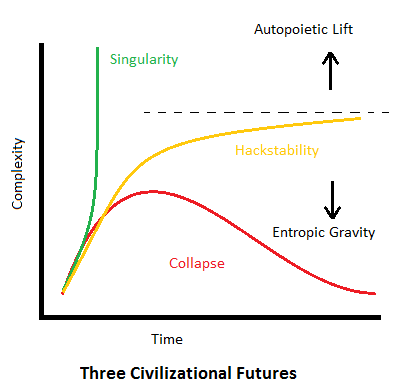
Stopping the Singularity: Hacking?

Venkatesh Rao is a PhD start-up consultant who (among many other things) writes really interesting, really long posts. In this one he writes about the three possibilities for our future: collapse, singularity, and the "hackstable" future, made so by constant tinkering and subversion of technologies ("barbarian intelligence" is how he puts it.) I think singularity-proponents would argue that by saying a singularity could be held in check by this behavior, but his argument is interesting in that proposes a dynamic equilibrium, which is what I proposed here - essentially, that if AI is possible, a better solution than trying to systematize morality may be to make AIs whose entire purpose is to autonomously destroy or at least hold in check AIs besides themselves. This is essentially the truce that has been drawn between multi- and unicellular life for the last billion years or so, and would essentially be an AI immune system.

This introduces its own problems - the technological analogs of autoimmune diseases (the anti-AI AIs sometimes mistakenly think of humans as AIs) or of leukemia (the anti-AI AIs reproduce out of control). But mutation in AIs is certain - are they recursively self-improving, or not? - so I'd rather have the logic favor us from the start, than assume we can make them generally friendly. (This is one approach being explored by the Singularity Institute currently.) It's not clear how hacking would hold the singularity in check; malaria might have slowed the industrial revolution, but it didn't stop it, and post-singularity, you and I are Plasmodium.


Of Rao's three options, note that singularity is not necessarily different in the long run from collapse. Evolution is non-teleologic, and life on Earth has had damaging non-equilibrium periods. Before they occurred it would not have been obvious that they would not result in the end of life on Earth, and it is not obvious that an event like a technological singularity, no matter how smart it might be, will not result in not only our extinction as we currently understand our species, but its own. A global proterozoic cyanobacteria bloom poisoning themselves and remaking the atmosphere will seem Liliputian, to a future alien scientist looking at Earth's strata, compared to a singularity as usually conceived.

"But the singularity will produce superintelligent entities to which we will be as worms!" you protest. Yes, but granting this, there must be limits to what intelligence can do. Even with this concept in ultimate extension, we have to accept that computation requires discrete elements, of which there are a fixed number of combinations in our finite universe. There will at least be a limit. And intelligence isn't magic; if you're at the bottom of a sheer pit with both a worm and an AI that's in the same kind of body as you, and it's about to fill with boiling oil, you're all screwed, and it doesn't matter how smart the AI is. (Incidentally these limits imply that P does not equal NP, in any real sense that is ever possible in the universe, never mind the formalism.) If you're protesting that the singularity overwhelms the fact of an eventual fundamental limitation on computation and all physical laws are suspended, then you're arguing that superintelligence is the same as magic, and if you believe that you should also believe (as I would) that we should stop wasting our time talking about it.

As I've observed before, if we believe that we can't possibly understand any post-singularity events, this presents epistemological problems closer to home in the singularity's genesis. If we can't understand it, we can't even argue that it hasn't already happened! Note that this statement is not an argument against the possibility of a singularity or coherence of the idea, but it does present problems of what and how we can know about such a thing.

Rao doesn't argue strenuously for a "cap" to AI but if we believe a thing like the singularity is possible, then we should do everything we can to stop it.