Showing posts with label physics. Show all posts

Sunday, December 6, 2015

Fermilab: Universe Looks a Little Bit Less Simulated

Fermilab tried to measure "quantum jitter", which would be expected if space and time are quantized, like energy. They did not find it.

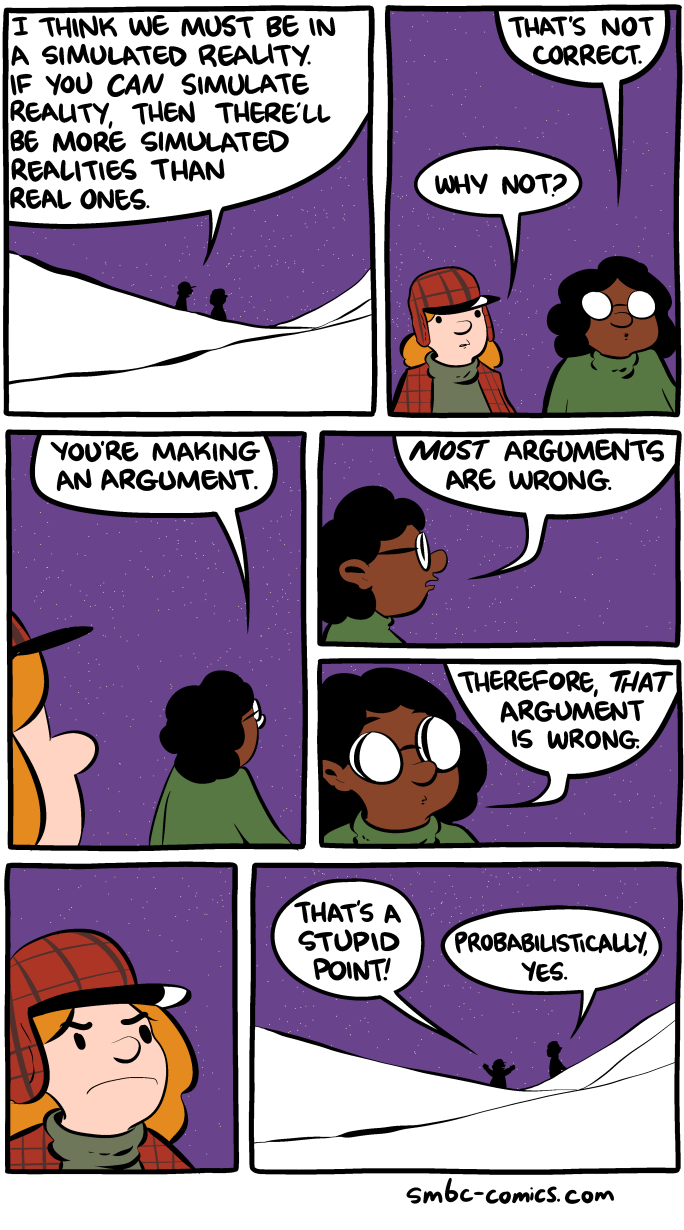
This is another way of testing the holographic theory of the universe - which is itself an extension of the model that black holes' entropy can be measured entirely from their event horizons. Of course, the model could be wrong or the instrument might not be detecting it, but even from a primitive Bayesian standpoint this moves us away from quantized spacetime, a holographic universe, and our expectations of what we might find if we are in a simulation. The two problems with simulation arguments remain: in general what we mean by "simulation" is very poorly defined and not agreed upon, and there is the PEP (pointless epistemological problem) of saying that the simulators could always make us forget the results, or change that parameter somehow when we try to measure it. In which case, the simulation argument is about the most untestable thing there is, and if we can't ever in principle know, why are we bothering to discuss it? (By the way, the "simulators could change it" argument assumes we know something of the simulators' nature and that it/they are trying to deceive us.) (Below from SMBC of course.)

Saturday, October 5, 2013

Mosh Pits Described by Gas Equations

Story here. Back in the day I described mosh pits to the un-initiated in exactly this way. Note: a mosh pit is clearly not an ideal gas, because the particles interact with each other.

Monday, July 15, 2013

Consuming Random Elements and Werewolves

I'm kind of jealous of the first half of the twentieth century. It was a time when you could just feed frogs rubidium and write down what happened. I once argued that based on its rarity, ruthenium was actually a better currency standard than gold; gold is (or was) a standard by historical accident of having a high redox potential, therefore being the only metal found in nature in its non-oxidized form, plus monkeys like shiny things. Okay, forget the common isotopes of elements; what happens when you start feeding, so heavy water to living things? Not much, actually. No eye lasers, no phasing through walls, you don't even turn into a werewolf. It doesn't even taste any different (according to Harold Urey)


Nope. Not even close.


So what do you have to do to poison yourself with heavy water? To show the initial effects, you'd have to drink about a quarter of your water weight. Those initial effects in mammals are sterility - D2O in high enough concentrations is toxic to rapidly dividing cells, just like radiation or free-radical generating chemical species; this is a result of the altered kinetics when free protons begin to be replaced with slightly-more-than-twice as massive deterium nuclei. Consequently as the concentration increases, the damage begins to effect other high-turnover tissues next, like the GI tract and after that, presumably the central nervous system. Mammals given only heavy water die after a week. It turns out a disgruntled employee at a Canadian nuclear power plant spiked the office water cooler with D2O back in 1990, but it wasn't enough to replace any significant water weight as mentioned above, and no one was injured.

One interesting (but simplistic) idea was that in slowing the reaction kinetics of an organism's biochemistry, you could slow the organism's aging. And indeed it was shown that Drosophila given D2O did live longer. No telling what's going on to their gametes or nervous systems, or what would go on in a longer-lived more neurologically complex organism!

The question of why our ancestors made some very basic chemical commitments (nerves based on sodium, potassium and calcium flux, for example) is interesting but ultimately not useful, very likely having to do with the happenstance of what was available and soluble at the Earth's wet crust. Lithium is similar enough to sodium that it can fool certain sodium channels in the central nervous system and decrease the rate or amplitude of mood swings in bipolar people, but that's a coincidence.

By the way, the werewolf formulas are pretty disappointing. There was one where you can use a mixture of nightshade and children's blood and smear it on your skin during a full moon but it didn't work. Maybe you can't use your own blood like I did (but I was ten, so it should count.) Another way is to drink water out of a wolf paw print in the Harz Mountains in Germany. I'll have to import the wolves since they're not extirpated in Germany.

Friday, February 15, 2013

Best Video of Russian Meteor

My favorite video of the Russian meteor is this one. Then again, at fireworks displays I'm one of those weirdos who turns around to watch the shadows. (Don't laugh, once I caught a pickpocket that way.) Just think of the energy released in the light and the sonic boom. Skip to 40s if you don't want to watch Siberian traffic.

Saturday, June 30, 2012

The Theory of Everything Really Might Be

Swiss AI researcher Jürgen Schmidhuber makes a computational argument for the possibility that our universe is completely deterministic - apparently random events are not, and therefore predictions for everything (everything!) can be compressed into short strings.  I got this from the list of "higher order" conspiracy theories here.  Note that he's not making a formal argument but rather making a weaker statement that we have no evidence that our universe does not have these characteristics.

Sunday, April 15, 2012

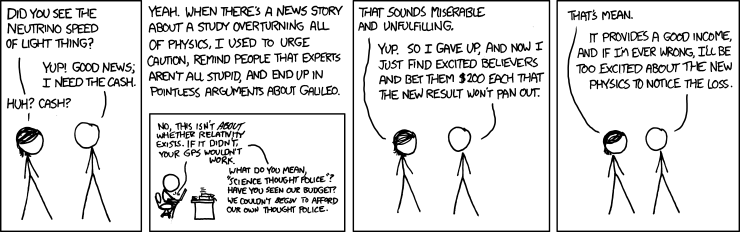
No Faster Than Light Neutrinos

No one is surprised except the researchers, but it was a loose cable.

I wonder if the XKCD guy made any money?

Friday, September 9, 2011

How The World Looks When It Rotates

To paraphrase an anecdote told by Paul Churchland in Scientific Realism and the Plasticity of Mind, Russell said to Wittgenstein that people had a hard time grasping that the world was round, and that the world rotated rather than the sky, because that's just not how it looks.

Wittgenstein retorted, "Then how would it look, if the world did look like it was round and rotated?"

It was meant as a smart-ass rhetorical question to prove Wittgenstein's point that the world already looks like it's round and rotates, if your thinking is good and you knew what to look for. But I disagree. Because if the world looked like it's round and rotates, here's what it would look like.

A Timelapse Journey with Nature: 2009-2011 from Henry Jun Wah Lee on Vimeo.


The dramatic impact on our perception made by just changing the time scale is sublime.

Thursday, September 1, 2011

The Physics of Throat Singing

We have two sets of vocal folds in our larynx; one is "false" or vestigial, and doesn't normally serve to help us make sounds. Little kids often discover this independently, although it has actually been elevated to cultural art form - previous post with Tuvan throat singers here. Here's PhD thesis in acoustics by Leonardo Fuks about the physical properties of both woodwind and false vocal fold phonation (main section here, ToC here). I wonder who learned it first, Tuvans or alligators?

As an aside, China got UNESCO to recognize throat-singing as their own cultural contribution, which is outrageous B.S.


Alash River, Tuva, by Konstantin Mikhailov.

Thursday, August 25, 2011

Bell's Theorem: We're Not In a Simulation

Bell's theorem is the one that predicts quantum entanglement. (If you're not already familiar, go here to learn about it.)


The point for this post is that Bell inequalities have repeatedly been shown to be violated, which means that there are no local hidden variables.

The implication is that quantum mechanics is at the "bottom" of reality; the implication for the simulation argument that I constantly decry as meaningless yet can't seem to keep myself from writing about (most recently here and here) is that we are not in a simulation. No local hidden variables means no concealed causally-upstream inputs.

This is what many simulation-worriers have told us to look for, and if QM is complete (as Bell's theorem suggests) they're not there, period. What we really need is a fully generalizable, formal argument as to whether hidden variables are in principle detectable from inside such a system. When I add cells to a game of Conway's life that's already running, is it just the equivalent (from the gliders' viewpoint) of particle pairs popping into existence? Too bad Turing didn't read more Descartes.

The reality-skeptic's counterargument of course (for example, from Robin Hanson) is that every time we do such experiments, the simulators get ontological do-overs to conceal their dastardliness, i.e. the rules of the simulation are changed briefly, and/or they make us forget, etc. etc. etc. Of course this is the same as saying that if we are in a simulation, we could never know (asking how we could know for sure if we are in a simulation is at least as interesting a twist on this question, which is usually asked in terms of how we could know we're not. That is, what could I do to trick someone else into thinking they're in a simulation when they're not?)

All of this again raises the question of why the simulators would care if we found out. When I'm playing Conway's life, if one of the gliders becomes sentient and figures out it's on my computer, it doesn't much matter to me. What are they going to do, spell out dirty words on the screen next time I check the playing field? Also, it often pays to be suspicious of any science that claims to have solved the universe, even if there is a rigorous argument supporting this. To argue by analogy: would Newton have been able to show, had he rigorously pursued it mathematically, that his own theories were NOT at the bottom?

In closing, just in case, please meet me at La Jolla Shores tomorrow to spell out dirty words.
Thursday, December 23, 2010

Alligators Vibrating Water

Alligators bellow when they're mating. I've never heard this in person but want to. Look at how the water above their backs vibrates when they do this:

Tuesday, July 13, 2010

Higgs Detected, But Not By LHC?

Maybe by the Tevatron in Illinois, USA. But this rumor went around before about 2 years ago, so we'll see.